Not a short story at all
Debbie Black, all 5-3 of her, has scaled the heights of women's basketball. Now she ferrets out the newest little Gnats.
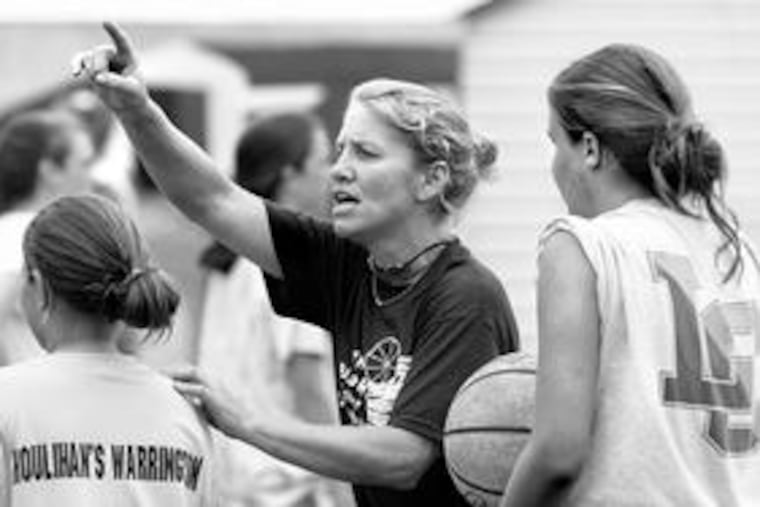
The basketball players warming up on a blacktop court are all ponytails and long legs. Well, most of them. Among the gangly 10-year-olds and preteens are a few small ones with spunk.
Debbie Black, half of the coaching staff of "The Black Sisters Basketball Camp" in Furlong, Bucks County, notices one in particular.
"She's got it," Debbie whispers, nodding to a 9-year-old named Tess. "I call it the X Factor."
Tess is a wisp whose face is pursed with seriousness. Debbie can tell by her play that the girl's height doesn't matter to her.
Because she's got it.
"She's scrappy, a little tomboy," Debbie observes. "Look at her intensity, the emotions."
Debbie, 41, knows all about the X Factor.
It defined her as a basketball player. She had no choice but to be all guts and grit, for she lives with the curse of any basketball dreamer.
Debbie is short. Gymnast short. Five-three on a tall day.
But for 18 years, Debbie did what no one thought was possible. She played pro ball with the longevity of a man. And she left a tall legacy: No one in the history of the Women's National Basketball Association has ever stood shorter.
If the naysayers had had their way, Debbie's career would have ended at the gym at Archbishop Wood High School in Warminster. But Debbie didn't hear them. She started for St. Joseph's University - the only school to recruit her - and took the Lady Hawks to four NCAA tournaments from 1984 to 1988.
After college, everyone assumed Debbie would disappear. There was no league for U.S. women in 1988. And play overseas? Too short!
But halfway around the world, a team from the Australian island-state of Tasmania took a gamble on Debbie. And took home its first national title.
But, oh, the baying of doubters.
When a women's league started in the United States in 1996, Debbie was invited to try out. But get drafted? Not only was she too short, now she was, at 29, too old.
She heard the whispering on the sidelines. So she played with an intensity that set the bar for everyone else.
Debbie was drafted by the Colorado Xplosion, playing later for the Utah Starzz and Miami Sol before retiring from the Connecticut Suns in 2005.
And throughout those eight years in the pros, Debbie always returned to Bucks County. She had a mission with the girls back home: to spark a passion for basketball among players like Tess.
Look at me, she'll tell each new crop of campers. If I can do it, so can you.
"Growing up, there wasn't a lot in terms of role models," Debbie explains. "I looked up to men in the Sixers because I really didn't have any women to look up to."
"This," she says of the camp she runs with older sister Barb Poli, "gives them an idea that there are women who've done things out there."
Nicknames are the mark of an athlete.
Make your own judgment about Debbie Black.
The Pest.
The Gnat.
Tasmanian Devil.
Giant Killer.
Debbie is perpetual motion, a knee-high blond dervish with a broad face, a high-voltage smile, and a voice as smooth as gravel. She plays a mind game, buzzing around the ankles of players so they have to come down to her level, forgetting that all they would have to do is lift their arms to pass over her head.
She also has a flair for drama. Camp kids love seeing the video of her in college when she took a nosedive for the ball, slid under the scorers' table, jumped up on the other side, leaped back over the table, and returned to play.
"I loved the fact she was so annoying," recalls Jim Foster, her coach at St. Joe's.
Not Dawn Staley, Philadelphia's top name in women's basketball. She's gone head-to-head in the pros against the Gnat. "There's always one that keeps coming back no matter how many times you swat it. Debbie's that kind of player," says Staley, coach of Temple University's women and a veritable giant at 5-6. "She redefined the position of being a small point guard."
Debbie, oddly, never thought of herself as short. When she'd watch game videos, she would just marvel at how tall everyone around her was.
Says Debbie: "I was one of those people who thought, 'This is what I have, how am I going to utilize what I have?' "
Two things about Debbie Black's basketball career:
She probably has her father's unabashed male chauvinism to thank.
And if it wasn't for a typo, her pro career probably wouldn't have taken off.
First, Bill Black. He was a jock. Lettered in four sports. Married a cheerleader and homecoming queen. Dreamed of a squad of sons. Got two for Team Black.
And then two daughters.
Debbie and older sister Barb were encouraged to do "girl things." Ballet was good. Basketball and football? Well, only because the Black clan had to field a team. Debbie and Barb were allowed to join the boys, but never, ever, allowed to cry.
"By the time I was 9 or 10, my dad actually coached my sister and me in basketball," says Debbie, whose family lived in Warminster. "He thought at first that it would be a little bit of a joke. But he found out that we could actually play. Ever since then, we won him over and he's been my biggest fan."
Bill Black triggered something in Debbie. It was attitude. She calls it her chip and explains: "Don't tell me I can't do anything, because once you tell me I can't, well. . . . "
As a senior at St. Joe's, Debbie was named an honorable mention to the 1988 All-America team for Street & Smith's magazine, which included her stats. One problem: It said she was 6-foot-3.
The owner of the Tasmanian Islanders called Foster about his star point guard, asking about her ability to score in the lane - the hallmark of a taller player, not one whose game was played at the kneecaps.
"All of a sudden I realized there was a little miscommunication," Foster says. "I remember telling him, 'Trust me. It'll be worth your while.' "
When Debbie arrived in the small city of Hobart (pop. 245,000), her team's record was 0-22. "They weren't bad," she says, "they just didn't know how to win." The following year, the team made it to the championships. In 1991, they won the national title.
Debbie went on to play for another team in the smaller city of Launceston (pop. 98,000). She packed the stands, says her former coach, Mike House. When the team won its conference title, the city held a parade in their honor. Debbie was made an Australian citizen.
It was, House says, "a fairy tale for a small town taking on the giants of basketball."
"I don't believe I had this unbelievable talent," Debbie says, "but I can make people believe in themselves."
After seven years in Australia, Debbie heard about a new league for women starting in the United States. She was asked to try out - but was placed at the bottom in the C Group of players. "There again is that chip. I thought, 'I'm in the C group?!' OK, I'll show them."
Of 560 athletes, 80 were drafted. Debbie suited up for the Denver Xplosion.
Today, Debbie Black has moved on to her next big challenge. She's an assistant coach at Ohio State University, working with her mentor, Jim Foster.
This summer, she coached more than 200 girls at clinics run by her and her sister. She says working with small kids helps to keep her grounded.
"Our whole camp is about hustle," says the Pest. "We give a hustle award and that's the most important award of the day. It's not the best kid at camp, it's the kid who gets the ball, helps out. It's the whole idea of a work ethic. . . . And when they see me play, they know it's not just once in a while, it's constant."
Philadelphia loves a sports underdog.
We consider Rocky to be a case of art imitating life.
We celebrate Vince Papale, the over-the-hill track coach who earned a walk-on spot with the Eagles in 1976.
We embrace the Mighty Macs of tiny Immaculata College, who took three national titles in the 1970s.
Debbie Black belongs on that mantel. Consider how they remember her in Australia.
When she returned to the States, Debbie donated money for her former team in Launceston to put up a huge board for honoring players. The team started the "Debbie Black Award" for the toughest one on the squad. So honored is this award that it's not always presented if no one lives up to her standards.
"I still hold her name up to any small girl and tell them the Debbie Black story," coach Mike House says, "a story of how a woman so small, with supreme ball-handling skills, outstanding speed and fitness, a tremendous work ethic, and the strongest possible desire to never lose, can succeed in a game for mainly tall women."
To watch a video interview with Debbie Black,
visit http://go.philly.com/debbieblack.EndText
.