Cheat Sheet | For any refinishing jobs, choose the right stain
Whether you plan to refinish an old chair, a floor, or an outdoor deck, choosing the right stain can be perplexing for the first-time do-it-yourselfer. A wrong choice can prove expensive and turn a good idea into a not-so-pretty picture.
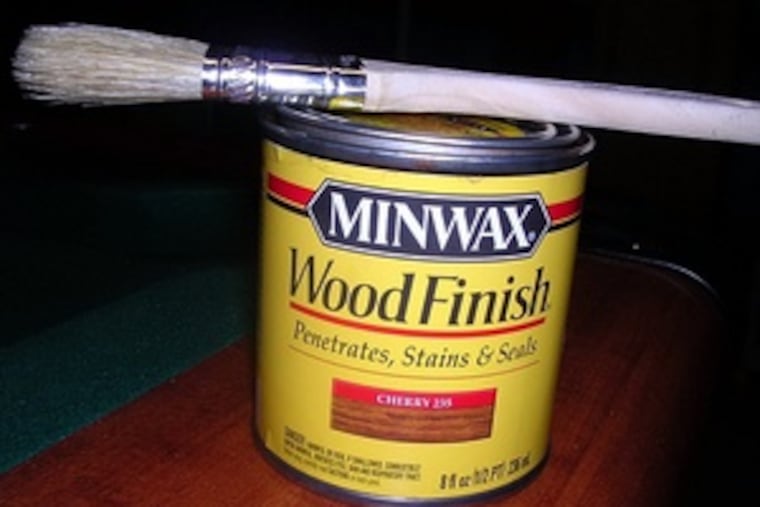
Whether you plan to refinish an old chair, a floor, or an outdoor deck, choosing the right stain can be perplexing for the first-time do-it-yourselfer. A wrong choice can prove expensive and turn a good idea into a not-so-pretty picture.
Need to know: In addition to deciding which color you want, you need to make sure the stain is appropriate for the job. Read the label information, which not only states where and how a stain is to be used, but what's in it, which could affect your health and the environment. With some exceptions (concrete stain is the most notable), interior stains cannot be used outdoors. And, as you might expect, exterior stains are typically formulated to deal with extremes of weather and other environmental issues that aren't present indoors.
Be sure to ask: How much stain do I need? For a deck, for instance, Cabot Co., which manufacturers stain, recommends finding the square footage by multiplying the longest point by the widest point, then adding extra for railings and steps. For siding, the general square footage can be determined by multiplying the perimeter of your house by the height (be sure to use the highest point).
For inside jobs such as floors and trim, measuring square footage is also the way to go. Smaller projects such as furniture require a half-pint to a pint.
Cover story: Depending on the stain, a half-pint will provide one coat covering about 30 to 40 square feet, according to Minwax, another manufacturer. Applying two or more coats tends to extend the life of a finish, depending on weathering and other environmental factors.
Use or lose: Buy only as much as you need. Stain tends to degrade over time, especially if it's been exposed to light, and the tint could be noticeably different than the finish you're trying to match, even if they came out of the same can.
Material world: Stains are available in oil- and water-based formulas. Water-based stains have lower volatile organic compounds, are not flammable, and adhere better to previously finished surfaces. Water-based is preferred for woods such as cedar and redwood that resist rot because they don't trap moisture. Deeper-penetrating oil-based stains are better for decks in extreme conditions, especially those that get little sun or too much, or stand in the salty, humid air of the Shore, the folks at Olympic say.
Less than clear: A stain with low opacity will have less pigmentation, resulting in a more natural appearance, because the stain lets the color of the wood grain through. High opacity means more pigmentation, which will hide the grain.
What will it cost? From a few dollars for a half-pint to $50 for up to a gallon, depending on stain quality, quantity, and where you are going to use it.
Prep school: The color you see on the can or in the store is not always what you get on the wood. Poor surface preparation may be to blame. Old stain or paint should be removed; if you suspect the presence of lead, go to www.epa.gov/lead for information. Once the surface is bare, it must be dry and free of mildew, dust and loose wood fibers. If it isn't, sand it. Raw wood should be sanded smooth - sanding helps stain adhere better. If wood is soft, it may need conditioning. Determine this by running a fingernail over a not-too-obvious section.
Operating manual: Use a paintbrush to wet the surface first, so the stain spreads evenly. Then use a paintbrush or clean cloth to apply the stain, and another clean cloth to remove the excess. Let it dry thoroughly before applying another coat. Two or three coats of polyurethane, varnish or shellac, sanded between each coat, help stain last longer.