This commentary on a splendid and imaginative new exhibition could be titled "Edgar Degas Comes to Reading," if it were not for the fact that Degas has been in the city for years.
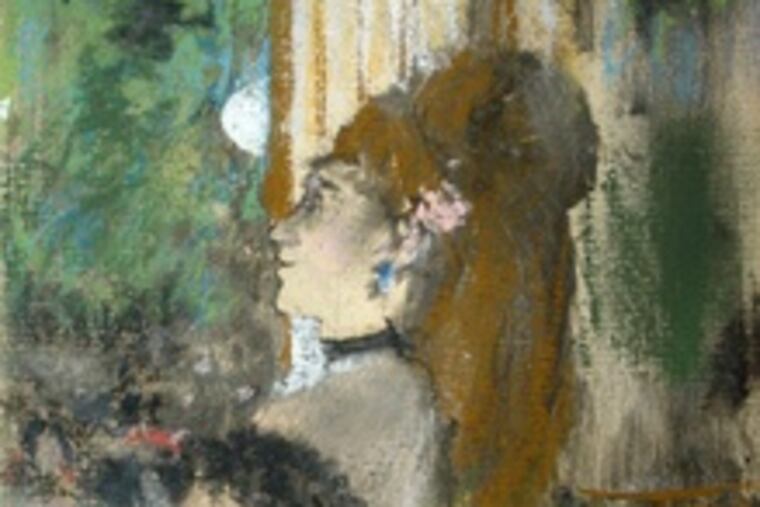
The Reading Public Museum owns three works by the French artist - an oil painting called Woman Ironing, a large drawing in charcoal and pastel, Woman Drying Herself, and a monotype print worked with pastel called The Singer.
These works entered the collection, at different times, as gifts from the estates of Henry K. and Martha Elizabeth Dick of Reading, uncle and niece. For a small regional museum, such works by a renowned artist immediately became collection highlights, even though both the painting and the drawing appear to be unfinished.
When museum director and chief executive officer Ronald C. Roth decided he'd like to organize an exhibition around these pictures, he called on two Degas specialists, Jill DeVonyar and Richard Kendall, for advice. They had guest-curated the exhibition "Degas and the Dance" at the Philadelphia Museum of Art in 2003.
Before DeVonyar and Kendall came to Reading to inspect the works, they discovered through its Web site that the museum owned a substantial group of Japanese woodblock prints, which they also examined during their visit. Knowing that Degas owned a number of Japanese prints and was, like many artists of his time, influenced by them, they suggested an exhibition theme that was both logical and innovative.
And so it is that we have "Degas and the Art of Japan," perhaps the most ambitious and certainly one of the most beautiful and fascinating exhibitions that this museum has ever attempted.
If you're not in the habit of traveling to Reading, this show deserves to be an exception. You'll not only see some unusual Degas works, including landscapes and some stunning woodblock prints, you'll also be able to visit the museum's newly renovated Latin American gallery and a show of 45 pieces of pre-Columbian art donated by Luther W. Brady of Philadelphia.
A significant aspect of the Degas show's visual appeal derives from the handsome installation designed by Keith Ragone of Newfield, N.J. Because most of the 61 works are small prints, drawings and watercolors that could easily become an undifferentiated mass, Ragone enlivened the deep mustard walls with oak panels thinly washed with white paint. This creates an animated surface topography that allows individual works to assert themselves.
DeVonyar and Kendall proceeded from the premise that Degas admired Japanese prints - he owned many - and adapted some of their compositional devices.
They emphasize a conjunction that's obvious when you see his images and those of such Japanese masters as Hiroshige and Utamaro juxtaposed, as they are here. Degas and Japanese artists were interested in similar subjects, most involving women (dancers, laundresses), various aspects of the theater (cafe concerts, Kabuki), and women bathing or dressing their hair.
Decorated fans provide another point in common; Degas often depicted women holding them, and the show includes a magnificent Japanese example, with ivory ribs and farming scenes on both sides. The fan is one of several loans from the Metropolitan Museum of Art, one of more than two dozen institutions in America, Canada and Europe that lent to the show.
Throughout the exhibition's seven thematic sections, works by Degas and various Japanese artists are displayed side by side, or in close proximity. The contributions from each side aren't equivalent, though; there are roughly twice as many Japanese prints as there are prints, drawings and paintings by Degas. Nor does the show attempt to demonstrate conclusively that any single work by him derived directly from a particular Japanese print, which would be difficult to achieve.
Nevertheless, as one proceeds through the various sections, consonances become both unmistakable and sometimes striking. Degas didn't borrow themes from the Japanese; that part of the equation is coincidence. But he seems to have responded to the way Japanese artists organized space, how they placed figures, and how they created visual energy through unusual perspectives and unorthodox cropping of figures.
"Degas and the Art of Japan" develops several levels of enjoyment and enlightenment. The first is the subtle counterpoint and harmony between Degas and his Japanese counterparts. Their subjects might be similar, but the media (woodblock print, etching, pastel drawing) are different, just as the effects achieved through these methods and personal idiosyncracies contrast markedly.
Yet although Degas and the Japanese are speaking different aesthetic languages, they harmonize as exquisitely as the players in a string quartet. From each side, evocations of feminine grace are especially congruent. One senses that, language aside, these artists would understand one another perfectly.
On another level, the exhibition offers a superb selection of Japanese printmaking from the 18th and 19th centuries. I was especially impressed, as the curators were, by what the Reading museum owns. Among the 10 prints from its own collection in the show are four scenes by Hiroshige from the series The Fifty-Three Stations of the Tokaido Road.
A number of loans are equally impressive, including Hokusai's South Wind, Clearing Skies (Red Fuji); Utamaro's Girl Dressing a Companion's Hair and his triptych, The Awabi Fishers; Shizuka Gozen Dancing for Yoritomo, by Suzuki Harunobu; and Interior of a Bathhouse by Torii Kiyonaga, one of several prints in the show that Degas owned.
The Japanese prints tend to dominate Degas, and not just in numbers. The show would have been considerably stronger if the museum had been able to secure a few more of Degas' major pastels or oils, such as Combing the Hair (National Gallery, London) and Women Combing Their Hair (the Phillips Collection), both represented by small color reproductions.
Consequently, it's the Japanese artists more than Degas that I will remember from this show, especially a masterly watercolor of two birds on a branch painted during a Paris dinner party by Watanabe Seitei, who gave it to Degas. This exquisite image speaks on equal terms to both European and Japanese taste while maintaining the distinctive voices of each. In that sense, it encapsulates the cross-cultural dialogue that Degas incorporated into his art.
Art | Degas and Japan
"Degas and the Art of Japan" continues at the Reading Public Museum, 500 Museum Rd., through Dec. 30. The museum is open from 11 a.m. to 5 p.m. Tuesdays through Saturdays, to 8 p.m. Fridays, and from noon to 5 p.m. Sundays. Special admission fees for this exhibition are $10 general, $6 for visitors 60 and older, visitors 4 through 17, and students with I.D. Information: 610-371-5850 or www.readingpublicmuseum.orgEndText