Art | Tiffany Studios' gleaming beauties Allentown show spotlights the how as well as the wow.
Tiffany lamps, characterized by dazzling mosaic shades of vividly colored glass, have become widely admired and sought after - and extremely valuable - since Louis Comfort Tiffany stopped making them about 75 years ago. Their stunning patterns and meticulous craftsmanship validate their reputation as treasures of American design.
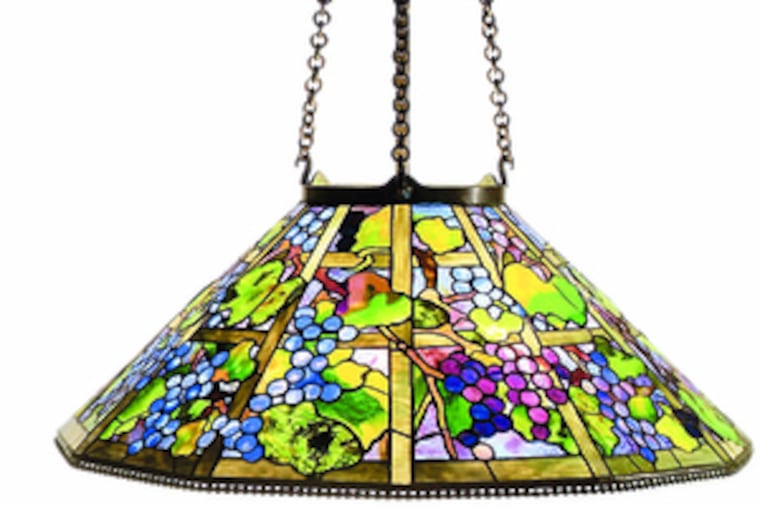
Tiffany lamps, characterized by dazzling mosaic shades of vividly colored glass, have become widely admired and sought after - and extremely valuable - since Louis Comfort Tiffany stopped making them about 75 years ago. Their stunning patterns and meticulous craftsmanship validate their reputation as treasures of American design.
Yet we shouldn't forget that these lamps were a commercial product. Tiffany Studios turned out thousands of them, which, in turn, inspired a host of imitations and fakes. Tiffany employed dozens of skilled craftsmen, and -women, in various specialties to design and assemble the lamps. Although not personally involved in their production, he got all the credit.
While Tiffany Studios ran on a factory model, the lamps weren't really mass-produced; they required considerable handwork, and even within standard patterns variations in color choices made each shade slightly different.
Tiffany lamps, which today can fetch hundreds of thousands, even millions, of dollars at auction, could still be acquired at reasonable prices when Egon Neustadt (1898-1984) and his wife, Hildegard, began to collect them about 1935.
Over a half-century, Neustadt, an Austrian emigre dentist, filled their Manhattan apartment with more than 400 lamps and leaded-glass Tiffany windows, along with metalwork. He also acquired thousands of sheets of opalescent sheet glass and samples of pressed glass used to make lampshades.
In 1983, Neustadt gave 135 lamps to the New-York Historical Society, one of two places in New York where the public can see pieces he owned. The rest became the Neustadt Collection of Tiffany Glass, which keeps some works on display at the Queens Museum of Art under a long-term agreement.
The Neustadt Collection, in Long Island City, isn't open to the public, but it does organize traveling exhibitions. One of these has settled in at the Allentown Art Museum, accompanied by a locally produced tribute to Moravian-born Alphonse Mucha, an art nouveau designer who worked in Paris.
The Tiffany show contains about three dozen lamps and unmounted shades, plus bronze lamp bases, lamp parts, and elaborate bronze desk items such as blotter ends, an inkstand and a reading glass. It also includes a magnificent stained-glass window whose intricate construction demonstrates the full range of Tiffany's amazing glass palette. All the tonal and textural effects in the window and the lamps are intrinsic to the glass; there isn't a spot of overpainting.
"Tiffany by Design" might be chromatically effusive - this is what one expects from Tiffany - but its main thrust is didactic, to reveal how the lampshades were constructed, how designs were modified, and how colors were harmonized to create the distinctive Tiffany style.
The lessons aren't heavy-handed and visitors can easily slide over them if all they require is visual delectation. There's plenty of that, even in a relatively small exhibition.
As you will see, most of the shade designs were inspired by nature, particularly flowers. Some shades, closer to the arts and crafts aesthetic, are geometric or, like the Wave and Favrilefabrique designs, abstractly textural. (The pressed-glass panels in the latter shade imitate pleated fabric.)
Tiffany designers worked with relatively few basic forms, but achieved considerable variety by changing motifs and colors. This is most evident in the exhibition sections called Color and Nuance, Pattern and Complexity, and Variations of Design. The show also compares authentic Tiffany lamps with similar reproductions and outright fakes, while a display of glass samples represents the extensive range of the studio's palette.
The adjunct display of posters and textile designs by Alphonse Mucha (1860-1939) develops the art nouveau theme in another direction. Mucha's sinuous, interlocking designs represent the apotheosis of that aesthetic, particularly in posters created for the French actress Sarah Bernhardt and in several cotton velveteen panels adorned with branches, berries and birds.
Perhaps the most virtuosic pieces are two colored drawings made to be reproduced as enameled plates. Even in this small selection, Mucha's impressive command of both process and subject matter confirms him as an art nouveau master.
Art | Tiffany Splendor
"Tiffany by Design" and "Alphonse Mucha" continue at the Allentown Art Museum, Fifth and Court Streets, through Jan. 6. The museum is open from 11 a.m. to 5 p.m. Tuesdays through Saturdays and from noon to 5 p.m. Sundays. For these exhibitions, a $5 surcharge is added to the regular admission fees of $6 general, $4 for seniors and students, and $3 for visitors 6 through 12. The $5 exhibitions surcharge applies on Sundays, when museum admission is free. Information: 610-432-4333 or www.
allentownartmuseum.org.EndText
go.philly.com/edwardsozanski.