A liberal turns her camera on evangelicals
The war figures prominently in Friends of God, Alexandra Pelosi's "road-trip" documentary about America's conservative evangelical community, released this month on DVD.
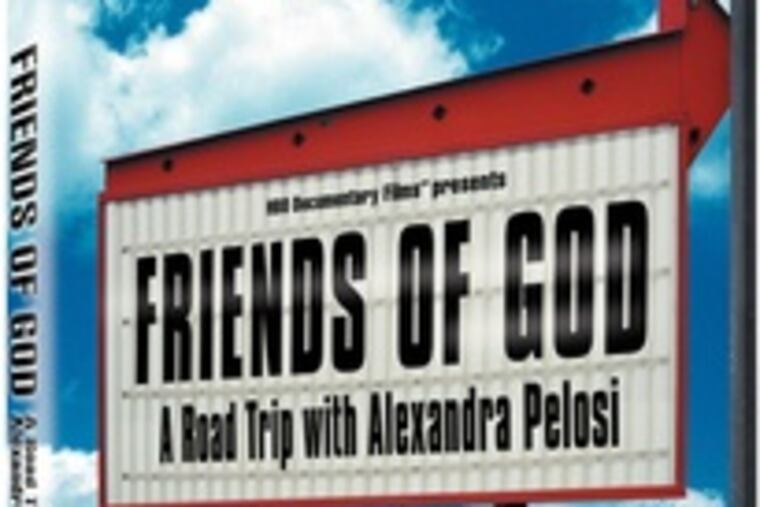
The war figures prominently in
Friends of God
, Alexandra Pelosi's "road-trip" documentary about America's conservative evangelical community, released this month on DVD.
But as the voice of an AM radio host points out at the opening of the film, the war that obsesses many of America's 60 million to 80 million evangelical Christians isn't fought anywhere near Baghdad's blast zone.
It rages on in that other Babylon - America. "We Americans are locked in a culture war," the disembodied voice thunders on as Pelosi drives along a North Carolina highway. "A war for the soul of America."
Pelosi said she decided to make Friends, first shown on HBO, because she was mystified by the political power evangelicals wielded in the 2004 elections. "They were such a reliable voting bloc for George W. Bush," she said on the phone from New York where she lives with her husband, Dutch journalist Michiel Vos.
"I grew up in San Francisco . . . and my version of America is so different, it's hard to think it's the same country sometimes," she said.
Ironically, Friends was completed just days before the November 2006 midterm elections, which the Democrats dominated, and which led to the election of the filmmaker's mother, Nancy Pelosi, as the first female Speaker of the House.
Pelosi, who shot the film herself, sans camera crew, begins her travelogue at a packed Friday night service at the Lakewood Church in Houston, where a trio of hip-looking young dudes tell her they are "high on Jesus."
She is impressed by the more than 50,000 worshippers at the service. Lakewood, which averages 47,000 attendees for its weekly services, is considered North America's largest church.
Its pastor, Joel Osteen, immediately marries religious commitment with politics as he explains his mission to Pelosi: "People who want to love God want America to stay on the right path."
Evangelical Christianity does not necessarily translate to conservative politics. As Ted Haggard, the now-disgraced former pastor of the New Life Church in Colorado Springs, Colo., tells Pelosi, "an evangelical is someone who believes Christ is the son of God; the Bible is the word of God; and you must be born again" as a Christian. No politics are mentioned.
That said, 78 percent of the evangelicals who voted in 2004 voted for Bush.
Pelosi spends a good deal of on-camera time with national figures such as Osteen, Haggard and Jerry Falwell, who died in May. But her film is mostly composed of vignettes with regular folk.
She visits at a Christian Wrestling Federation match in Texas ("They come for the wrestling, but stay to be saved," an organizer tells her); talks engines with the Cruises for Christ car club in LaGrange, Ga.; chats with a strolling Jesus in the streets of a mock-Jerusalem at Holy Land Experience theme park in Orlando, Fla; putts around at a biblically themed miniature golf course in Lexington, Ky.; and sits in her car as Pastor Sharon Jones gives her a personal prayer at the drive-in prayer window of the Drive-Thru Church in Richmond, Va.
Pelosi makes no secret of her own political commitments as a liberal. But she is never less than respectful - if at times overly self-deprecating - to her subjects.
She said she finds it important to "let the people talk for themselves without inserting too much of myself" into the film.
Pelosi's disarming persona helps explain the effectiveness of her films, which include the playful Journeys With George, a rich, insightful profile of then-candidate Bush during his 2000 campaign, which she made while she was at NBC.
"I think it has to do with my camera," said Pelosi, who uses a "tiny, $1,000 digital video camera you can get at Circuit City.
"If you have a little camera, people don't take you that seriously, they don't quite believe you're a journalist."
Some viewers may be surprised by Pelosi's warmth for her subjects.
It's evident in her assessment of Haggard. Just after Friends was completed, the pastor stepped down as leader of the 30-million-strong National Association of Evangelicals after a male prostitute alleged that the pastor had paid him for sex once a month for the previous three years.
"I felt sad for him and his family," said Pelosi, who related that Haggard had been especially kind to her while she was making the film. "If anyone is being hypocritical, it's the people who threw him out. They're the ones who are supposed to preach forgiveness and reconciliation."
And Pelosi said she was proud when Falwell "called me and said he really liked" the film and thought it was a fair representation of his beliefs.
But some of those tenets disturb Pelosi. She said she found it strange that everyone she interviewed reduced politics to "values issues."
"They only care about abortion, evolution and gay marriage," she said. "What about the war in Iraq, the economy and the environment? Or do those issues only matter to Democrats?"
Lifestyle issues seem so distant from most Americans' daily lives, Pelosi said. "The economy affects everyone, every day. How many people are affected by gay marriage?"
But Pelosi said she does admire the emphasis on family life that she saw everywhere she went.
Referring to an episode in the film about a Tennessee couple who are home-schooling their 10 kids, she said the wife, Susan Chapman, who at age 34 was pregnant with her 11th child, "changed my life."
"That woman had such a healthy perspective: For her, being a mother wasn't a matter of trying to squeeze your kids into your 'real' life," said Pelosi who has an 11-month-old boy and is pregnant with her second child. "Her only priority was her family.
"It's quite a life lesson for a Manhattan woman whose neighbors all got nannies with their first baby."