Mozart and Maria on a string
The puppets are alive with "The Sound of Music," by Salzburg Marionettes.
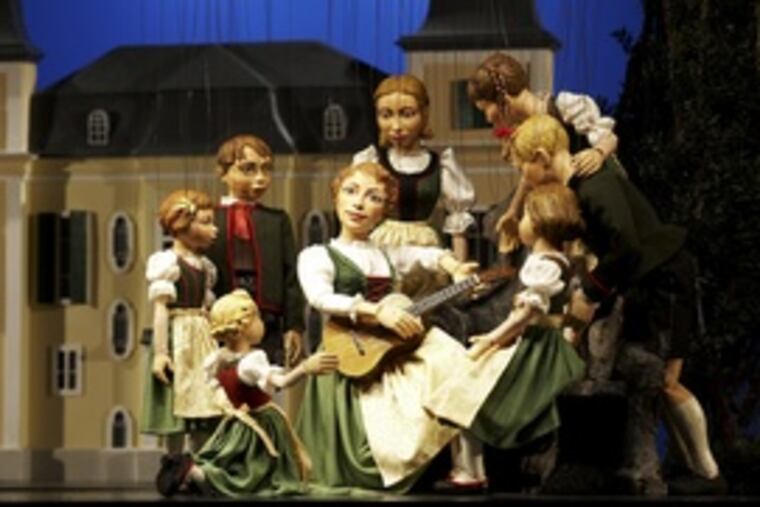
Droves of tourists can always be found on Salzburg's narrow Getreidegasse, the street where Wolfgang Amadeus Mozart was born. But a far greater number would rather take a
Sound of Music
bus tour to see where Julie Andrews climbed the hills in one of the most popular movies of all time.
Generally the two camps don't meet. Classical-music lovers who gather at Salzburg's summer music festival tend to dismiss the sugary Broadway show-turned-Hollywood movie, about the rosy-cheeked novice at a local convent who captures the hearts of a handsome widower, Capt. Georg von Trapp, and his seven yodeling children. Conversely, those who want to see every site connected with the 1965 film typically prefer songs like "Edelweiss" to
The Marriage of Figaro
.
But now one of the town's most prestigious musical organizations, the 94-year-old Salzburg Marionette Theater, is bridging the gap: On its current U.S. tour, which stops at the Kimmel Center's Perelman Theater this week, it presents not only one of its finest stagings from the Mozart repertoire,
The Magic Flute
, but also a brand-new production of
The Sound of Music
. Gretl Aicher, artistic director of the theater since 1977, admits that the whole field of American musicals seemed alien territory when, a decade ago, she was approached by a marketing executive.
"Oh, no," she told him. "We do Mozart, and we're not interested."
But, eight years later, after seeing
The Sound of Music
in London, Aicher and her colleagues decided that it wasn't such a stretch, after all. They loved the music. And it was time to try a wholly new kind of production.
Theirs was not an easy task in terms of pleasing the locals, because Salzburgers have been displeased with the movie from the day it was shown. It contains as much fiction as fact (the real von Trapps didn't even live there; they were from the nearby town of Aigen) and, worse, because its "folk songs" aren't at all what the family sang, but Rodgers & Hammerstein inventions.
But with a new production, the company could address precisely that type of issue. Director Richard Hamburger says the opportunity it afforded them was "irresistible."
"We were able to do research simply by walking onto the street, by going to the abbey where Maria Rainer was once a novice," he says. "And who knows better how the cast should be dressed or how they act than the people who actually live there? This gives a freshness and authenticity to the ideas behind the production."
The show Philadelphians will see this week is not anything like the campy sing-alongs that have drawn audiences around the world in droves (and in dirndl, wimples and lederhosen) to join in song with the on-screen Julie Andrews.
Rather, Aicher says, the interpretation is traditional - and, at 90 minutes, far shorter than the almost-three-hour movie. Much dialogue has been cut because puppets don't do well with subtle movements - but in song they can whirl above the floor, fly, slide over staircases, and generally do what humans can't.
For Hamburger, this ability to "defy gravity" was among the greatest pleasures in his new undertaking. "Scenery and objects can be animated to appear and vanish in seconds," he says. "The mountain that Maria cherishes is also a puppet and can move and respond to her passions. The doe of the 'Do re mi' lyric can suddenly appear on stage."
Hamburger, who is director emeritus of the Dallas Theater Center, where the new
Sound of Music
had its world premiere last week, had never before directed a cast of wood. He found that to be a delight rather than a hindrance.
"I am usually limited to the earthbound nature of actors on a stage," he says. "With the marionettes, I've been able to bring alive fantasies that were, in the past, mostly limited to my imagination." Furthermore, since all the characters were "custom-made," he could specify how they were to look and move.
For
The Sound of Music
, adds the company's managing director, Barbara Heuberger, 100 marionettes, up to 3 feet in height, were hand-carved out of lime wood. Their finely detailed, handmade attire is affixed permanently on each - which means that if a costume change is required, so is a new puppet.
"Seven von Trapp children and three sets of clothes for each means 21 puppets," Heuberger says.
While the company typically uses existing recordings to accompany the on-stage action, a new soundtrack was created for
The Sound of Music
, starring such Broadway names as Christiane Noll, Martin Vidnovic and Jonathan Groff.
Marionettes are puppets that are string-controlled from overhead. The nine Salzburg puppeteers stand out of sight on a bridge over their miniature stage, manipulating as many as 15 strings per puppet, which enables them to create a great variety of movements.
At times, all nine are crowded together on the bridge, their hands wonders of intricate movement. The backstage visitor can only marvel that the strings of one puppet don't get tangled with the others'. It is an exacting art, one that takes years to master.
To date the Salzburg theater has been a family affair. Gretl Aicher grew up with marionettes; she was born 16 years after her grandfather created the company, and she saw it develop, under her father's direction, into an art form known and respected around the world. On his death in 1977 she took over, adding such works as Mozart's
Così fan tutte
and Humperdinck's
Hansel and Gretel.
When her tenure ends the company will no longer be family-run, Aicher says. But it will be in good hands. "Younger people are really running it now," she says.
And, she points out, the old traditions continue through such longtime puppeteers as Heide Hölzl, who has been with the company for 45 years.
Vibrant and energetic at 79, Aicher has been the soul of the marionette theater for 30 years. She looks upon the puppets as living creatures and has dedicated her life to them. How long she will continue with the company, she says, depends on how her energy level holds up. The physical and emotional demands of puppetry are great, and getting through a five-week tour in 11 cities with a total of 31 performances isn't exactly a snap.
By the end of the run, the only people who won't be exhausted will doubtless be the wooden ones. They have been gifted with eternal youth.