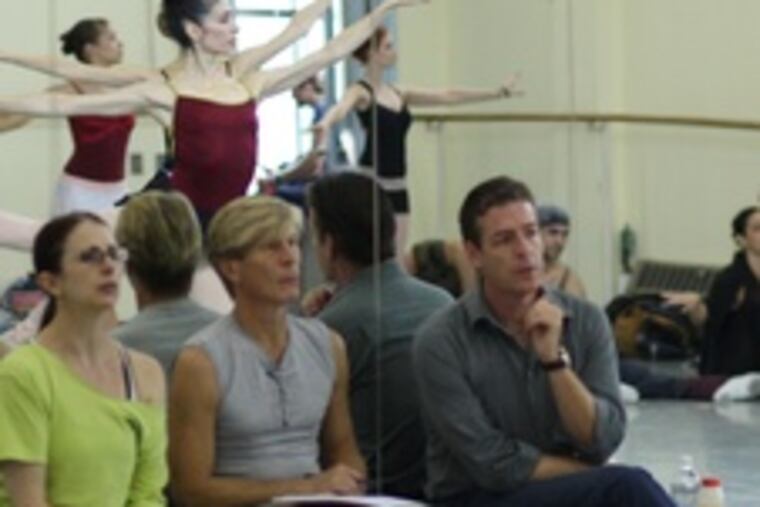
Pennsylvania Ballet has not performed in New York City - save for a brief appearance at a festival last fall - in 22 years. This week the company returns, to dance six shows tonight through Sunday at City Center.
"Sometimes I feel like even though we're only 100 miles away from New York, we're this little hidden treasure down here," artistic director Roy Kaiser said, crowded in his office by costumes from
Carmina Burana
and
Lambarena,
two of the five ballets on the City Center program.
That time gap between New York outings is particularly telling because, in its first 22 years, the now-44-year-old Pennsylvania Ballet toured regularly and was regarded as one of the nation's preeminent regional companies.
Founded in 1963 by Barbara Weisberger, who studied with George Balanchine in the 1930s and '40s (and who will be in the City Center audience Saturday), the company had the great choreographer's blessing - and license to perform a number of his ballets.
Until the mid-1980s, the troupe spent as many as 12 weeks a year on the road, performing across the United States. It appeared several times on PBS's prestigious "Dance in America" series and was the resident company of the Brooklyn Academy of Music.
And then, nothing.
"That was a different time, financially and in many other ways," said Kaiser, who joined the corps de ballet in 1979 and has been artistic director since 1994. "Across the country, there were many companies [touring a lot]. All of us, to varying extent, either slowed or stopped that in the late '80s and during the '90s."
An important ingredient in the successes of the flush years came from the National Endowment for the Arts, which encouraged and funded tours. That budget has long since been cut.
In those difficult times, the company more than once was on the brink of folding; between 1987 and 1989 it even joined forces with the Milwaukee Ballet and briefly became the Pennsylvania-Milwaukee Ballet. In 1991, then-artistic director Christopher d'Amboise launched a Save the Ballet campaign, and eventually Pennsylvania Ballet began to regain its footing.
Not that it's been easy. "I discovered through experience, people have very long memories," Kaiser said.
Public signs that the company has been on the upswing included the new
Swan Lake
, which celebrated choreographer Christopher Wheeldon created in 2004 for the company's 40th anniversary. In 2005, Pennsylvania Ballet made its first international tour, to Scotland's Edinburgh International Festival. And last week, it named Matthew Neenan resident choreographer.
The future looks brighter still. In about three years, the company expects to move into new studios and offices on property it purchased this year at 321-31 N. Broad St. Until then, the dancers and artistic staff are moving from South Philly to temporary housing in East Falls, while the administrative staff hunkers down in Center City.
But it's all good, Kaiser said.
"After we finished in Scotland - and we had such great success there - as an organization we just really set as one of our goals trying to create more of a national, and ultimately international, prominence for the company. Kind of recouping a little bit."
This week's performances include Balanchine ballets that speak to the company's history, as well as more recent Neenan ballets, and
Lambarena
, by Val Caniparoli of the Tulsa Ballet, which Kaiser said hadn't been seen in New York in about 12 years.
Concerto Barocco
has particular significance, Kaiser noted, because it was the first work Balanchine gave Pennsylvania Ballet when it was founded. It also was the first piece the company danced in 1968, at its initial appearance at City Center. And
Serenade
was the first ballet the choreographer created in the United States.
As for the Neenan dances, Kaiser said, "I knew I wanted to do some of Matt's work, because he's done so much for us over the last few years."
Kaiser called
As It's Going
Neenan's most mature piece yet. His reimagining of
Carmina Burana
, which replaced the vintage John Butler choreography last spring, will be performed with live vocals by the New York Choral Society.
Neenan said he was "pretty petrified" when the company began rehearsing
Carmina
for New York because several key dancers were injured.
"It's been like a domino effect. One or two people go out, and then before you know it you're pulling people out of their old spots. It's really just four people, but it affects eight to 10." Once rehearsals got under way, however, he said they went "really well. You have to allow for those mistakes."
This profile-raising New York exposure doesn't come cheap. The company is self-presenting at City Center, which means it's footing a bill of more than $700,000.
"Anytime the curtain goes up on Pennsylvania Ballet, it's expensive," Kaiser said. "There's just no way around it."
Still, other tours are in the works. In June, Pennsylvania Ballet will be at the Kennedy Center, in the Ballet Across America festival. And Kaiser said he hoped the City Center season becomes an ongoing date. His goal is to return to New York, unofficial world capital of dance, every two to three years.
"Personally, I want New York audiences to see Pennsylvania Ballet," he said. "I want the dancers to be seen. I think they deserve that."