Plastic-bag art: The carryall becomes the craft-it-all
Too-plentiful totes are knitted into whimsical goods, political statements.
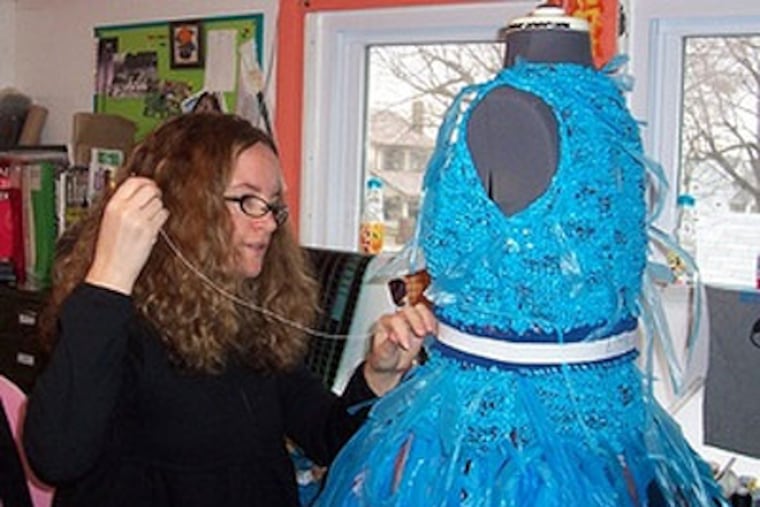
When Kristin Leigh Jordan cleans up after her dog, Daisy, she reuses plastic grocery bags. But after Earth Day this year, Jordan thought of another way to repurpose those masses of polyethylene.
She creates skeins of plastic yarn, also known as "plarn," then knits them into sturdy, multicolored handbags.
"I used to have mountains of plastic bags," she says. "I'm a bit of a neat freak, so it was a problem."
Now, friends and family donate bags to help Jordan, 34, who lives in New York, in her new adventure in textiles.
As governments explore ways to reduce plastic-bag waste, the crafty and artsy alike are transforming these pliant containers into creations that promote ecological awareness, make political statements, or simply look stylish.
MyRecycledBags.com, for instance, sells crocheted items and offers patterns for making your own baby bibs, coasters, lunch sacks, totes, and even a keeper for - what else? - plastic bags.
"There is so much you can do with those plastic bags," says Marlene Harelick, 68, who lives in Fair Lawn, in North Jersey. Among her favorite creations is a bath mat she made by knotting the blue plastic bags her New York Times is delivered in into a thread, then crocheting with it.
Those seeking guidance on the plastic bag's potential can find it on several Internet sites, including Craft magazine's Web site, www.craftzine.com. One of Jordan's muses was the DIY Network's online page for Knitty Gritty (http://
www.diynetwork.com/diy/shows_dkng/), which is shown at 2 p.m. weekdays.
Turning the bags into a workable material is not a task for the impatient.
This year Cathy Kasdan, who was working toward a master's degree in textile design at Kent State University in Ohio, transformed more than 400 plastic grocery bags into workable yarn. She snipped off the tops and bottoms of the bags and then spiral-cut each bag about 11/2 inches wide all the way around. Using double-sided tape, she attached the spirals together.
"Sometimes I tied the two ends in a knot," Kasdan says. "But I liked the flatness of using tape for knitting."
With her plastic yarn, Kasdan, 33, created a 1950s housewife ensemble that included a white short-sleeve blouse and a blue knee-length skirt. She accessorized with a red belt, pillbox hat and clutch.
Kasdan chose red, white and blue plastic bags as her medium because she wanted to incorporate the patriotism of post-World War II America into her clothing. In the 1950s, she says, the use of plastic moved from the war front to the home front.
"I wanted to say, 'Here we go! Yea, America!' " Kasdan declares with a Midwestern twang. "Plastic is a good material because there is so much of it that I had an unlimited supply. I could make 10 dresses."
Kasdan had experience working with plastic bags: She was a supermarket clerk in high school. "I'd be ringing people out, and I would think, 'Oh, my God, we go through tons and tons of bags.' "
Plastic shopping bags have been a mainstay of the consumer experience since they were introduced in 1977, according to the Progressive Bag Alliance, an industry group of manufacturers. The Environmental Protection Agency says that about 380 billion plastic bags, sacks and wraps a year are consumed in the United States - and that one bag can take 1,000 years to decompose.
Several African countries, including Botswana, Eritrea and South Africa, and some states in India have regulations against the use of plastic bags, which can be lethal to animals that swallow them. Ireland imposes a tax on plastic bags, and this year San Francisco became the first major U.S. city to ban plastic grocery bags in large supermarkets and pharmacies. Several other cities in the U.S. and abroad are considering bans.
"I think it's wonderful," says Shaun Muscolo, 49, of Simi Valley, Calif. "I think it's a matter of time before it happens nationally."
Muscolo is a designer for Haute Trash, which defines itself as "a troupe of resourceful artists who produce runway fashion shows featuring haute couture made from society's trash."
Along with artistic collaborator Judy Nielsen, Muscolo has created a line of dresses that includes a wedding gown made from white plastic grocery bags and a shimmery black cocktail dress made from videotape.
"The dresses have tiny holes that act as air conditioning," Muscolo says. "The models never complain."
Wearing the clothes is less important than sending a political and artistic message. "Haute Trash shows are all made out of garbage to show how much excess trash there is," Muscolo explains.
So when a friend wanted to borrow the white wedding dress for her nuptials, Muscolo declined. "I mean, this is a joke," Muscolo says. "A person should have a real wedding dress with respect."
She did let a friend wear a dress knit out of bags from Nordstrom's to a party. Afterward, Muscolo hosed the dress down in her backyard, which is cheaper than dry-cleaning it.
Recycling scrap materials is not a new idea, obviously. Rag rugs and quilts made from old clothing have been around for hundreds of years.
Some weavers have used such materials as funeral ribbons and Stroehmann bread wrappers in their rugs, according to the book Weaving Rag Rugs: A Women's Craft in Western Maryland by Geraldine Niva Johnson.
But knitting with plastic isn't for everyone. Bella Fruchter, 85, who has been knitting since she was 10, makes ponchos, sweaters, shawls, hats and booties. But only with wool.
"Plastic is baby stuff," Fruchter says. "I don't do that."
To each her own, plarn knitters might say. Such naysayers have certainly not deterred Jordan. The full-time lawyer recently started Daisy's Bags, named after her dog, with the aim of creating an upscale-accessories business. Her first bag sold for $75 - not a bad price for a polyethylene purse.
Says Jordan, "I'm hoping the time is right, with everything going green."