Art | Not Always As Envisioned
An art jaunt to New York demands planning ahead. Yet MoMA's Seurat drawings were a highlight stumbled upon.
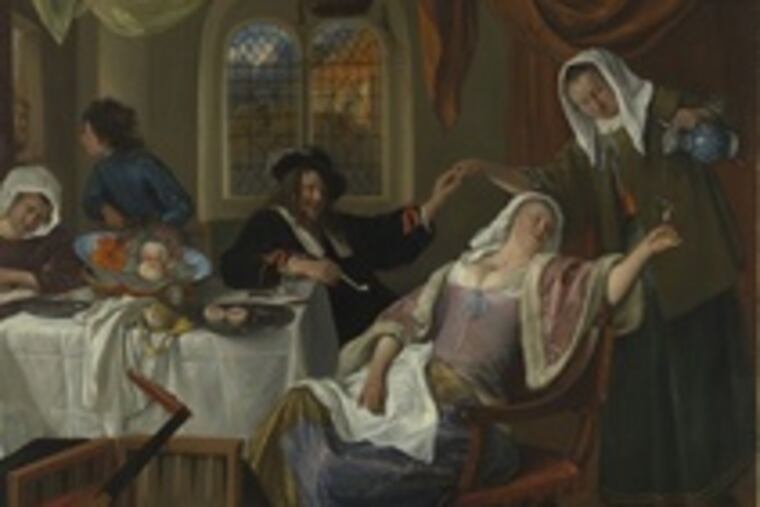
There is always too much art in New York to see in a single day, or even two, if one is a serious looker. Coming in from the provinces, it's prudent to handicap exhibitions beforehand, especially when contending with holiday crowds.
Handicapping is an imprecise art, though. An exhibition for which I had high hopes, "The Age of Rembrandt" at the Metropolitan Museum, turned out to be somewhat disappointing, mainly because of the way the paintings are organized. On the other hand, Georges Seurat's drawings at the Museum of Modern Art, which I had inexplicably neglected to put on my itinerary, turned out to be the highlight of the excursion. Had I not stopped at MoMA to see Martin Puryear sculptures, I would have missed it.
"The Age of Rembrandt" consists of the Metropolitan's entire collection of 228 Dutch paintings, most from the 17th century. Among them are 20 by Rembrandt, 11 by Frans Hals and five by Joannes Vermeer.
This lineup, plus assorted gems by Jacob van Ruisdael, Gerard ter Borch and Pieter de Hooch, among other Golden Age worthies, sounds like Elysium for admirers of Dutch art. It doesn't quite play that way, though, because of the unorthodox installation.
Instead of grouping either by artist or by genre (landscape, portraits, still life), the hanging emphasizes the chronological order in which the paintings were acquired, beginning with 174 purchased in 1874, and major donors of Dutch art, such as Benjamin Altman and Henry Marquand.
Examining how this formidable collection developed, particularly the role played by New Yorkers, is instructive up to a point, but not, I suspect, what most visitors would like to see. I, for one, would have preferred all the Rembrandts together, the better to evaluate just how much the museum can teach me about that artist. As it is, the big names are scattered throughout the show, which is broken into major and minor sections separated by a long walk.
The Metropolitan's "Abstract Expressionism and Other Modern Works: The Muriel Kallis Steinberg Newman Collection" is a more appropriate and conventional homage to a prescient collector. In the early 1950s, Newman, a native of Chicago and longtime resident there, put together a splendid group of paintings by the abstract expressionists of the so-called New York School. These include a prime Jackson Pollock "drip" abstraction, an early and masterly de Kooning and a Robert Motherwell Elegy.
After a collecting hiatus, Newman added works by artists such as Kenneth Noland, Morris Louis and Claes Oldenburg. The show consists of 63 paintings, sculptures and works on paper by 50 artists. The sculpture is noticeably strong, with major pieces by David Smith, Theodore Roszak, Ibram Lassaw and Richard Stankiewicz.
An artist in her youth, Newman was blessed both with an exceptional eye for art that would become canonical and with the courage to acquire it during its gestational period. She promised the collection to the Metropolitan in 1980, but decided last year to make the gift immediate. This tribute to her acumen is well worth an excursion into the bowels of the 20th-century section.
And so to Seurat, the progenitor and master of pointillism - paintings constructed from hundreds of tiny dots of color that are translated by the viewer's eye and brain into shimmering, albeit static, shapes and harmonies. Seurat drew more than he painted, images that are similarly static, like frozen shadows, but created more from continuous tonal washes.
His preferred drawing medium was conté crayon, dark and thick, on laid paper, which imparts a grainy texture. As the MoMA exhibition indicates, his images emerge from velvety blackness, as if he began with a uniformly dark surface and erased them into legibility. The light in most of these works is all the more luminous and powerful for being minimal.
If Seurat had made only these drawings he would still be considered a great artist. Yet the exhibition isn't entirely black and white; it includes some small paintings, allowing one to see how he achieved his cool, detached view by different means.
It also prompts one to wonder why an artist whose images are so static is nevertheless so compelling. I put it down to calculation and craftsmanship. Nothing here is impulsive or dashed off, but laid down meticulously, and with precision and superb finish.
As noted, I stopped at MoMA to see the retrospective for Martin Puryear, a sculptor, usually in wood, who, like Seurat, leaves nothing to chance. His constructions are by turns elemental and whimsical, and often suggest references to the everyday world even though they don't usually incorporate recognizable elements.
Craftsmanship and the inherent character of materials, whether wood strips and blocks or wire mesh, contribute significantly to the palpable objectivity of Puryear's sculptures. These are flights of fancy but with mass and presence. They seem like things that could logically exist in nature, except that no one has seen such inventions outside of a museum.
Puryear's work keeps getting bigger. In the second-floor atrium, the museum has placed several pieces that appear to reach toward infinity, a sinuous "ladder to the stars" that reminded me of the painting by Miró, Dog Barking at the Moon, and an upturned wheeled cart whose elongated tongue dissolves at the vanishing point.
Puryear is one of two African American artists having museum shows in Manhattan; the other is Kara Walker, whose mordantly satirical critiques of slavery, racism, violence and subjugation of black women occupy a floor at the Whitney Museum of American Art.
Walker began her revision of American history as it involves blacks in the early 1990s by revivifying a genteel 18th-century device, the cut-paper silhouette. Over the years, she has transposed the cutout into jerky film animations, even as the silhouettes themselves have morphed into wall-size murals. The Whitney show includes three of the latter, one of which is a near-circular panorama, and many of which include images of promiscuity, violence and explicit sexuality.
Walker's revisionism eschews restraint, despite the inherently polite nature of the cutout. She's saying that in the case of the black experience, the past isn't past, it's the present. The internal tension between the character of the medium and the bitterness of the message gives her work exceptional potency.
One other small exhibition, at the Morgan Library & Museum, deserves mention. It celebrates the publication of the 22 letters that Vincent van Gogh wrote to fellow painter Émile Bernard during the late 1880s, and the promised gift of 19 of those letters to the library by Clare and Eugene Thaw. In them, van Gogh discusses paintings planned, in progress and completed, as well as general artistic philosophy. Six are illustrated with detailed sketches, with color choices indicated. (Bernard's letters to van Gogh haven't survived.)
The show also includes 22 small oils, drawings and watercolors by both artists that relate to the letters, which are in French. The obvious appeal here is insight into the creative process by an artist whose ability to explain his thinking, known also from his extensive letters to his brother, Theo, stands as a rare and beautiful phenomenon. Van Gogh was a talented writer, and his letters are among the most perceptive discursions on art that exist.
One also takes from this splendid little show the comradeship that existed between van Gogh and Bernard, and the concomitant realization that such collegiality is today an equally rare commodity. The illustrated letter demanded time, passion and commitment to the ideal of a brotherhood of artists, something in which van Gogh believed fervently but which eluded his most heartfelt efforts to achieve.
Art | Holiday Highlights
Metropolitan Museum of Art, Fifth Avenue at 82d St. 9:30 to 5:30 Sundays and Tuesdays through Thursdays, 9:30 to 9 Fridays and Saturdays. "Age of Rembrandt" through Jan. 6, Newman collection through Feb. 3. 212-535-7710 or www.metmuseum.org.
Museum of Modern Art, 11 W. 53d St. 10:30 to 5:30 Wednesdays through Mondays, to 8 Fridays. Seurat drawings through Jan. 7, Puryear sculpture through Jan. 14. 212-708-9400 or www.moma.org.
Whitney Museum of American Art, Madison Avenue at 75th St. 11 to 5 Wednesdays, Thursdays, Saturdays and Sundays; 1 to 9 Fridays. Kara Walker through Feb. 3. 800-944-8639 (800-WHITNEY) or www.whitney.org.
Morgan Library & Museum, 225 Madison Ave. 10:30 to 5 Tuesdays through Thursdays, 10:30 to 9 Fridays, 10 to 6 Saturdays, 11 to 6 Sundays. Van Gogh letters through Jan. 6. 212-685-0008 or www.themorgan.org.EndText