Following through
Demer Holleran, the nation's dominant women's squash player, takes on her next challenges: Owning a fitness club and making the sport accessible.
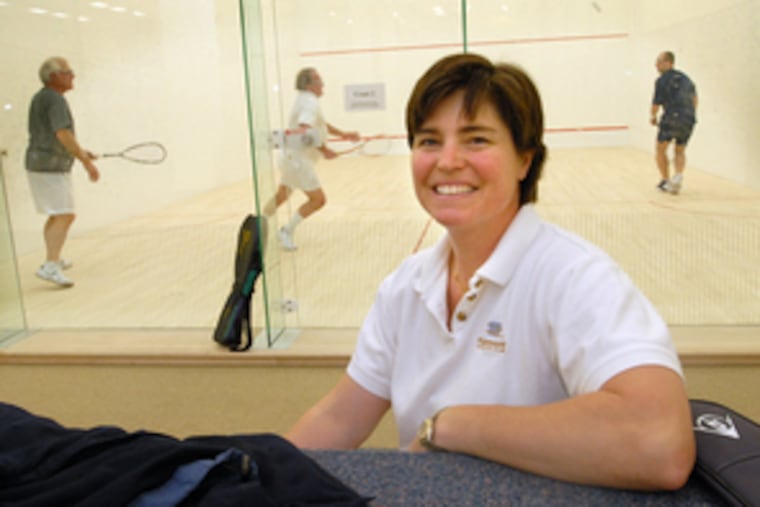
The most dominant player in the history of U.S. women's squash is not standing on a court, smashing down opponents. She is directing a man in a T-shirt toward a treadmill, wiping smudges off a hardwood floor, eating a tuna sandwich, and answering a phone.
The most dominant player in the history of U.S. women's squash is Radnor resident Demer Holleran. These days, she identifies more with the new-business-owner part of her persona than with the squash-star part.
Last spring, the genial, can-do Holleran, 40, opened the Fairmount Athletic Club. The King of Prussia squash-and-fitness facility is her dream, six years in the making.
And she's banking on the resurgence of the sport most associated with private clubs and upper-crust types to make that dream a success.
Holleran - who amassed more than 30 national titles between 1989 and 2004, more than anyone else in U.S. history - was deep into her run coaching the Penn women's squash team when she had a revelation.
"I thought, 'Am I going to coach this team forever, or am I going to do something else with my life?' " Holleran said recently.
She was successful as Penn coach, leading the team to its first national championship, in 2000. But as much as she loved coaching, the restless competitor realized she was ready for a new challenge.
Holleran and a business partner began to gather investors, research the market, talk to banks. Six months into the process, the partner dropped out - things were moving too slowly for him.
But she stayed at it. The club opened June 1, before the birth of her second daughter. (Holleran is a single mother to Emery, 2, and Ella, born in October.)
"I can see the finish line," she said. "I can see what I want to achieve and how to get it. I'm pretty dogged."
That's an understatement. In the estimation of James Zug, the official historian of the United States Squash Racquets Association, Holleran is "arguably the greatest American player ever. She was a well-rounded player, and she hit a lot of tough shots. She was mentally tougher than her opponents."
She retired from singles play in 1999, and won her last doubles title in 2004. But in the small, close-knit world of squash, Holleran, who hails from a family of competitive squash players, is still very visible.
"Demer's such a high-profile figure," Zug said. "People know the Hollerans, people know her. She's not one of those stars who went away."
Philadelphia has long been a squash hotbed, with the first national headquarters located in the city, the first doubles court built here, and a number of strong school teams and standout players.
Squash is on the upswing, with growth in courts and youth tournaments, and a serious contender to become an Olympic sport. For years, it has been played almost exclusively in private clubs with costs that make it difficult for the typical person to play.
Holleran is eager to expand the region's reputation and to make the sport more accessible.
Fairmount, located in a 46,000-square-foot former warehouse, is part of a local building boom, with new courts going up in clubs, schools, and even in North Philadelphia, as part of a program to benefit urban kids. Holleran's venue, however, is the biggest venture.
"The thought of expanding squash into the commercial arena was really my motivation," Holleran said. "This goes a long way to improving our standing in the squash community."
Holleran grew up in Gladwyne, the oldest of four squash-playing sisters and the daughter of one of the country's best men's doubles players.
Merion Cricket Club felt like home to Holleran, who remembers standing on a squash court with her dad at age 3 or 4, begging him to hit balls with her.
"I loved racquet sports, and I was really athletic," she said.
She started competing at age 11 and started winning almost immediately. She played for Shipley's team, and then for Phillips Exeter. After graduating from Princeton in 1989 with a degree in economics and four scholastic championships, Holleran was at a crossroads.
"I didn't know what to do," she said. "I said, 'Maybe I'll go into banking, but maybe I'll go overseas and play squash for a year.' "
She opted for the latter, moving to Germany and playing around the world. Holleran was already ranked No. 1 in the U.S., but had her sights set on higher goals.
After a year of competing, and winning, she realized a career in squash was a possibility. At first, she worked as a squash pro to supplement her income, and in 1991, she took the Penn job and later, a job coaching the women's U.S. squash team. Meanwhile, she was still playing, achieving her highest international rank, 21, in 1996.
When it was time to venture into a new field, Holleran did her homework, conducting exhaustive demographic research and taking a class at Wharton to hone her business skills. She gathered a group of investors made up almost entirely of Philadelphia-area squash players.
Zug said Holleran's business style mirrors her approach to squash.
"She was a grinder, wearing you down," Zug said. "That's how she operates with this business."
In addition to Fairmount's squash courts, there are weight, group exercise, spinning, and yoga and Pilates rooms. There is a babysitting center, locker rooms and a sauna. There are high ceilings, plenty of natural light, and lots of shiny new equipment.
Players come from an hour away to train, to take lessons from the squash pros, including Holleran.
Fairmount has about 450 members so far, split between squash players and those who only use the fitness equipment. But Holleran is confident her gamble will pay off.
"It's exciting to see money coming in, it's exciting to see our monthly income steadily increasing. We're getting closer to breaking even," she said.
But, of course, there's the part of her that's itching to get back to serious training, even though business and babies call.
"Maybe I'll win again," Holleran said. "I need to work on my fitness, and then who knows?"