A playwright practices to deceive
What better way to investigate the nature of identity than in a play - where people pretend to be other people, putting on makeup and costumes and fake accents?
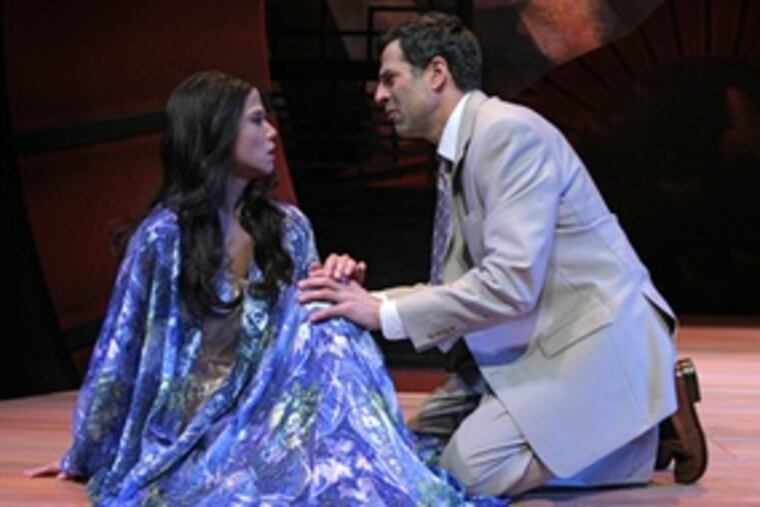
What better way to investigate the nature of identity than in a play - where people pretend to be other people, putting on makeup and costumes and fake accents?
"I seem to like stories about a major deception," says David Henry Hwang, author of the Tony-winning
M. Butterfly
, which opens tomorrow at the Philadelphia Theatre Company's Suzanne Roberts Theatre. In a recent telephone interview, he noted the similarities between the 1988 play that made him famous and his newest work,
Yellow Face
, which opened last month at the Public Theatre in New York.
A character in
Yellow Face
says, "My face became my mask," and Hwang focuses in the play on a deception that becomes "the fundamental component of identity - by playing the role, you become the role."
Yellow Face
's deception is about race - a Caucasian actor passes himself off as Asian and builds a career on that fraud.
In
M. Butterfly
, a man pretends to be a woman. The original actor in the role of Song Liling, B.D. Wong (now best known as the psychiatrist in TV's
Law & Order: SVU
), used initials in place of his name, Bradley Darryl, so that the cast list wouldn't give away the plot's twist. Two decades later, Hwang feels that it's too late to keep the secret - by now, everybody knows.
The plot is based on the true story of a French diplomat, who, when arrested in the 1980s for treason, maintained he never knew that his Chinese opera-singer lover of 20 years was a man, not to mention a spy. Their pillow talk, it turns out, provided information that helped launch the American war in Vietnam.
So
M. Butterfly
is a play about deception - and self-deception. And race. And gender. And politics and history and theater. "The whole distinction between life and theater," Hwang says, "isn't really a distinction - it goes back to 'All the world's a stage . . ..' "
The title reveals not only the plot's gender-bending (the "M." is the abbreviation for "Monsieur") but also Hwang's witty, incisive spin on Puccini's
Madama Butterfly
- which is, he points out, an opera written by an Italian, based on a French novel, about a Japanese woman who falls in love with an American man. And
M. Butterfly
adds a few layers of its own, since a Chinese man is playing a Chinese woman who, in a performance of
Madama Butterfly
, is playing a Japanese woman while the Frenchman is playing the role of her American lover. Then Hwang adds more masks - but no need to give all the secrets away.
Politics and gender inform each other: One of the central points of
M. Butterfly
is that because the macho West viewed Asia as feminized (thereby ascribing to Vietnam the wish to be dominated - what a character calls the "international rape mentality toward the East"), the arrogant assumption that the United States would easily win the war was a crucial mistake.
As Hwang points out, "The stereotype always hurts the stereotyper more than the object stereotyped; for example, at the beginning of WWII, the West thought that Japanese eyes were too small for them to be good pilots. . . ."
But the political relevance the play had in 1988 has inevitably altered with time. China is certainly no longer feminized by the Western psyche; nevertheless, Hwang points out, "in recent revivals of
M. Butterfly
, when the French ambassador says, 'The Americans love to hear how "welcome" they'll be,' the line gets a huge laugh," the audience finding a contemporary Middle Eastern relevance.
But with the passage of time, Hwang thinks that the balance of the play probably has shifted, and that "although the political aspect continues to be relevant, the play now affects people on a more intimate, visceral level than on a cerebral level."
He adds that the play also is "less shocking and naughty than it used to be - this was pre-
Crying Game
," he notes, referring to the 1992 film renowned for its own gender-based surprise - "and gay people were far less integrated into society than they are now."
Of the similarities between
M. Butterfly
and
Yellow Face
, Hwang says, "I'm interested in fluidity of identity. We think we know who we are, but then something happens and that alters our sense of identity. This theme resonates through much of the work I've done."
(Philadelphia audiences may remember the 1988 U.S. premiere here of a bizarre experimental musical called
1000 Airplanes on the Roof
, cocreated by Hwang and Philip Glass. In it, people are altered by contact with extraterrestrials, which carries the Other - fundamental to all Hwang's work - to a radical extreme.)
Hwang says he has several new shows in the works, one a martial-arts musical, another a one-woman show based on the memoir of Tsai Chin, an actress who will perform the piece. She grew up in bohemian Shanghai, studied acting in London, and created the iconic stage role of Suzie Wong, as well as the iconic film role of the diabolical daughter of Dr. Fu Manchu (played by Boris Karloff, a famous example of "yellow face" - Caucasian actors cast in Asian roles). She was the first Westerner invited back to China after the Cultural Revolution ended - the Cultural Revolution during which her parents were killed.
And there is a soon-to-be-produced opera based on David Cronenberg's movie
The Fly
(talk about "fluidity of identity"!), with music by Howard Shore (
Lord of the Rings
). Cronenberg directed the film version of
M. Butterfly.
As the web of connections, references and similarities intensifies throughout the interview, Hwang says, chuckling, that it's only in retrospect he realizes this: When he's living it, "it's just moment-by-moment; looking back, it's like snapshots in an album."