Birthing Albee's twins
PRINCETON - "Did they find the twins yet?" The question buzzed around the biz for months. Edward Albee, America's foremost living playwright, celebrating his 80th birthday this year, had written a new play in which the main characters were identical twins. The world-premiere production of Me, Myself & I is running at McCarter Theatre in Princeton, under Emily Mann's direction.
PRINCETON - "Did they find the twins yet?"
The question buzzed around the biz for months. Edward Albee, America's foremost living playwright, celebrating his 80th birthday this year, had written a new play in which the main characters were identical twins. The world-premiere production of
Me, Myself & I
is running at McCarter Theatre in Princeton, under Emily Mann's direction.
The play features 28-year-old male twins who are identical and who still dress alike, making them virtually indistinguishable - even to their mother, played by Tyne Daly. She, for reasons unknown, has named them both Otto: OTTO (referred to as "uppercase Otto") and otto ("lowercase Otto"), the palindromic effect intensified by the cases: Uppercase Otto is loud, lowercase Otto is not.
Initially, Albee wasn't daunted by the prospect of casting first-rate identical-twin actors, reportedly having opined, "Anything is possible in the theater."
So last May, world-class casting director Laura Stanczyk (she did the recent revival of Albee's
Who's Afraid of Virginia Woolf?
and
The Seafarer
on Broadway) began the search. For six months she scoured the United States, Canada and Britain, turning up about two dozen pairs in the right age range, the majority based in Los Angeles where there is lots of TV work for twins.
But most lacked the theater training and language skills an Albee play requires. "You could hear the way the language sang as soon as the lines were spoken by real actors," Stanczyk said. Still, "every couple of weeks we'd find another pair and go see them."
She and Mann, who is McCarter's artistic director, did interview several sets of twins who at first seemed suitable, but inevitably it turned out that (in the words of the playwright) "most of them couldn't act their way out of a paper bag."
In the end, Albee says, "We didn't end up with identical twins, but you're not going to know it. When you see the play, you're going to see identical twins there."
The key was finally giving up on finding the real thing and instead switching to a hunt for two actors similar enough in age, physique and height to be made to look alike.
Stanczyk knew Michael Esper as a young actor with serious talent; she had sent him to the eminent Irish director Gary Hines at the Galway Theatre in Ireland for their production of
Long Day's Journey Into Night
. Mann felt right away that he was right for OTTO.
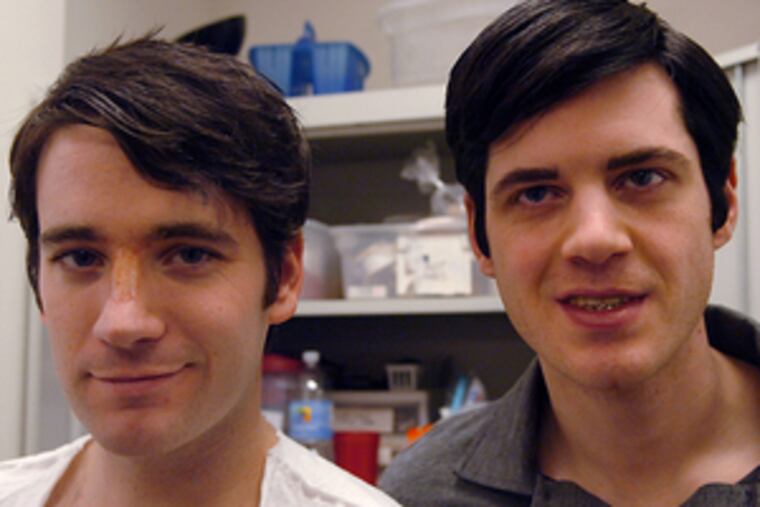
Then Esper had to be "twinned," matched physically to another actor. Stanczyk went through thousands of photos in her office until she spotted Colin Donnell and said, "Oh my God, that looks like Michael!"
But "like" wasn't enough - Albee wanted identical. So here's how they made that happen:
Jennifer von Mayrhauser, a prominent costume designer (from 16 seasons of
Law & Order
of TV to
Come Back, Little Sheba
, opening tonight on Broadway), was in on the search from the start.
"I never created twins before," she said. "It was the hardest transformation I've ever done - and it was really fun to design."
A daunting number of elements had to be factored in, coloring being the most obvious: Donnell's hair is almost black and his eyes are blue, so Esper's medium brown was dyed to match, and he wears blue contacts over his brown eyes. When they get haircuts they have to go together so they'll match.
Their bodies are slightly padded to look the same, one wears a tiny lift to equalize their heights, and the shapes of their noses and their teeth (altered by prosthetic veneers to make their speech patterns similar) were made identical. One man's rosier lips had to be dealt with, as did the other's 5 o'clock shadow.
"It was fascinating," von Mayrhauser said. "It gave me an insight into being a twin - you have to share everything!"
Esper (OTTO) and Donnell (otto) say they're having the time of their lives, in addition to being thrilled at this career opportunity. But they admit that becoming a twin was "unnerving," and "disconcerting."
Esper explains: "You try out somebody's behavior and then see him do that to you. Is he making fun of me, you wonder."
Donnell adds, "The unconscious gestures - a manner of walking, how he puts his hands in his pockets, how he carries himself - we're always watching each other."
Asked what
Me, Myself & I
is about, director Mann replies, "Who am I really? Does identity come from DNA? From soul? From personality? From family? What makes us sing?" The play, she says, is "never didactic, but a constant brain tease." (A review will appear in Monday's Inquirer; it opened Jan. 18 but Albee asked that it be closed to critics for another week while he tinkered with the script.)
Albee, who was adopted and knows nothing of his biological parents, was predisposed to get the twins just right because "twins have always intrigued him - he always thought he might have a twin somewhere."
Mann finds that she too is fascinated by twins: "When you look outside yourself - you see yourself. Like looking in a mirror."
And she says she, like everyone else connected with the play, now sees twins everywhere.