Art: Pummeled by sound at 'Puppet Show'
After an hour of being aurally assaulted by "The Puppet Show" at the Institute of Contemporary Art, I belatedly recognized a novel exhibition paradigm, the video arcade. Within the main gallery, a number of video booths that look like packing crates blare simultaneously and incessantly, each obtruding on its neighbors in a way that precludes thoughtful consideration of any single video.
After an hour of being aurally assaulted by "The Puppet Show" at the Institute of Contemporary Art, I belatedly recognized a novel exhibition paradigm, the video arcade. Within the main gallery, a number of video booths that look like packing crates blare simultaneously and incessantly, each obtruding on its neighbors in a way that precludes thoughtful consideration of any single video.
"The Puppet Show" must be intended for young people accustomed to electronic multitasking. You don't pass through this show, you're enveloped by it. Indeed, artist Terence Gower, who designed the installation, reportedly intended it to function as a work in its own right.
This would be fine if "The Puppet Show" consisted of unrelieved mediocrity. But in this carnival-midway format the good stuff is not only hard to recognize but nearly impossible to savor, no matter how committed one is to paying serious attention. Plus, after about an hour of unremitting cacophony one's head begins to ache.
Ingrid Schaffner, the ICA's senior curator, started with a wonderful idea, to examine the proliferation of puppets, puppetry techniques and puppetry concepts in contemporary art. She and exhibition cocurator Carin Kuoni of the New School in New York City chose 28 artists to exemplify how this puppetry renaissance manifests itself, mainly through videos, sculpture and photography.
Some of these artists stand on considerable reputations, such as Louise Bourgeois, Bruce Nauman, Dennis Oppenheim, Kiki Smith, William Kentridge, Mike Kelley and Kara Walker. However, individual works sometimes feel only tenuously connected to the putative theme. Not explicitly stated, it boils down to asking why puppets are so appealing and why artists have adapted this traditional medium to contemporary expression.
The answers are simple enough: Puppets are not only cute, they have license to transgress, to act out human emotions and impulses in a way that would be more shocking and subversive when performed by live actors, as they are in Nauman's brief video,
Violent Incident.
A scuffle between a man and woman at a dinner table would be burlesque if acted out by Punch and Judy, but when portrayed naturalistically its ambiguous denouement - it appears to be a stabbing - is mildly horrific. Puppetry softens the blow, even when, as in Walker's mordant, puppet-based animations about the exploitation of slaves, the blow is nearly lethal.
The more substantial works in the show, particularly Kentridge's video about apartheid in South Africa, a collaboration with the Handspring Puppet Company, exploit puppetry's allegorical power wonderfully. Unfortunately, the Kentridge piece is on the midway, where, even with an ear pressed to the screen, one can barely hear a word.
Visitors enter the exhibition through a chamber called Puppet Storage, whose shelves are filled with real puppets and related artifacts designed, I suppose, to establish an appropriate mood.
Inside, the exhibition divides into contemplative and rowdy. Except for Bourgeois' sculptures, especially an elegant bronze called
Henriette,
the quiet works aren't as compelling, in large part because many exist on the verge of the puppet world.
The raucous parts are videos, some made with puppets and some with actors. Gower's idea of installing most of these inside packing cases flops miserably. Unless intended purely as visual jokes, videos need to be isolated, not only for practical reasons but because this signals to the audience that they're more than entertainment, and deserve to be taken seriously.
Fortunately, four of the higher-quality videos have been given enclosed (but not soundproof) rooms in the center of the gallery. Here one finds Walker's searing
8 Possible Beginnings,
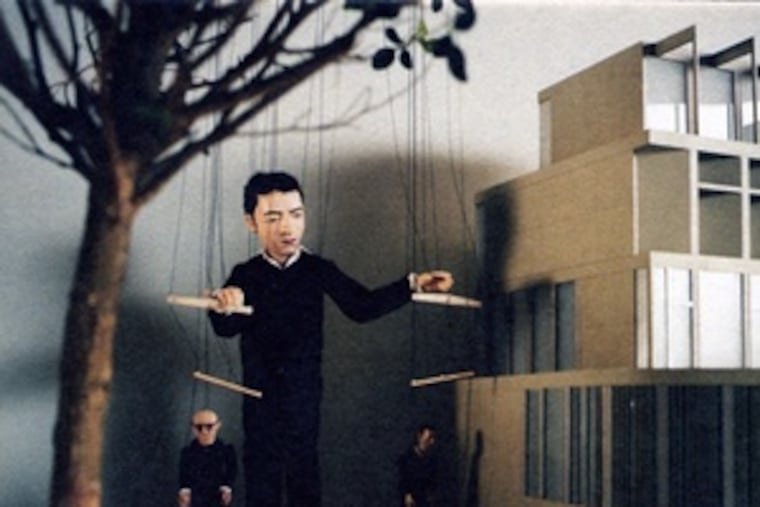
Pierre Huyghe's hauntingly beautiful "puppet opera" about the commissioning of a Le Corbusier building at Harvard University, and Christian Jankowski's whimsical "puppet conference" on the history of female imagery in art.
Also in this cluster, Philippe Parreno and Rirkrit Tiravanija collaborate on a send-up of art-world panels, in which they and other artists appear both as puppet talking heads and as spectators. Art-world pretentiousness has rarely been so deftly skewered.
On the negative side of the scale, Israeli artist Guy Ben-Ner's video
Karaoke
transforms a penis, presumably the artist's own, into a cuddly hand puppet. To call it puerile is woefully inadequate. Paul McCarthy's
The Painter
fails to rise above simpleminded slapstick; the 5-year-old sitting next to me found it hilarious.
I could abide the inane work if only the installation would let me dig into the meaty stuff. No such luck, though - it's multitask or perish.
Something similar is going on upstairs in the ICA's Project Room, where Carlos Motta (born in Colombia, lives in New York) has installed a project called "The Good Life." To create it, he conducted video interviews on the streets of a dozen Latin American cities, asking a variety of passersby what democracy meant to them.
The segments are stitched together as a documentary, in Spanish with English subtitles, that play on 10 video monitors placed on four stepped platforms that resemble miniature grandstands. All the monitors play at once, and they're not synchronized, so the result is another Tower of Babel.
"The Good Life" is described as a "work in progress," which I presume is supposed to excuse any lack of focus or structure. One can't in good conscience call it art, but it's decent journalism despite its open-ended quality. You can watch for a minute or an hour, with the same result.
Next door, Trisha Donnelly relieves the continuous chatter with a Zen-like installation, a row of drawings, photos, sculptures and video projections along one wall of a otherwise empty gallery. Several "sound sculptures" chime in periodically.
Donnelly wants us to appreciate how little visual stimulation is required to trigger an association with a memory, an emotion or a place. She provides the trigger, you complete the equation. Time is a critical element; the piece is supposed to heighten awareness of its passing. It did that for me. More than once I thought, why am I spending time looking at this?
Art: Artful Puppetry
"The Puppet Show" and "Carlos Motta: The Good Life" continue at the Institute of Contemporary Art, 36th and Sansom Streets, through March 30. "Trisha Donnelly" continues through Aug. 3. The gallery is open from noon to 8 p.m. Wednesdays through Fridays and from 11 a.m. to 5 p.m. Saturdays and Sundays. Admission is $6 general and $3 for students over 12, artists, and senior citizens. Free Sundays until 1 p.m. Information: 215-898-5911 or
» READ MORE: www.icaphila.org
.