Love's skill sets
A Penn psychologist runs workshops to train couples on how to stay in the game. Meet two sets of winners.
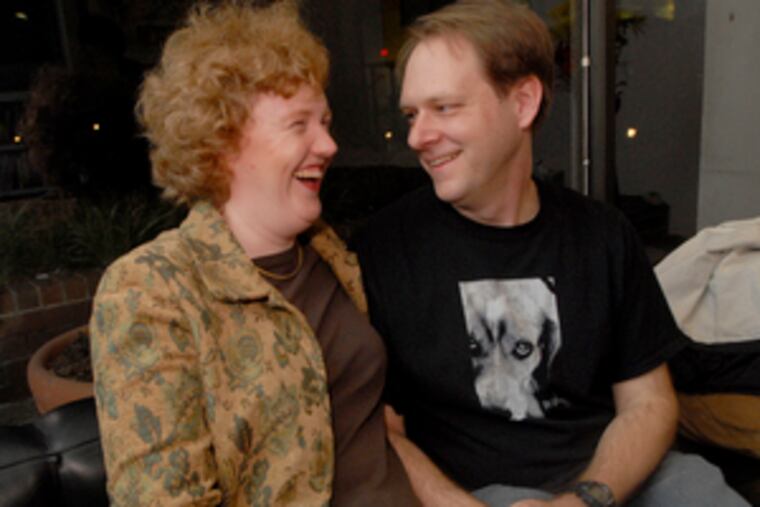
We take lessons to merengue, kickbox, or paint watercolors.
But how to love, not so much.
The truth is, every couple could use guidance on keeping it together. "Skill," the ancient Roman poet Ovid wrote, "makes love unending."
People can sit down and be taught how to effectively function as a pair, insists Judith Coché, a University of Pennsylvania psychologist who runs the Coché Center, based in Center City.
A fixture on programs like Oprah, Good Morning America, and Today, Coché runs workshops for couples. In August, her work was the subject of a New York Times Magazine cover story, which will soon be expanded into a book.
"We all need help," Coché says. "We learn coupling mainly by osmosis, and create an only vaguely formed idea as to how it works.
"Love is a major life event. But without skills, it goes downhill."
Inspired by Valentine's Day, Coché recently invited two of her more-successful workshop couples to explain how they make love stay - and the Ovid-like skills they possess to be happy.
David and Dona Behrend
The Behrends, one of those cute couples you see sitting close and smiling a lot, live in Bryn Mawr.
David, 65, tall and athletic, ended his previous marriage in divorce. Dona, 59, open-faced and smiling, was widowed. Between them, they have five grown children from their first marriages.
Married nine years, the couple met after Dona, a historian for the Philadelphia Records Department, answered David's ad in Philadelphia magazine. David, an executive career counselor, had written that he loves the Phillies, Vermont and reading the New York Times.
All that resonated with Dona, who came to see David as a good-hearted man who dotes on his kids.
The couple went to Coché to improve communication skills. "There's never a lack of communication with couples," Coché points out. "There's often a lack of effective communication."
Dona's first marriage had few bumps. "I was in a very happy marriage for 23 years," she says. "It was automatic. I never thought about it."
In the beginning of the Behrends' relationship, Dona says, "it wasn't there: the feeling of trust and intimacy, being able to say what you need to say."
They learned, first, the idea of "active listening" - really hearing the other partner.
"After she makes a statement, I have to repeat it, to make sure I heard," David says. "That's challenging."
Active listening doesn't imply agreement. "I repeat what he says, and he thanks me for listening," Dona says. "So we're not just mashing anger and yelling."
"We may agree to disagree," David says. "We don't disagree a lot."
Dona makes a face, then disagrees.
"Well, I do agree with you a lot," she says. "But I have also grown not to sweat the small stuff. The things that annoyed me about you before just weren't big stuff. I'm less judgmental."
The two also needed to learn how to negotiate. The Philadelphia Orchestra proved to be a problem.
Dona loves it, while David prefers doo-wop. She attends six concerts a year, and, Dona says, "it was a battle to get him to go. He complained incessantly."
"I asked Dr. Coché if I had to go to the concerts, and she said, 'Yup,' " David says. "So I did."
To pay him back, Dona goes to doo-wop concerts with her husband.
The couple say love alone doesn't get you through. You have to work at a marriage.
"Communication is the most important thing," David says. "And I feel blessed to be married to Dona."
"Having him adds to my sense of calm," Dona says. "And it's never boring."
Scott and Rebecca Kruer
Scott, 39, and Rebecca, 35, of Boothwyn have been married two years, the second marriage for both.
The Kruers, who met at a church, don't have children. They say they came to the workshops to avoid repeating mistakes from their previous marriages.
"Our relationship is good," says Scott, a T-shirt-wearing warehouse coordinator for Costco. "We wanted to be sure it stays that way."
Still, their union was not without problems, which presented themselves on padded paws: Scott's beagle, whippet and border collie.
"I felt like I was second to those dogs," says Rebecca, a stylishly dressed human-resources consultant. "They were a major issue for me."
Good at communicating, Rebecca presented the issue clearly. And Scott backpedaled.
"He was avoiding, while I was trying to talk about it," Rebecca says.
This is typical, says Coché. Often, a woman will know what she needs and ask her man for it, she says. "The assertive voice can feel harsh for a man, and he shrinks away, then builds a barrier. Then it gets harder for the woman to talk with him, and he fails to communicate effectively, becoming annoyed."
For his part, Scott says, the dogs represented stability in a changing world. He lavished attention on them. But it didn't mean Rebecca was less important.
"I learned to hear her on this, and the hearing is the important thing," Scott says.
"And yes, she ranks above the dogs."
The Kruers' friends all tell them they seem like the happiest couple in their circle.
"It's funny, because we're not the kind of couple that finishes each other's sentences," Scott says. "We're kind of stubborn, actually."
And they won't be doing anything grand and romantic for Valentine's Day either.
"It's not a big holiday in our house," Scott says.
"We'll probably just have dinner," Rebecca adds. "But we'll be spending the time alone and together."
Coché smiles and nods knowingly.
Lessons in Love: Staying Together
Being part of a couple is, for most people, the best lifestyle ever developed on the planet, says Center City couples expert Judith Coché.
But staying together can be tough.
What follows are, in no particular order, a few nuggets and ideas expressed by Coché or taught at the Coché Center to help spouses and lovers.
Screaming hurts the nervous system.
Without good habits of communication, emotional decay sets in.
Women are often the emotional caretakers, while men are wonderful problem-solvers.
Problems develop for couples when they can't negotiate body rhythms (a night owl versus a morning person); when one is a glass-half-full person and his or her partner is the opposite; when the couple are sexually mismatched, with one person actually not physically attracted to the other; when finances can't be agreed on; when values differ (one partner wants to save all money for a child's college education, while the other wants to take trips).
Respect is key. Without it, resentment can build and grow into contempt, a precursor to divorce.
Resist the urge to tell your partner, "I told you so."
One should have a willingness to be influenced by what one's partner thinks.
There should be at least five times as many pleasurable, pleasant experiences for a couple as tense, painful ones.
You should want to have your way just half the time.
- Alfred Lubrano
EndText