Art: A painter who knew no bounds
Elsie Driggs was admirably adventurous in style and subject matter.
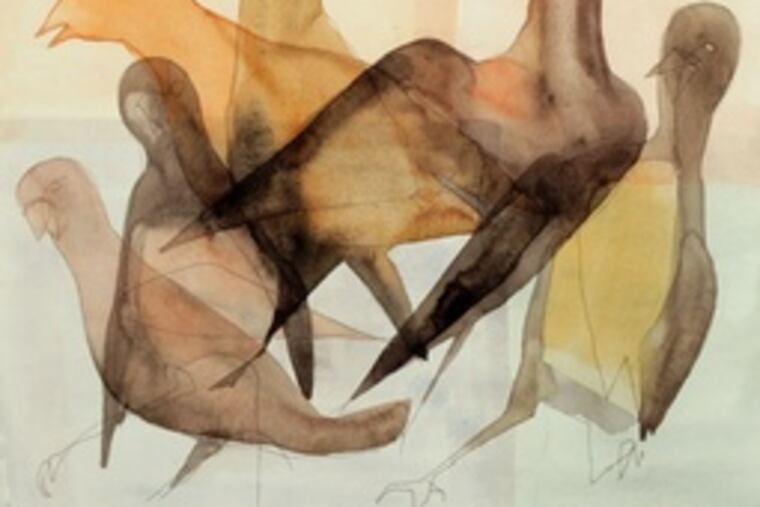
It's been more than 17 years since the Philadelphia region has been treated to a major exhibition of paintings by Elsie Driggs, who lived in Lambertville, N.J., from 1937 to 1969.
The earlier show, at the New Jersey State Museum in Trenton, introduced an adventurous painter who pushed far beyond the boundaries of the precisionist aesthetic for which she is usually remembered, when she is remembered at all.
If one reduced her achievement to one painting, it would be Pittsburgh of 1927, a poetic evocation of steel-mill smokestacks bathed in a smoky luminescence, Griggs' way of evoking the Steel City's miasmic air pollution of the time.
Precisionism, which also involved such painters as Charles Sheeler, Niles Spencer, Charles Demuth and Ralston Crawford, was more an attitude toward subject matter than a formal movement. The precisionists developed industrial themes - factories, mills, locomotives, bridges. Their images were usually angular and crisply delineated.
Pittsburgh, painted in a near-monochrome of bluish-grays, is more romantic in mood but also vaguely classical in its compositional rigor. If it's possible to love a factory, this picture can make you do so. It's not only a masterpiece of precisionism, but of American art generally, an intensely radiant fusion of power, lyricism and historical moment.
Pittsburgh seizes one's attention on approaching the new Driggs retrospective at the James A. Michener Art Museum in Doylestown. This show of 62 oils and works on paper was organized by Connie Kimmerle, the museum's curator of collections, as the institution's latest tribute to major artists of the Philadelphia region.
Though Driggs and her painter husband, Lee Gatch, lived in Lambertville for more than 30 years, they were not part of the New Hope circle. They were neither landscapists nor impressionists and they were more involved with New York City than with the regional scene.
As the Michener show reveals, Driggs can't be neatly pigeonholed, even as a precisionist. There are only two, possibly three, paintings in that style on view, but then she made only five or six in all. The only major one missing from this exhibition is Aeroplane of 1928.
Driggs studied at the Art Students League in New York from 1918-22. She began to exhibit in New York in 1924, and made her early reputation there.
When I saw the Trenton show in 1990, I was puzzled by the apparent lack of a plausible evolutionary progression in her art. In particular, the 1940s and '50s were essentially blank. Her career seemed to consist of unrelated passages arbitrarily strung together.
The Michener show repeats this pattern, but makes it more understandable. For one thing, during most of the Lambertville years Driggs didn't have a studio. She and Gatch lived in a small house, and he, being the man and having the bigger reputation, got the only studio space. She got the kitchen table, where she painted watercolors.
More important, Driggs was never content to belabor a single line of inquiry. Brilliant as she was at precisionism, she was more interested in testing variations on her basic aesthetic formula - classical order and repose tempered with what she described as "something happening," and which we experience as liveliness or vibrancy.
This "classical quickness" is the engine of her creativity. Subject matter and media change through the years, but Driggs' remarkable ability to impart the quickness of life to inanimate objects and static tableaux remains constant.
This is apparent in her earliest works, in which right from the beginning of her career she transformed banal and overworked subjects into expressions of palpable life force. A prime example is the small oil Chou of 1923, a simple head of cabbage, which, with its Cezanne-inspired structural audaciousness and muted cubist colors, reads as a slightly predatory presence.
More in terms of circumstances than stylistically, Driggs' career breaks into three segments. First come the precocious oils and drawings of the 1920s, when she was single and mixing with leading lights of the New York scene. This decade produced early gems such as a portrait of Natalie Van Vleck, some velvety pastels of plants, and Pittsburgh.
It also produced small watercolors such as The Mob and Riot, in which Driggs first explored the phenomenon of bodies in motion. The watercolors are ingenious, really more colored drawings built up from precise, animated line. They pack considerable energy into small spaces as they edge toward semi-abstraction.
In career phase two, Driggs, confined to her kitchen table in Lambertville, created, in watercolor, marvelous sequential-motion images of animals and birds such as Who Killed Cock Robin and Three Bison. Inspired by the poet Emily Dickinson, she also produced lighthearted visual metaphors such as I Taste a Liquor Never Brewed and Balloons, all from the 1930s.
The next decade and a half is mostly blank; presumably Driggs was occupied with her young daughter, Merriman, and other domestic responsibilities. In the mid-to-late 1950s she returned to oils, sometimes adding collage, with works such as Dancer and Moonstruck Goat, whose mosaiclike collage patches suggest that she was influenced by Gatch's abstractions.
After she got her own studio, her paintings became more imaginative and lyrically abstract, as Herringbone Sky, Calligraphy and Deity, all from 1965, demonstrate.
After Gatch died in 1968 and Driggs moved back to New York, her paintings became for a time even more abstract and symbolic. She began to make large drawings that included collage or assemblage elements, like the wooden shoe lasts in Cobbles.
Finally, in her 80s, she closed the circle on her career by reprising precisionism in the oil The Javits Center, a crystalline melding of linear pattern (gridlike window frames) and nature (blue sky and clouds reflected in the glass). The building dissolves into its environment.
Driggs - who died in 1992, three weeks short of her 94th birthday - painted her last picture, a nostalgic view of Hoboken, N.J., in 1986, when she was 88. This soulful skyline provides a fitting capstone to the life of an admirably inventive and consistently optimistic modern painter, one who never tired of testing the limits of the aesthetically possible.
Art: Precision Painting
"Elsie Driggs: The Quick and the Classical" continues at the James A. Michener Art Museum, 138 S. Pine St., Doylestown, through April 13. Hours are 10 a.m. to 4:30 p.m. Tuesdays through Fridays, 10 to 5 Saturdays and noon to 5 Sundays. Admission is $6.50 general, $6 for visitors 60 and older, and $4 for students with current ID. Information: 215-340-9800 or www.michenerart
museum.org.
EndText