The Passion of Frida Kahlo
Exhibit spotlights artist who depicted death, pain, hopelessness on canvas
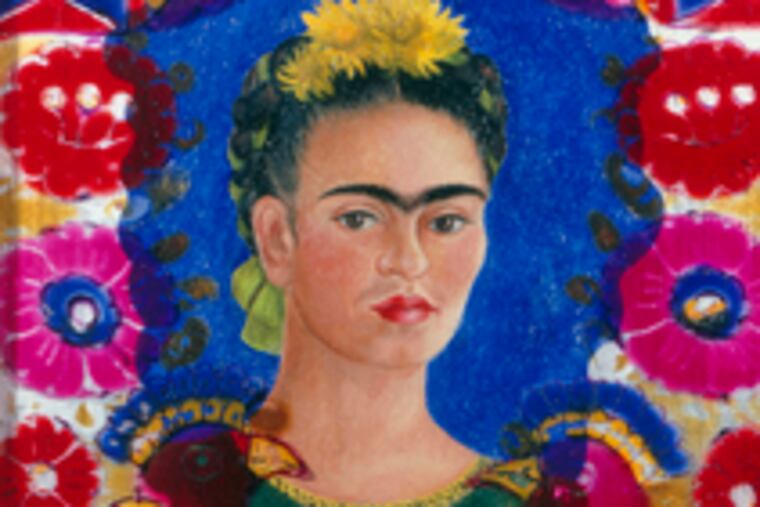
THE
OEUVRE
of Frida Kahlo continues to amaze her fans nearly 54 years after her death - none more so than her meticulous biographer.
Kahlo scholar Hayden Herrera - one of the curators behind the Frida Kahlo exhibit opening today at the Philadelphia Museum of Art and whose 1983 biography of the iconic Mexican artist was the basis for the 2002 movie "Frida" - said she recently discovered a few new details in one of her favorite Kahlo paintings, "A Few Small Nips." ("Unos cuantos piquetitos.")
The history of that painting can be traced to 1934, a year in which Kahlo didn't complete a single painting. Her creative drought was precipitated by her discovery that her philandering husband, famed muralist Diego Rivera, had carried on a yearlong affair with Kahlo's beloved younger sister, Cristina.
What brought Kahlo back to her easel in 1935 was a newspaper story about a man who had stabbed his lover to death. The suspect confessed, but excused himself to the judge by saying he'd given the victim just "a few small nips."
Kahlo imagined the violent scenario, with a fedora-wearing man, smiling slightly and standing over a nude and bloodied dead woman. She lay on a narrow bed, head tilted to the side, wearing one black shoe and a jeweled garter. Blood covers his shirt, her bed, the floor, even spilling from the picture onto its wooden frame. It's Kahlo's "bloodiest painting," Herrera noted recently to reporters.
Last fall, when the painting was unpacked from its crate at the Walker Art Center in Minneapolis, Herrera said she saw for the first time small indentations on the frame, presumably made by a knife. Kahlo had stabbed the frame, adding her own fury to the work, something Herrera hadn't noticed while looking at slides and pictures of the painting.
"She put her own misery onto the woman's calamity," Herrera said. At the time, Kahlo had told people she felt "murdered by life."
Murder, suicide, death, psychic pain, hopelessness, physical agony, unrealized dreams, loneliness - this was the life expressed freely and without restraint by Kahlo.
On paper, not the kind of themes to attract a mass audience, but Kahlo has become a magnet. You can find her iconic image on refrigerator magnets, earrings, light switchplates, posters and mouse pads. Her art resonates with feminists, Chicanos, modern art enthusiasts and the gay and lesbian community, Kahlo scholars say.
Kahlo once said she painted her reality.
And it was a turbulent one. Polio as a child. A near-fatal bus accident at 18. Two tumultuous marriages to Rivera. Three miscarriages. Dozens of surgeries, including a leg amputation. Kahlo culled from her life of physical and emotional torment the inspiration to paint some 200 works, 40 of which are in the Philadelphia exhibit, the only museum east of the Mississippi River to be included in the tour. (A quarter of Kahlo's painting are unaccounted for.)
The exhibit includes four Kahlo works that have never been displayed in the United States: "Me and My Parrots," "Diego and Frida 1929-1944," "Magnolias" and "The Two Fridas," one of only two oversize Kahlo paintings. (The other, "The Wounded Table," is lost, according to the "Frida Kahlo" catalog.)
Kahlo's paintings, for the most part, are extremely personal, almost intimate, and painted on small canvases. The Frida style is infused with indigenous culture, Catholicism, politics, humor and fiery spirit.
Far from being a victim, Kahlo "is a figure of resilience," said Amalia Mesa-Bains, noted Chicana artist who is the director of the visual and public art department at California State University-Monterey Bay.
"I think often people portray her as a suffering victim. We [Chicanas] thought of her in another way. As overcoming her struggle, a metaphor for Mexico, coming into her own," she said.
Mesa-Bains turned to Kahlo for inspiration when she underwent several surgeries about five years ago. "How did she do it?" Mesa-Bains pondered, referring to the 30-plus operations Kahlo endured during her 47 years. A year before her death in 1954, Kahlo's right leg was amputated, a leg she had covered up with long skirts and dresses for most of her life because polio had left it withered.
Like biographer Herrerra, Elizabeth Carpenter, the show's co-curator and an associate curator at the Walker Art Center, is fond of her subject.
Carpenter, who worked on the show for two years, calls Kahlo "irrepressible, astonishingly original." The artist is just what our post-millennial world needs. "Our current culture celebrates victimization and dwells on it. Her life story is a story of inspiration."
Kahlo, Rivera and his fellow muralists were involved in mexicanidad, an intelligentsia movement to reclaim Mexicans' indigenous roots after the country's 1910 revolution. Kahlo was inspired by the Mexican tradition of retablos, or ex-votos, small paintings on tin that depicted a miracle or divine intervention. Usually the genre includes a short expression of gratitude within the art.
But Kahlo, being Kahlo, reinterprets the genre with a twist. For example, in "The Suicide of Dorothy Hale," a painting commissioned by Claire Booth Luce to commemorate a New York City society woman who plunged from a hotel to her death, Hale is seen three times in the painting - as a tiny figure leaping from the building, a larger shrouded figure flying through the air and finally as a corpse, eyes wide open, on the pavement. In red, bloodlike paint, Kahlo writes a short narrative, dedicating it to the dead woman.
(Luce, had planned to give the painting to Hale's mother, but refused to accept this violent work, and even threatened to destroy it.)
Kahlo "transformed the dark side of life into very striking images. They're colorful, they call your attention," said Yolanda Martinez-San Miguel, associate professor of Latin American literature at the University of Pennsylvania.
The exhibit, which originated at the Walker in Minneapolis last fall and heads to San Francisco in June, also focuses on Kahlo away from the canvas.
Personal photographs of Kahlo with friends and family fill several galleries at the museum.
These photos have never before been on display because they are part of a private collection of Vicente Wolf, prominent New York interior designer.
The photos reveal a more joyful Kahlo than depicted in her paintings. She swigs from a bottle. She touches Diego's hand, smiling.
She is slightly furious on a phone.
But she doesn't hide from her pain either; several photos show her in traction during one of her many surgeries.
In the photos her face is similar to the one revealed in her self-portraits, but she appears softer, more feminine, and her intense gaze is not so distant. *
"Frida Kahlo" opens today and runs through May 18. Exhibit hours: 10 a.m.-5 p.m. Tuesday through Thursday, 10 a.m.-8:45 p.m. Friday (last ticket 7:30 p.m.), 10 a.m.-6 p.m. Saturday and Sunday (last ticket 4:30 p.m.), $20 adults, $17 seniors, students, youth 13-18, $10 children 5-12, under 5 and members free. For tickets, call 215-235-7469 or www.philamuseum.org.