Art: Painting suffused with pain
Contrary to what is often written about her, Frida Kahlo was not a surrealist. She was a magic realist who painted her life as it happened to her, as she felt and remembered it.
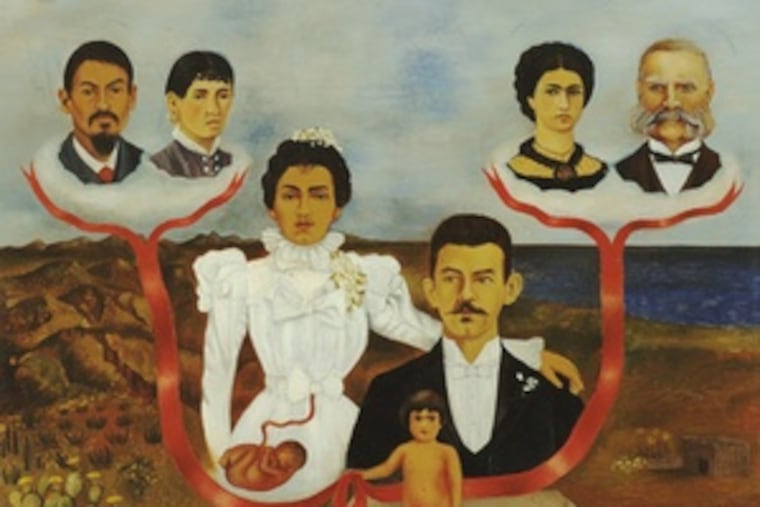
Contrary to what is often written about her, Frida Kahlo was not a surrealist. She was a magic realist who painted her life as it happened to her, as she felt and remembered it.
We know this because in her paintings we recognize and empathize with her pain, both physical and emotional. Many people, especially women, have experienced analogous slings and arrows, although not always to the same degree.
Despite their heavy symbolism, Kahlo's paintings don't depict an otherworldly life, or imaginary dimensions of everyday existence. They make remarkably vivid the universal human struggle to overcome adversity. Once seen, they're hard to forget.
As the Kahlo exhibition at the Philadelphia Museum of Art indicates, the legendary Mexican painter, who died in 1954 at age 47, wasn't a modernist, either. Some art historians and critics insist on portraying her as such, but her art tells a more elemental and timeless story.
Kahlo's paintings can be linked to medieval images of Christian martyrdom and also to evocations of pain and death in Mexican folk art, especially the small panels called ex-votos. A half-dozen of these in the show make the comparison explicit.
Kahlo has become a legend in part because of her extraordinary life - polio as a child, severely crippled at 18 in a bus-trolley accident, married twice to famed muralist Diego Rivera.
The second leg of her legend rests firmly on her often astonishing images - hearts and blood vessels outside the body, necklaces of thorns, that sort of thing. She created supremely intense and memorable images of pain. In fact, this traveling exhibition should be titled "Frida Kahlo: I Suffer."
It was organized by the Walker Art Center in Minneapolis in association with the San Francisco Museum of Modern Art to mark the centenary of the artist's birth in Coyoacán, a southern suburb of Mexico City.
It's not large - fewer than 50 paintings and more than twice as many photographs of Kahlo, friends and family. The photos, which constitute the opening section, once belonged to her and Rivera. They're now owned by the Vicente Wolf Collection in New York City.
One can't understand Kahlo's art without knowing something of the circumstances that inspired it. The relatively large number of photos help with that, but many are small and hard to see. If your eyes are weak, bring a magnifier.
With the exception of a few still lifes, most paintings are portraits of one kind or another, and the majority of those are self-portraits. As with Picasso's, Kahlo's art exposes intimate secrets and relationships. However, where Picasso transmuted his experience, usually formally, she served hers raw. When we look at his work, we admire ingenious aesthetic transformation. With her, we think of agony.
Kahlo began her career as an untutored (or "naive," if you prefer) painter, with pictures like
Self-Portrait
of 1930. It's compelling because it's direct; one senses steely determination behind the impassive facial mask.
A portrait of her friend and medical adviser Dr. Leo Eloesser and a double portrait of her and Rivera, both made in 1931, more clearly reveal her intuitive approach. By contrast, a highly unorthodox portrayal of Luther Burbank, also from 1931, in which the celebrated plant breeder is rooted in the earth like a tree, announces Kahlo's creative magic, especially concerning fertility.
As her art developed through the 1930s and '40s, her style became more refined. By the time of
Self-Portrait With Small Monkey
of 1945, she was painting more conventionally.
However, throughout the show her style alternates. The most striking and confessional images, such as
A Few Small Nips
and
Henry Ford Hospital,
are decidedly more "naive" than her formal portraits. This enhances their emotional power.
Kahlo's ability to vividly visualize wrenching emotional crises such as miscarriage
(Henry Ford Hospital)
and spousal betrayal
(A Few Small Nips)
constitutes her distinctive contribution to 20th-century art. She never sublimates, as Picasso did. She's always intimately, and imaginatively, diaristic, with nothing held back.
In
Hospital,
Kahlo lies on a bed in a pool of blood, a fetus hovering over her. In
Nips,
a naked woman bleeds from multiple knife wounds as her male attacker stands over her. There's so much blood spattered about that it even stains the picture frame. This picture, based on a real-life event (in which she was not involved), refers to Rivera's adultery with the artist's younger sister.
In another pictorial cri de coeur,
Without Hope,
Kahlo is force-fed through a massive funnel crammed with a variety of disgusting-looking food. In
The Dream,
she sleeps on an airborne bed, accompanied, on the canopy, by an embodied specter of death.
The canonical Kahlo image, which suggests the passion and crucifixion of Jesus, is
The Broken Column.
Strapped into a supporting corset, Kahlo displays her shattered spine through an opening in her torso, which is pierced by nails. The allusion to Jesus might seem far-fetched, but Kahlo herself once offered such an allusion.
One isn't surprised by that, because she used art as exorcism, a way to surmount a plethora of tragedies that included unremitting physical pain, multiple miscarriages, and persistent philandering by Rivera.
She immortalized their 1939 separation and divorce in
The Two Fridas,
a tour de force that distills her catalog of pain into a monumental double portrait. This painting, like most of her images, is almost embarrassingly personal, and yet it touches anyone who has experienced severe emotional trauma.
Fortunately, the show isn't unalloyed pain and death. It ends with a group of late still-lifes of fruit, cut to display their luscious fleshiness. Perhaps the most beautiful picture is a still-life of magnolia blossoms, one of which is suggestively phallic. Fertility consistently stimulated Kahlo's imagination.
So did Rivera, despite his serial unfaithfulness. Kahlo affirms that with the show's most poignant painting, in which she embraces a nude, childlike Diego as both, in turn, are enfolded in the arms of Mother Earth.
Kahlo was a courageous, even heroic, woman. Yet as compelling as her art and life may be, she emerges from this show as a major minor artist whose art is persistently narcissistic and, when she compares herself with Christ, even hubristic. That her work continues to enchant a broad audience is essentially a by-product of what she intended it to proclaim - that "I suffer."
Art: Art of Suffering
"Frida Kahlo" continues at the Philadelphia Museum of Art, 26th Street and the Parkway, through May 18. Hours are 10 a.m. to 5 p.m. Tuesdays through Fridays, to 8:45 p.m. Fridays, and 10 a.m. to 6 p.m. Saturdays and Sundays. Admission by special ticket is $20 general, $17 for visitors 62 and older, students, and visitors 13 to 18, and $10 for visitors 5 to 12. Order tickets by calling 215-235-7469 (235-SHOW) or through the museum Web site,
» READ MORE: www.philamuseum.org
. General museum information: 215-763-8100 or 215-684-7500.