Unearthed gems from Gamble & Huff
As their hits put them in the Rock and Roll Hall of Fame tomorrow, Philly's Gamble & Huff are mining the vaults for lost soul.
Back in 1972, Teddy Pendergrass sang it: "If you don't know me by now, you will never ever know me."
More than 35 years later, it would stand to reason that those words - written by Kenny Gamble and Leon Huff, and sung when Pendergrass was a member of Harold Melvin & the Blue Notes - would still apply to the Philadelphia International Records catalog.
A listen to the new The Sound of Philadelphia: Gamble & Huff's Greatest Hits, seconds that notion. The chart-topping smashes are here: The O'Jays' "Love Train," Billy Paul's "Me & Mrs. Jones," McFadden & Whitehead's "Ain't No Stoppin' Us Now."
Each is a familiar example of the sophisticated, string-sweetened soul that was the trademark during the '70s heyday of the duo, who will be inducted tomorrow into the Rock and Roll Hall of Fame.
They are the first recipients of the hall's Ahmet Ertegun Award, named for the legendary Atlantic Records co-founder, who died in 2006. The award, the new name for the hall's "non-performer" category, has gone to producers such as Sam Phillips, Berry Gordy Jr., Phil Spector, Clive Davis, and George Martin.
Being inducted with an award named for Ertegun is "quite an honor," Gamble said in an interview. "He's someone who is admired by everyone, who always gave credit to African American artists."
But there's another new collection that tells a not-so-familiar story. Conquer the World: The Lost Soul of Philadelphia International Records tells a fascinating shadow history of the African American-owned and -operated Philadelphia label that took the baton from Motown and Stax as the dominant, socially conscious soul-music label of its era.
None of its 16 tracks achieved the AM-radio omnipresence of "Back Stabbers" or "I'll Always Love My Mama." Excavated from the vaults by researchers at Sony who are engaged in a major Philadelphia International reissue campaign, Conquer digs up shoulda-beens and coulda-beens like Chicago soul singer Johnny Williams' "It's So Wonderful" and Bunny Sigler and Dee Dee Sharp's finger-snapping duet "Conquer the World Together."
Many of the cuts were so obscure that they were forgotten even by the songwriting-and-producing duo who oversaw their creation.
"I'm shocked that they found all of these," Gamble said by phone last week, along with his partner, from the Sony offices in Manhattan. "They are unbelievable to hear. And some of them are pretty good."
Some are better than that. Not that every track on Conquer is a unearthed masterpiece, up to the level of The Sound of Philadelphia (**** out of four stars) classics.
But Conquer (***) exhumes cuts like 1974's "Yellow Sunshine," by the sharp-dressed funk-rock group of the same name that is pictured on the disc's cover, and journeywoman Carolyn Crawford's celebratory 1975 single "Good and Plenty."
There are oddities such as "Ghetto Woman (Parts 1 & 2)," by the gruff-voiced Ruth McFadden (no relation to Gene McFadden, the key PIR player, who died of cancer in 2006). "She does some trash-talkin' on there," said Gamble, chuckling along with his partner. And there are several appearances by Sigler, PIR's unsung hero, including the kitschy "Theme from Five Fingers of Death," recorded for the 1972 kung fu movie.
Conquer also includes some absolute gems. Chief among them is "Makin' Up Time (Parts 1 and 2)," a seven-minute seduction by Baltimore vocal group Frankie & the Spindles, led by the falsetto of Frankie Kennedy.
"It's a beautiful waltz, with incredible harmonies," said Joe McEwen, the Northeast Philadelphia native who compiled the collection along with Leo Sacks. McEwen cites the 1973 single as a prime example of the Gamble and Huff "doo-wop sensibility mixed with a jazz sensibility."
That sensibility had its beginnings when Gamble, from South Philadelphia, met Huff, from Camden, in the lobby of the Shubert building on South Broad Street and recruited him to play piano on "The 81," a would-be dance craze song by Candy & the Kisses.
Songs by artists such as North Philadelphia's Soul Devalents - or Soul Devalients, depending on which spelling in Conquer's credits you trust - were often released as one-off singles that, for whatever reason, never caught fire.
"We were looking for the right sound, the right song, the right voice," Gamble said.
Many of the Conquer cuts, like "Stop Taking My Love" by the Mellow Moods, a Camden vocal group, can stand up to PIR hits like the Ebonys' "You're the Reason Why." But Gamble doesn't believe that any grave injustice was perpetrated against the largely unheard songs on Conquer.
"I think everything did what it was supposed to," Gamble, 64, said. With Berry Gordy's Motown as their model, Gamble and Huff employed a community of musicians, not to mention brilliant arrangers like Thom Bell. "We had a lot of people with us, and once we had an avenue for getting our music out, we shared that with other people. It was very competitive. And the best record would win."
The PIR catalog has had much exposure recently on TV shows and beer commercials, as well as in movies like last year's Pride, starring Terrence Howard.
"After the era of Motown, Stax and Philly International," said Huff, 65, "you had all of this music made by machines. And a drum machine can never compete with a live drummer. Maybe the guys today would argue with me, but to me, there's nothing like being in a studio full of live musicians."
The most ubiquitous PIR artists of late have been the O'Jays, led by Eddie LeVert Sr., whose "For the Love of Money" is the theme to Donald Trump's The Apprentice. The O'Jays' "Love Train" is used to sell Coors Light.
In January, the O'Jays sued Philadelphia International and Gamble and Huff, alleging "theft, larceny and misappropriations of royalties" and demanding $3 million in back payment and punitive damages.
Gamble and Huff say they first heard of the O'Jays' suit when they read about it in the newspaper. "To me, when you have some kind of contract dispute, you call the person up and say, let's sit down and talk about this," said Gamble, who called the suit's language "violent" and "slanderous."
"We're not those kind of people. We always looked after all of the artists' best interests. . . . I spoke to them two days before that, and they never mentioned it to me," he added. "So I took it personal when they did that. It's like that song 'Backstabbers.' "
"What they doin'?" Huff said, reciting a line from the song. " 'Smilin' in your face. . . .' That wasn't right."
Despite the bad blood, Gamble believes they'll make peace with LeVert and his partner, Walter Williams. "We've been knowing each other for 30 years or more. Friends don't sue each other. We'll work it out."
Gamble and Huff continue to hold the music they made with the O'Jays in the highest estimation. Asked to name a song they are most proud of, Huff cited the late Lou Rawls' 1976 monster hit "You'll Never Find Another Love Like Mine." "We really stepped up our A game on that one, production-wise," he said. "And Lou's performance was so classy."
Gamble named "Love Train," a song that, like "You'll Never Find," he wrote and produced with Huff to an arrangement by Bobby Martin.
" 'Love Train' was the epitome of the message in our music," said Gamble.
"People in the world should be harmonious with each other. That's what that song was trying to say. Love was the message that we were sending out from the little office we had down there at 309 S. Broad St. And the beautiful part of it is, those songs are still standing the test of time. They're still out there."
Other Hall of Fame 2008 Honorees
Performers
John Mellencamp: Indiana-born rocker and Farm Aid co-founder
behind "Pink Houses."
Leonard Cohen: Poet, novelist and songwriter,
sepulchral-toned Canadian bard.
Madonna: Multimedia pop icon of "Like a Virgin," now 49-year-old Material Mom.
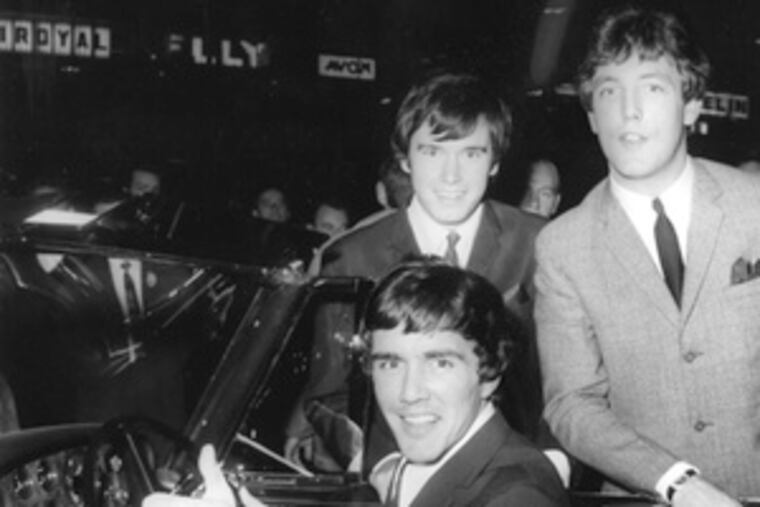
The Dave Clark Five: British Invasion band that scored 15 consecutive Top 40 U.S. singles. The band's lead singer, Mike Smith (far right), died Feb. 28.
The Ventures: The most successful instrumental combo in rock history, known for "Walk - Don't Run" and "Hawaii Five-O."
Sidemen
Little Walter: Harmonica virtuoso who was a key member of bluesman Muddy Waters' '50s band.
SOURCE: Rock and Roll Hall of FameEndText