Combating 'shame' of blindness
Sabriye Tenberken has experienced firsthand the prejudice that blind people are subjected to in her adopted homeland of Tibet. She has heard the curses directed at students from her training center, Braille Without Borders, when they venture out on the streets of Lhasa.
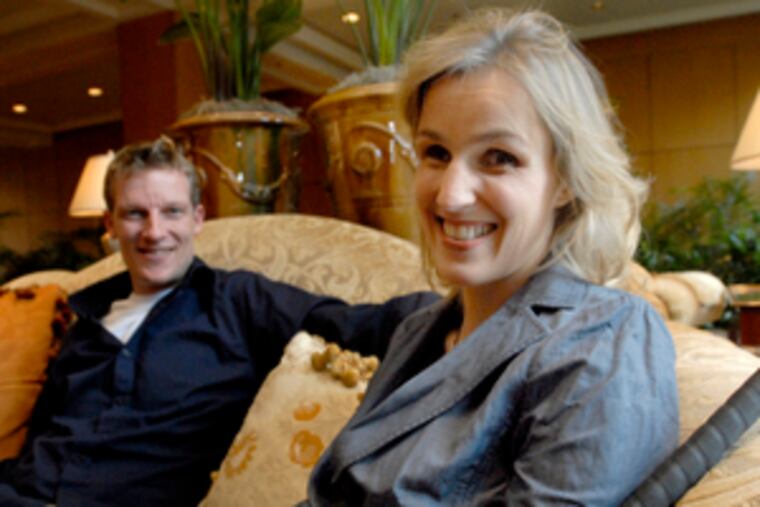
Sabriye Tenberken has experienced firsthand the prejudice that blind people are subjected to in her adopted homeland of Tibet. She has heard the curses directed at students from her training center, Braille Without Borders, when they venture out on the streets of Lhasa.
This shocking treatment stems in part from ignorance and in part from religious beliefs in this Buddhist country.
There is a remarkable scene in the new documentary
Blindsight
, capturing the attempt of six of Tenberken's blind students to scale a 23,000-foot peak in the Himalayas, that shows a Tibetan boy musing about the crimes he must have committed in a previous life to have earned the terrible karma of blindness.
But according to Tenberken, who went blind at 12, she encounters discrimination in Europe and the United States that is just as distressing, even if it is more subtle.
"They think blind people are a little bit more backwards or stupid," she said in a leafy hotel lounge during a visit to Philadelphia this week. "They talk very loud and very exact to them."
"When I'm traveling with Sabriye," says Paul Kronenberg, Tenberken's sighted partner in the foundation and in life, "they don't communicate directly with her. They always speak to me. 'Is she hungry?' I'll say, 'You know, she can speak.' "
As detailed in her book,
My Path Leads to Tibet
, Tenberken, 37, has been a tireless fighter for more than a decade against the strictures placed on the blind. But taking blind teenagers mountain-climbing?
"These kids come from the mountains," she says. "They have to learn the terrain of uneven paths, paths with rocks rolling under your feet, paths encrusted with ice. It's like a blind kid in Philadelphia. He has to manage traffic, the subway and weird people coming up to him."
She knows whereof she speaks. At 16, she came to Philadelphia for a yearlong English immersion course at the Overbrook School for the Blind. She lived with a host family in East Falls and traveled by herself for classes, an hour each way, taking SEPTA buses.
She acquired that fierce independence in her native Germany at a boarding school that stressed demanding academics and rigorous athletics, including solo white-water rafting.
The teachers would run down the riverbanks shouting warnings. "Go right!" or "Rock!" "Of course you couldn't hear them because of the waves," says Tenberken. "Those were precious experiences."
She wanted to volunteer for a relief agency, helping the disadvantaged in developing countries, but was repeatedly turned down.
"I asked them, 'Can you imagine [sending] a blind person into the field?' and they said, 'No! No way! We couldn't for security reasons,' " she says. "But when you are a blind person, you hear this all the time: 'This is not possible. That is not possible.' And at a certain point you stop listening to that."
She studied Tibetology at the University of Bonn and created a Braille system for Tibetan, which had not previously existed. After establishing her training and educational organization (
» READ MORE: www.braillewithoutborders
.
org) in Tibet, she traveled the country alone on horseback.
"I had the chance to go to really really remote villages and to find children that were blind," she says. "I found children that were 4 and 5 years old that were tied to the bed because the parents didn't know their blind child could walk. Some children had never learned to talk because the parents didn't talk to them because the parents believed that blind is also mute. Some children were hidden away in dark rooms."
Two common causes of blindness in Tibet are overexposure to UV radiation from high-altitude sunlight and cornea infection from the thick soot residue of burning yak dung, which rural families use as heating and cooking fuel.
"I don't believe in schools as much as I believe in training centers to give blind children daily living skills so they can go to regular schools," says Tenberken. "What is much more important is that they overcome the shame. 'Hey, guys, you cannot tie me to the bed; you cannot hide me away. I'm an equal human being. I'm blind. So what?' "
The 2004 climbing expedition seen in
Blindsight
was an extreme example of that. As Tenberken explains, "We are never overprotective of our kids. They climb trees. They go kayaking. They are traveling the world on their own."
"They go out in traffic in Lhasa," says Kronenberg. "That's much more dangerous than any mountain."
Movie
Blindsight
Opens tomor- row at Ritz at the Bourse