Scorsese finally bags the Stones
The director talks of his concert film and his career-long fondness for the group.
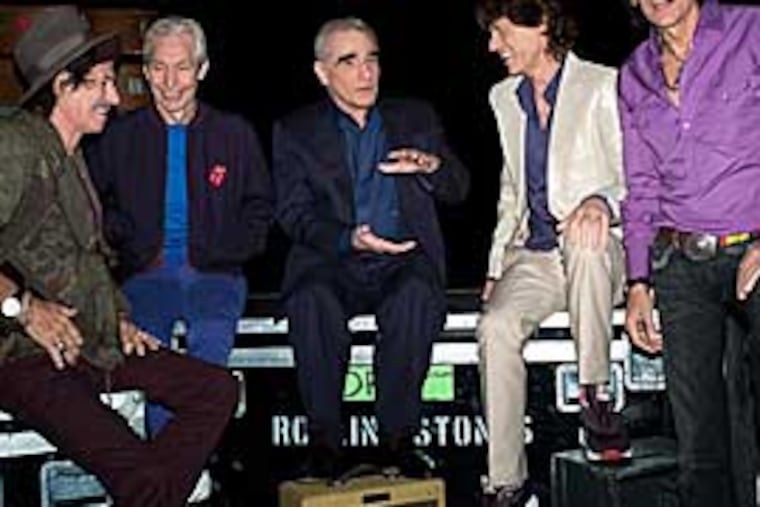
Martin Scorsese got his wish.
Not to win an Oscar, which the director of Raging Bull, Taxi Driver and The King of Comedy did with The Departed, in 2007.
No, it was something more important. With Shine a Light, opening Friday, he finally got to make his Rolling Stones movie.
Stones music has been as much of a constant in Scorsese's films as Robert De Niro. He's made use of "Gimme Shelter" so many times Mick Jagger recently joked that Shine a Light was the first Scorsese movie that didn't feature the song.
The themes of American identity Scorsese has examined in violent dramas he's also explored in music movies like The Last Waltz (1978) and No Direction Home: Bob Dylan (2002).
But the 65-year-old director never corralled the Stones until he shot two concerts at Manhattan's Beacon Theatre in November 2006 for Shine a Light. Along with Jagger, Keith Richards, Ron Wood and Charlie Watts and their backing ensemble, it features the White Stripes' Jack White, bluesman Buddy Guy, and Christina Aguilera.
It's a concert film with a smattering of interview footage that captures the wrinkly, but still virile-sounding band mixing classics such as "Satisfaction" with obscurities like Muddy Waters' "Champagne & Reefer."
Scorsese recently talked about the Stones, movies, and music by phone from Boston, where he's making a movie based on a Dennis Lehane novel, starring Leonardo DiCaprio, Ben Kingsley and Michelle Williams.
Question: So you're about the same age as the guys in the Stones.
Answer: Apparently, yeah. I never think of that, you know. They're the Rolling Stones and they're still performing.
Q: You came of age listening to them.
A: I grew up listening to them and still do. So much of what I do in film comes from listening to their music over the years. . . . So a lot of their music became part of my DNA. I use music a lot to infuse, or inspire, I should say, scenes, camera movements, the way I shoot a picture, the energy that goes into a film.
Q: What about the Stones was so powerful for you?
A: When I was growing up, the first music I remember hearing was Django Reinhardt, the Hot Club of France, Stephane Grapelli. My father's records. And I remember seeing images coming from those sounds. It's the same thing with the Stones. Jagger's vocal, in a way, sounded like an instrument.. . . And a lot of it, too was that in the late '50s, early '60s I got to see the Threepenny Opera in New York, Off Broadway. Kurt Weill and Bertolt Brecht. And I became fascinated by that music and listened to it constantly.
Q: And the same thing happened with the Stones?
A: Their music hit me the same way. The music and the lyrics and the message and the tone. It had a street truth to it.
Q: Do you know about Sway, Zachary Lazar's novel about the Stones in the '60s? It's the Satanic-era Stones, but it's about filmmaker Kenneth Anger, whose 1965 experimental film Scorpio Rising uses music by Elvis Presley, Bobby Vinton, Martha and the Vandellas.
A: Well, Kenneth Anger's Scorpio Rising . . . was the first time I realized you could have access to popular music for a soundtrack. Because at that time, we couldn't use the music of our time, because we couldn't pay the rights.
And yet, I knew that if I got to make a film and I had to rely on conventional scoring, I couldn't do it. . . . Primarily, my soundtracks are known for the music that I put together myself. I could never fully feel comfortable with a scored film, because I don't come from that era.
Q: Is there a typical kind of scene or mood a Stones song is perfect for?
A: It depends, but there's a certain drive in their songs. A certain provocation. A kind of energy. Certainly an edge. You can go back to [1965's] "The Spider and the Fly," which is like Kurt Weill to me. All the way up to "Gimme Shelter," which is as pertinent today as when I was first written. Up to "Back of My Hand."
Q: Talk to me about the faces of musicians. I watched The Last Waltz, and I was thinking about the way Levon Helm and Robbie Robertson looked then, and the way they look now. And the same thing with Mick and Keith.
A: It shows you a life that's been lived. And a life that's living still. . . . And it reads on their faces, it reads in their movements, their bodies, their very souls are up there on screen. You look at Keith's hands as he plays the guitar, you look at Jagger's eyes. The lines in his face.
Q: This movie is really a different kettle of fish than The Last Waltz . . .
A: . . . or No Direction Home. It really is. But for me, all I can say it was an obsession to get the Rolling Stones in performance on film. I simply wanted to do my best for their music. It's something I always wanted to do.
For a full version of this conversation, visit http://
go.philly.com/inthemix.EndText