Art: Taking Botero seriously
Fernando Botero, who will be 76 in two weeks, caught the art world's collective eye a half-century ago, yet his art is so idiosyncratic that it continues to defy definitive analysis. I, for one, have never been able to decide whether the Colombian native is a sly and exceptionally deft satirist or a market-savvy merchandiser.
Fernando Botero, who will be 76 in two weeks, caught the art world's collective eye a half-century ago, yet his art is so idiosyncratic that it continues to defy definitive analysis. I, for one, have never been able to decide whether the Colombian native is a sly and exceptionally deft satirist or a market-savvy merchandiser.
After seeing the Botero exhibition at the Delaware Art Museum, I'm only slightly less ambivalent. This traveling show of about 100 paintings, drawings and sculptures suggests a third interpretation - that Botero is deadly serious. He wants us to accept his contemporary "baroque" exaggerations of traditional visual language at face value, as homages to such titans as Diego Velázquez and Piero della Francesca, and as his entree into their distinguished company.
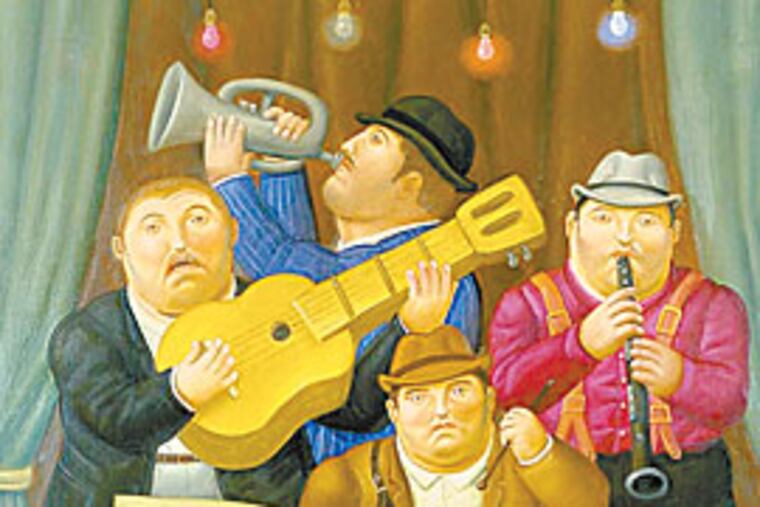
Botero is the artist who visualizes human figures inflated to the proportions of parade balloons - sausage limbs, porcine bodies, melon heads - usually with vacant expressions. Why would a serious artist exaggerate so grotesquely except as caricature? This, at least, is the immediate impression the paintings make.
But wait - one painting, The Widow, portrays the artist's mother and her three young children, including himself. This, like many pictures in the exhibition, is large, nearly 7 by 6 feet. Why would an artist of Botero's considerable talent and skill transform his widowed mother into a female Fatty Arbuckle? Certainly not as a joke, or even for commercial exploitation. So perhaps we should presume serious intent.
Before taking another step into this conundrum, I should mention several things about this show that make me uneasy. First, every work belongs to Botero - highly unusual, to say the least, especially in a museum presentation on such a scale. Vanity exhibitions fit this model, although this show was organized by Art Services International of Virginia.
Second, although Botero has been painting since the 1950s, the show concentrates on the last two decades. There is some earlier work, particularly Homage to Ramon Hoyos, a cyclist, and The 20.15 Massacre, that are darker and more disturbing than superficially bland figures such as The First Lady.
These paintings indicate that Botero is a more complex artist than his signature images would have us believe. Better balance between such earlier, more expressive work and the recent paintings would help an audience being introduced to Botero to make sense of his evolution, and especially of his later style.
The older paintings reveal the artist with a darker side. To be fair, this impulse doesn't disappear in later pictures, as we can see in Woman Falling From a Balcony of 1994 and Earthquake of 2000. Still, evocation of catastrophe in a caricaturing style seems incongruous.
Third, the show comes with a fat catalog published by Yale University Press, yet the essays are more promotional than edifying, and contribute relatively little to understanding the artist's motivations and intentions.
Even with these caveats, "The Baroque World of Fernando Botero" is a worthwhile experience, although - or perhaps because - it fails to resolve the enigma. In either event, it offers some delicious painting, especially in still lifes and some figurative/genre groups such as The Orchestra, The Street and the brothel scene titled The House of Marta Pintuco. The latter two are resonant of the equally enigmatic French artist known as Balthus.
In particular, The Orchestra, four musicians onstage, demonstrates how Botero can inject a vague psychological edge into a scene that otherwise looks vapidly ordinary - perhaps the defining quality of Balthus' art. Picnic, a sleeping man counterpointed against a lush tabletop still life and a spouting, distant volcano, projects a similarly disquieting mood.
The few still lifes may be Botero's most piquant images. The suggestively Cubist Still Life With Mandolin effects a startling transformation of this familiar genre; the massive instrument appears to be carved from honey-colored marble. Technically, Pear also is a still life, although it could also be read as a portrait or landscape. A gargantuan fruit fills the canvas, its bronze skin nearly perfect except for a tiny bite out of one edge and two wormholes (and one worm).
Many paintings appropriate images by famous artists from Piero to van Gogh - as homages, one hopes - or portray artists Botero admires. These are of far less interest, in large part because it's hard to see their point. In fact, restatements of such classics as La Infanta Margarita by Velázquez and van Gogh's Sunflowers remind one that Botero's mature style can easily come to seem mannered and tiresome.
One quality is impossible to gainsay, though - Botero is a sensitive and charming colorist. His colors are bright, harmoniously cheerful and ingratiating; they should send you out of the museum thinking of Latin American sunshine and gaiety.
Rare encounter
Elihu Vedder (1836-1923), an American painter, muralist and book illustrator identified with the symbolist movement, doesn't receive much attention these days, which is understandable. Even in the 19th century, he was known as a mystic who created fey, visionary images that today look archaic.
His most famous paintings include The Roc's Egg, The Lair of the Sea Serpent, and The Questioner of the Sphinx. But he is perhaps best remembered today for the illustrations he created for Edward FitzGerald's translation of the Rubáiyát of Omar Khayyám published in Boston in 1884.
Khayyám was a 12th-century Persian mathematician and astronomer who wrote about a thousand often-enigmatic quatrains about youth, life, death, rebirth and the transience of existence. Perhaps the most famous of these contains the lines, "A book of verses underneath the bough / A jug of wine, a loaf of bread, and thou."
Given its themes, the Rubáiyát was an ideal commission for Vedder, who was given to the same sort of melancholy musings. Working in chalk, pencil, ink and watercolor, he produced his drawings between late spring 1883 and early spring 1884. They were reproduced in the bound book by a photo-transfer process using gelatin plates called Albertype, which closely resembles lithography.
More than 50 of Vedder's original drawings, augmented by several oils, are on view at the Brandywine River Museum through May 18. The oils all come from the Smithsonian American Art Museum.
Vedder reproduced the verses by hand on the corresponding illustrations. The drawings are near-monochrome, highly detailed and evocative of the 19th-century Aesthetic Movement, which extolled beauty for its own sake in art and decoration.
While the drawings are indeed conventionally beautiful, the verses are darkly introspective. Images of angels, maidens, philosophers and religious scholars amplify meditations on the role of fate in human existence.
Vedder's drawings, like FitzGerald's translation, have come to be regarded as classic for their time and place. Light-sensitive, they are not regularly exposed to public view. The Brandywine show is a splendid opportunity to make their acquaintance, and that of Vedder as well.
Art: Inflated, Not Fat
"The Baroque World of Fernando Botero" continues at the Delaware Art Museum, 2301 Kentmere Parkway, Wilmington, through June 8. Hours are 10 a.m. to 4 p.m. Tuesdays through Saturdays and noon to 4 p.m. Sundays. Admission is $10 general, $8 for visitors 60 and older, $5 for college students, and $3 for visitors 7 to 17. Through June 8, visitors who present ticket stubs from the Frida Kahlo exhibition at the Philadelphia Museum of Art will be admitted at half price. Information: 302-571-9590, 866-232-3714 (toll-free) or www.delart.org.
EndText