'Norma': Valiant attempt at the impossible opera
Few are called; almost none are chosen. So it is in the most crucial elements of Bellini's Norma, so that by the end of the Opera Company of Philadelphia's thoughtful, serious endeavor to bring it to life Friday, the piece seemed a bit impossible. Making Norma dramatically convincing is tough; vocal casting is tougher. Success was only intermittent on both fronts. Part of the problem is that Norma allows no good marks for getting halfway there. It's either there or it's not.
Few are called; almost none are chosen. So it is in the most crucial elements of Bellini's
Norma
, so that by the end of the Opera Company of Philadelphia's thoughtful, serious endeavor to bring it to life Friday, the piece seemed a bit impossible. Making
Norma
dramatically convincing is tough; vocal casting is tougher. Success was only intermittent on both fronts. Part of the problem is that
Norma
allows no good marks for getting halfway there. It's either there or it's not.
Relatively speaking, this was one of the better
Norma
productions I've seen live. But then, my frame of reference was a Baltimore Opera production years back in which static moments in this tale of Roman-era Gaul were artificially animated by falling snow. The Metropolitan Opera's current production is all shiny, glassy and abstract, like a high-end Marriott Hotel.
OCP's set designer John Conklin had a scorched pine forest in Act 1 (suggesting the work of the repressive Romans) and the Peruvian Andes in Act 2 (suggesting the primitive wildness of the repressed Druid culture) that were suitably atmospheric, while stage director Kay Walker Castaldo attempted to give context to the unlikely romance between Roman general Pollione and his enemy's high priestess, Norma, with mimed battles during the overture. These kinds of touches can help a Puccini opera with iffy casting, but not this one. In fact, sets aren't needed at all when Norma reaches the level of performance the opera requires.
And that's the hardest part - achieving that level of performance.
Conductor Corrado Rovaris was ready for galvanization with a lean, vital approach to the score, rock-solid playing from the orchestra, and pulse-racing tempos that felt completely right, even giving an edge to what can seem like an endless succession of funny little Italian marches that cover entrances and exits. But orchestra is only a frame for the concentrated vocal lines, which is where the storytelling truly lies. As Pollione, Philip Webb was more than adequate, though workmanlike, and Eric Owens was suitably grave in the thankless role of Druid leader Oroveso.
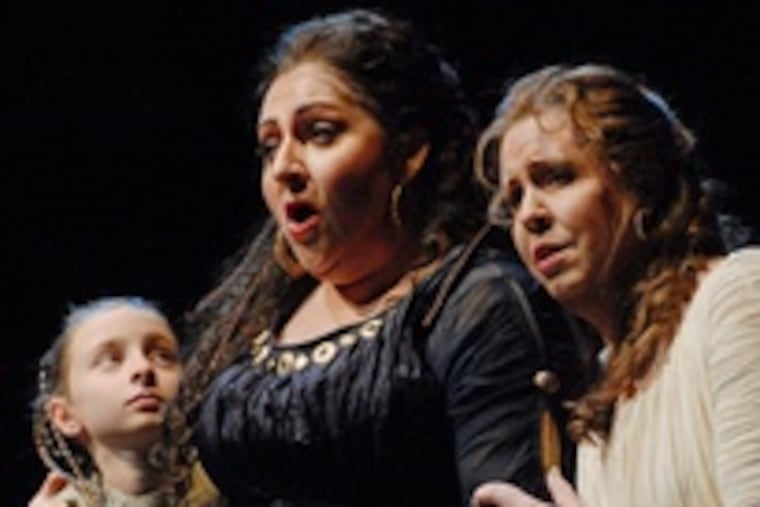
The two female roles, Norma and her confidante Adalgisa (who alternately vie for and resist Pollione's affections), are what make the opera, and though they threw off some good dramatic sparks in Act 2, they were an odd vocal match.
As Norma, Christine Goerke sounded like a thoroughly displaced Wagnerian. Those dramatic upward leaps that create such an exciting crest to a phrase were consistently and considerably under pitch. Great Normas have been hugely inaccurate, Gina Cigna for one. But Goerke's upper range rarely bloomed, hampering her expressive potential, and the words, crucial to this opera, sometimes seemed bottled up inside her large (and often marvelously rich) sound, detracting from the performance's rhetorical success. Phrasing had a sameness - unlike lighter-voiced Kristine Jepson, whose Adalgisa had many fine moments when text and phrasing achieved a unified and powerful expression, and others that left you wanting even more expressive precision.
I'm tempted to say, "Oh well, some day . . . . " Then again, these singers are of a caliber that by the end of the run, they just might pull it off.
Norma
Music by Vincenzo Bellini. Libretto by Felice Romani. Conducted by Corrado Rovaris, directed by Kay Walker Castaldo, set design by John Conklin, costumes by Richard St. Clair.
Cast:
Eric Owens (Oroveso), Philip Webb (Pollione), Christine Goerke (Norma), Kristine Jepson (Adalgisa), Allison Sanders (Clotilde)
Performed at
the Academy of Music Wednesday, Sunday, April 16 and April 18. Information: 215-732-8400 or
» READ MORE: www.operaphilly.com
.