Art: A less-celebrated Mexican talent
Juan Soriano comes to the Philadelphia Museum of Art, the first exhibition of his work in a major American museum, as an adjunct to fellow Mexican Frida Kahlo, more famous than he but not necessarily more talented.
Juan Soriano comes to the Philadelphia Museum of Art, the first exhibition of his work in a major American museum, as an adjunct to fellow Mexican Frida Kahlo, more famous than he but not necessarily more talented.
The pairing of Soriano with Kahlo emphasizes the museum's long-standing interest in the art of Mexico and Latin America, of both colonial and modern periods. As testimony to this, two photographs in a special issue of the Museum Bulletin that serves as a catalog for the show depict Art Museum curator Henry Clifford photographing the artist in 1943.
Soriano (1920-2006) isn't as well known in the United States as Kahlo or Diego Rivera and the other Mexican muralists, in large part because he lived in Mexico until 1950 and for extended periods in Europe thereafter. Yet based on this modest sampling of 16 early works, he deserves wider attention.
In paintings such as
Dead Girl, Guardian Angel
and
Children Playing,
he exhibits an appealing combination of realism, romantic fantasy, an occasional breath of surrealism, and intense poetic engagement with the emotional dimension of life.
Even when addressing morbid subjects, as he does in
Dead Girl
(there's a similar painting in the Kahlo show), Soriano does so through visual language - particularly his soft colors - that's uncommonly tender, even soothing. There aren't any rough edges in Soriano, as there are in Kahlo, nor any overt proselytizing for Mexican culture. His art embodies a Latin sensibility, but the mood is more feminine than macho.
Only one painting among the 16 might strike some viewers as mildly shocking (I found it startling in its audacity): the picture called
Saint Jerome.
In Soriano's interpretation of this traditional Roman Catholic theme, the bearded penitent in the wilderness gives way to a seductively erotic male nude lounging in a bedroom. A skeleton reflected in a mirror behind the man completes a triple allusion to death, eroticism and religion.
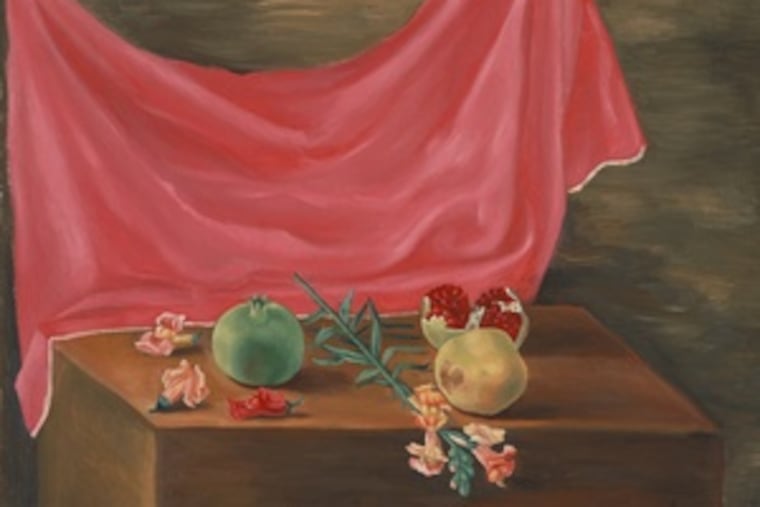
Lush still lifes such as
Children Playing
can feel as intensely symbolic as any 17th-century Dutch vanitas, especially when they're as meticulously rendered as
Still Life With Insect,
featuring a withered flower, or the still life composed of pomegranates, lilies and carnations against a flaming pink backdrop. In the latter, the mood is more Spanish than Dutch.
From these paintings and the mystical
Guardian Angel,
in which a nude youth's fall from a balcony is arrested by a winged male angel, one surmises that Soriano experienced emotions profoundly. Intense feeling married to precise craft characterizes all the paintings, regardless of subject.
Curated by art historian Edward J. Sullivan of New York University, a friend of the artist, the show covers the years 1935 to 1950, when Soriano lived in his native Guadalajara and then in Mexico City. Consequently, it most strongly reveals how indigenous culture influenced his art. The title of the show, "Fragile Demon," aptly encapsulates the qualities that make this art such a rewarding discovery.
An American original.
Benjamin West might not have been a painter for the ages, but during nearly six decades working in London he established, through his example, that native-born Americans could hold their own with their British colleagues.
This was a major breakthrough, and it was achieved by a painter who rose improbably from the humblest of beginnings to the pinnacle of the British art world.
The trajectory of West's career was remarkable by any measure. The painter who never attended art school eventually became president of the most prestigious art academy in London. The colonial rustic born on a farm in what is now Swarthmore became the favorite painter of King George III.
West is remembered today for a handful of iconic images that purport to immortalize significant moments in history, such as the death of British Gen. James Wolfe at the Battle of Quebec and the negotiation of William Penn's famous treaty with the Indians.
Perhaps the most impressive aspect of West's career is that he was essentially self-taught. He had some informal basic instruction in Philadelphia, but he taught himself to draw by copying Renaissance masters during a residence in Italy, from 1760 to 1763.
As we see in an exhibition of West's drawings at Woodmere Art Museum, he mastered academic drawing but didn't become an inspired draftsman. Nothing in this show of 60 drawings from the collection of Swarthmore College will turn your head.
West's drawing often feels slightly tentative, and lacks the robustness, fluidity and assurance one finds in masters such as Raphael, who likely was one of his models.
Yet, one must take into account that many of these drawings, most executed in ink or conté crayon, are sketches for paintings, either single figures or densely populated compositional tableaux, such as
Deputations Before a Roman Emperor.
There also are a few portraits, such as one of Swiss painter Angelica Kauffmann, and detailed studies of heads and hands, all typical of art practice of the time. One of the more charming images depicts a grazing donkey, while one of the more stirring is the contorted horse's head that animates the painting
Death on the Pale Horse.
West set up as a portrait painter in London in 1763 but subsequently became better known as a history painter who drew his morally instructive subjects from the ancient world, the Bible, and even from contemporaneous events. He was not especially inventive except in one respect; in
Death of Wolfe
he painted the participants in contemporary dress instead of the usual togas, a radical departure that transformed history painting.
There aren't any recognizeable Wolfe drawings in the show, but there are some for other famous West canvases, such as
Agrippina Arriving at Brundisium with the Ashes of Germanicus
. There is also a moving head of a bearded man drawn in conté and white chalk, one of several studies for
The Ascension
.
"Hail Sacred Genius," curated by Woodmere's W. Douglass Paschall, is a demanding show for several reasons. Many drawings represent fragments of larger compositions, so it helps to know something about his work.
As in all drawing shows, gallery illumination is relatively dim, and many drawings are done on dark blue or brown paper, making the outlines difficult to read. Still, this is an exceptional collection of material by a local artist of some importance, and well worth a little time and patience.
Clearing the record.
All the drawings in the exhibition "Elihu Vedder and the Rubáiyát of Omar Khayyám," at the Brandywine River Museum through May 18, were lent by the Smithsonian American Art Museum in Washington, D.C. The oil paintings were lent by other museums and private collections.
Art: Mexican Charmer, American Striver
The Juan Soriano exhibition continues in Gallery 181 at the Philadelphia Museum of Art, Parkway at 26th Street, through May 11. Hours are 10 a.m. to 5 p.m. Tuesdays through Sundays and to 8:45 p.m. Fridays. Admission is $14 general, $12 for visitors 62 and older, and $10 for students with ID and visitors 13 to 18. Pay what you wish Sundays. Information: 215-763-8100, 215-684-7500 or
» READ MORE: www.philamuseum.org
.
Benjamin West drawings from Swarthmore College remain on view at Woodmere Art Museum, 9201 Germantown Ave., Chestnut Hill, through June 8. Hours are 10 a.m. to 5 p.m. Tuesdays through Saturdays and 1 to 5 p.m. Sundays. Free admission. Information: 215-247-0476 or
» READ MORE: www.woodmereartmuseum.org
.