Color-blind casting
Racial diversity onstage brings new dimensions to old plays, both regionally and on Broadway.
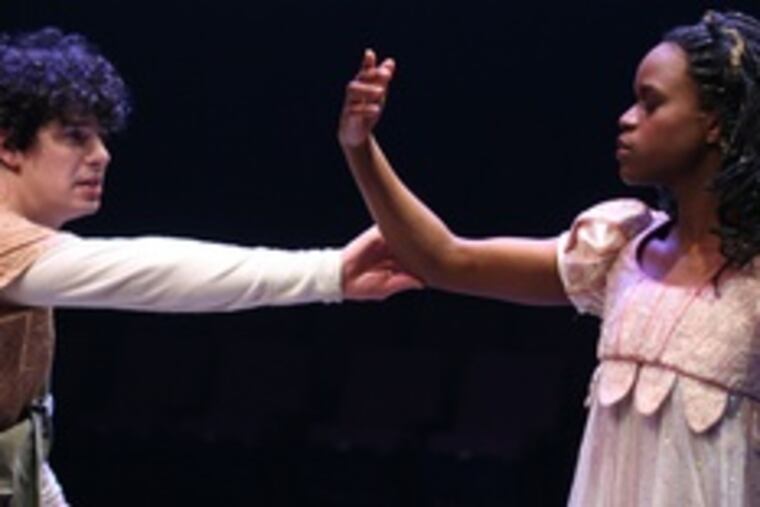
Not a word is changed, not a character rewritten, but the
Our Town
that the Arden Theatre will open in Old City this month is not exactly the white-bread slice of New England that Thornton Wilder wrote about in 1938. It's more like . . . well . . . our town: Its cast of 29 is just about split down the middle - half white, half black.
Nothing in the script has changed, either, in the backstage tale of a fallen actor and his wife called
The Country Girl
. But the Broadway revival that opened Sunday is not exactly what Clifford Odets envisioned when he wrote it for the stage in 1950, then saw it become a film with Bing Crosby and Grace Kelly. This production stars the estimable Morgan Freeman, in a mixed marriage with the equally estimable Frances McDormand.
In many professional regional theaters like the Arden, color-blind casting - putting actors in roles irrespective of race - is by now more or less a given after 20 years of building on the practice. Coincidentally, that's also the age of Arden, whose December production of
Sleeping Beauty
starred Nako Adodoadji, a black actress, in the title role. She had white parents and her costar was a white prince, David Raphaely.
Nontraditional casting - which to a lesser extent includes men playing women and vice versa, or using performers with disabilities - is not new on Broadway either, although it has been less common than in regional theater. Yet in the last year, three Broadway revivals have featured African American actors in major roles normally played by whites.
Freeman's performance in the strangely muted production of
The Country Girl
marks his return to Broadway after two decades of film acting. Although the show, directed by Mike Nichols, plays as if someone left the hand brake on, the portrayals by Freeman, McDormand and Broadway veteran Peter Gallagher are often compelling.
Earlier this season, S. Epatha Merkerson (TV's
Law & Order
) carefully constructed a portrayal of the sad, complex wife in another drama of family turmoil from the '50s, William Inge's
Come Back, Little Sheba
. And at last season's end, Broadway musical actress Audra McDonald played the rural-American daughter in
110 in the Shade
.
In all three cases, the actors' race has brought an unexpected dimension to the work; ultimately, though, a genuinely color-blind element - talent - is the reason the three portrayals are notable.
Broadway is also home to a production that's not color-blind but is markedly color-conscious. The entire star-studded cast of the current revival of Tennessee Williams'
Cat on a Hot Tin Roof
is African American, and the play, which is drawing large, enthusiastic and predominantly black audiences, points to a related dynamic on Broadway this season: an abundance of shows exploring race or the experience of American minorities.
Last night yet another arrived. Taking the stage of the Booth Theatre as if he himself had sat on the nation's highest bench, Laurence Fishburne opened the one-man
Thurgood
, about the late Thurgood Marshall, the first black U.S. Supreme Court justice.
Some shows that examine racial issues already were running when the season began.
Hairspray
, the musical about integrating a '50s teen TV dance program, has been a hit for six years;
Avenue Q
has plumbed racial and other differences for five; and the fully integrated story of
Rent
, 12 years running, is set to close this year.
The Color Purple
, author Alice Walker's Pulitzer Prize winner about an abused black girl's journey to independent womanhood, is on national tour, heading to the Academy of Music in June. The new
Passing Strange
is the hip musical tale of a middle-class black teenager from California who tries to find himself while living on the far edge of Europe's avant garde. And
In the Heights
is a hit musical that surveys a Latino neighborhood in Manhattan and the racism within it.
On Broadway, "it's a good year," says Sharon Jensen, executive director of the Alliance for Inclusion in the Arts, which recently changed its name from the Non-Traditional Casting Project. It started up in 1986 to address exclusion in film, TV and theater, and is now an established player in the arts; it consulted on two of the above-mentioned shows.
Says Jensen, a 19-year veteran of the group: "I don't know any casting director who isn't on board by now with being more diverse, or hasn't at least the will to do it. We're not there yet, but we're at the point of transformation."
Jensen notes that professional regional theaters and Broadway - two different stage animals - have reached this point in their own ways. "In a nonprofit professional theater, you have an institution that's consistent - you can establish policies. In the commercial theater, different people with different ideas and ideals come together around a given project, and stay together as long as the show is successful. You don't have a policy that can relate from one production to another."
She uses a phrase - "a healthy theater ecology" - to emphasize that color-blind casting is one strategy that also includes traditionally cast productions. "You still continue to respect a playwright's intent. There should be room for all of this."
So you're unlikely to find a white actor playing Thurgood Marshall, or a black Tevye fiddling on a rooftop - although in 2000 a Connecticut arts high school cast an African American girl in that role.
"Having freedom with the casting has just unlocked
Our Town
in a different way," says Amy Dugas Brown, the Arden's associate artistic director in charge of casting. The diverse cast, currently in rehearsal, "makes it resonate with a contemporary audience." Nineteen years ago, People's Light & Theater Company did color-blind casting of the idyllic American play on a much lesser scale, and gender-swapping, too - in addition to changing the setting from New Hampshire to its home in Malvern.
Most casting directors now appear to consider a play's integrity first. "When it's not crucial to the role, open it up to the world. We try to do that whenever we can," says Lois Kitz, casting director at Philadelphia Theatre Company. The company, in its 32d season, has always employed color-blind casting, and in 1989 cast African Americans in Terrence McNally's two-character
Frankie and Johnny in the Clair de Lune
.
Its production of Wendy Wasserstein's college drama,
Third
, which just closed, cast African American actress Melanye Finister, a member of the People's Light troupe, in a major supporting role. "I read the play a couple of years ago and really liked it," Finster says, "but I never imagined me in it. That's just how we limit even ourselves."
"We have seen a change," she says of diversity on stage, in the audience - and in America, too. "Here, we have the first woman and the first African American in a heated presidential race. When you take the temperature of the country, you can extrapolate a different sense of the world, that maybe we're ready to embrace some bigger ideas that are more inclusive. Something is evolving. We're growing up a little bit."