Art: Medium messes up Mike's message
After seeing the brief orientation video, a six-minute sampler of what awaits in the gallery beyond, anticipation for "Mike's World" is high. The highlight piece makes the new exhibition at the Institute of Contemporary Art and the artist it features, Michael Smith, look appealing. As I stepped through the curtain, I expected to enjoy this show.
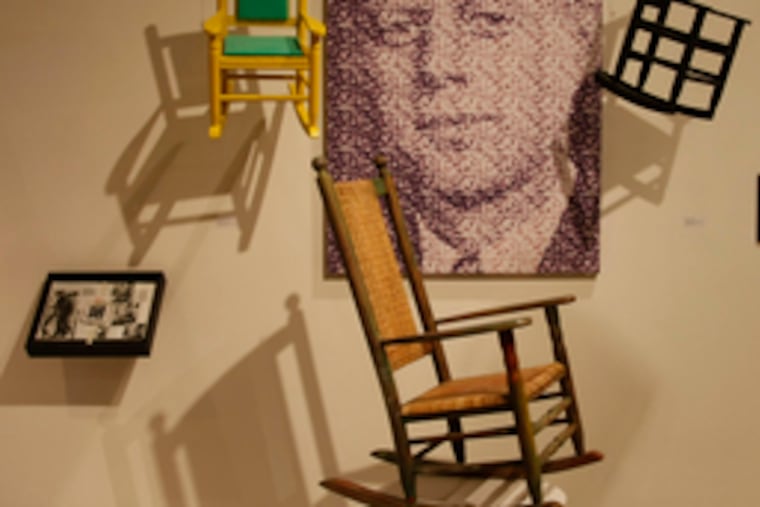
After seeing the brief orientation video, a six-minute sampler of what awaits in the gallery beyond, anticipation for "Mike's World" is high. The highlight piece makes the new exhibition at the Institute of Contemporary Art and the artist it features, Michael Smith, look appealing. As I stepped through the curtain, I expected to enjoy this show.
As it developed, I did and I didn't, not so much because of Smith, who knocks himself silly creating the long-running role of a genial but witless shlimazl. The problem is the medium, a museum installation. Smith is essentially a performer, a sketch comic even. Television, if not the stage, is his ideal medium.
The ICA exhibition contains a multitude of videos, but they run simultaneously, in parallel. As a result, the persona of Smith's character comes across as fragmented, so one has to wrestle the pieces together. Beyond this, the videos compete for one's attention with the profusely detailed installations that function as context. In a way, each distracts from the other.
The individual installations are, in fact, so elaborate that one needs to spend considerable time in the gallery to become engrossed in them. It's not a question of watching every minute or of memorizing every detail and noticing all the objects - the section called 2Mus-Co 1969-97 must contain thousands - but a matter of letting the ethos of "Mike's World" infiltrate every atom of your consciousness. Only then are you prepared to appreciate Smith's flatfooted humor and sly cultural critiques.
Total enlightenment is difficult to achieve, and not just because few people have sufficient discretionary leisure but because the noise level in the gallery, from the videos and animated pieces such as the multimedia sculpture Take Off Your Pants, is loud and unremitting. Just keep in mind that "Mike's World," like much of what the ICA programs these days, is age-specific. Young people weaned on television, video games and multitasking should settle in comfortably. Print-generation types are more likely to become annoyed and disoriented.
The Mike in "Mike's World," the bumbling loser who usually misses the boat or even the wave that propels it, isn't an incarnation of Smith, who describes his protagonist as a Candide character who fails repeatedly to make himself hip, popular and financially successful. The discrete segments that make up the exhibition, which was organized at the University of Texas, reprise his various projects since the 1970s. Some of these were created with collaborators, particularly director and producer Joshua White.
Born in Chicago in 1951, Smith is a New York artist now teaching at the University of Texas. One video is a sales pitch for the SoHo loft in which he lived and worked for more than 20 years. In most of his videos, his comic style is laconic or, as he describes it, bland. In one memorable sequence, Mike dons a new powder-blue leisure suit and practices pelvic thrusts as he prepares for a night of disco fever.
Mike appears to have discovered disco just as the trend-setters were abandoning it. This explains the failure of his theatrical lighting company, Mus-Co (combining Music and Color), which he hoped would capitalize on the disco craze. You can relive those halcyon days in the elaborate Mus-Co section of the show. You might discover that, as with the leisure-suit video and a fallout-shelter snack bar, much of Smith's humor and social commentary seems dated and banal, or even sophomoric.
That's one of the exhibition's problems. The other is the mistaken belief that exceptionally detailed settings - Mus-Co is the obvious paragon here - translate into anything beyond fascination with the stupendous amount of effort needed to create them. There isn't anything especially humorous or transcendently symbolic in the office of a commercial lighting company that has been recreated down to the last paper clip.
The only one of Smith's tableaus that seems fresh and piquant is The QuinQuag Arts and Wellness Centre Touring Exhibition, perhaps because it dates from early in this decade. QuinQuag, which requires considerable reading on your part, purports to tell the story of an artists' colony near Woodstock, N.Y., founded by a wealthy woman. It's supposed to be fictional, but to me sounds suspiciously like the real-life Arts and Crafts colony Byrdcliffe.
"Mike," who made money in the dot-com boom, buys the property; the tableau represents his proposal to transform it into a "wellness center," whatever that means. Naturally, we expect the dream to fizzle.
As we encounter Mike in the various scenarios that Smith has created for him, he comes across as a victim of life's unpredictable vicissitudes, as most of us are. This epiphany would have been far more pointed if, for a museum presentation, the retrospective had been compressed into a large-screen film or video, which would have enhanced its performance character and made the narrative more coherent. As it is, the show is more a comedy midway that periodically reminded me of SCTV, except that both its satire and its humor are far less punchy.
An Even More Youthful Vision. Speaking of age-specific, Trenton Doyle Hancock's installation in the ICA's upstairs project room and along the ramp carries us one, or perhaps two, generations closer to current art's preoccupation with gothic fantasy, almost certainly derived from video games and comic books.
Hancock, born in 1974 and holder of an M.F.A. from Tyler School of Art, tells a story of deadly combat between two mythic species, the human-plant hybrids called Mounds and the mutant-ape Vegans. In the project room, filled with fascinating and beautifully executed if slightly repellent drawings, paintings and small sculpture of fake food, this enmity is barely evident. In fact, you'll be lucky to make much sense of it at all.
Hancock's full, lurid vision emerges more floridly in the wallpaper with which he has lined the ramp that connects the upper and lower galleries. The paper is not only densely packed with text and images, it's fluorescent and, when viewed through special glasses, three-dimensional. The wall is said to be particularly dramatic at night, when illuminated by black lights.
As with Michael Smith, one has to admire the high level of imagination and energy that brought this work into the world. However, one also wonders, how far down the age scale are visual artists like Hancock prepared to go? He seems determined to pitch his work to the level of movies and popular music. It seems like a disturbingly adolescent mindset for an artist in his mid-30s.
Art: Life of a Loser
"Mike's World" and "Trenton Doyle Hancock" continue at the Institute of Contemporary Art, 36th and Sansom Streets, through Aug. 3. Hours are noon to 8 p.m. Wednesdays through Fridays and 11 a.m. to 5 p.m. Saturdays and Sundays. Admission is $6 general and $3 for seniors, artists and students 13 and older. Free Sundays until 1 p.m. Information 215-898-7108 or www.icaphila.org.
EndText