In StorySlam, strangers go on stage & bare their souls
IF WHAT'S DONE in the dark will come to light, baring your soul to a shadowy room of strangers could end in disgrace. But at First Person Arts StorySlam, where 10 amateur storytellers mount a dimly lit stage to share details of intimate experiences with an audience of unknowns, it usually ends with applause.
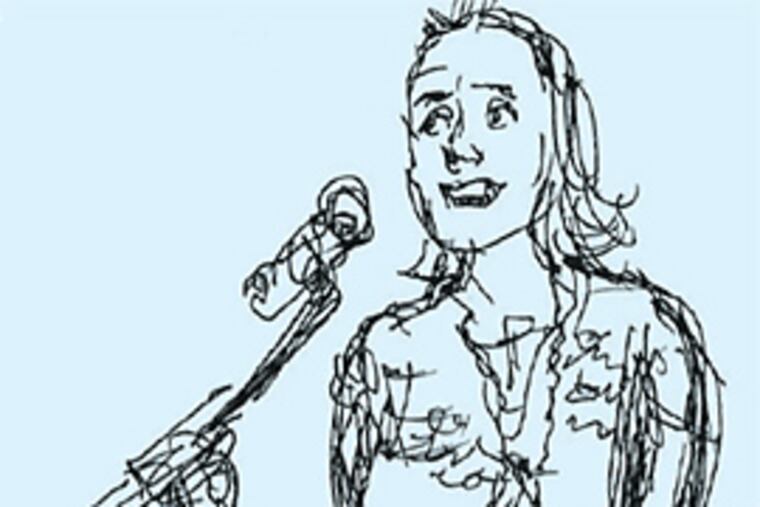
IF WHAT'S DONE in the dark will come to light, baring your soul to a shadowy room of strangers could end in disgrace. But at First Person Arts StorySlam, where 10 amateur storytellers mount a dimly lit stage to share details of intimate experiences with an audience of unknowns, it usually ends with applause.
A hybrid of a confessional and an open-mic night, StorySlam is "the most democratic" way for the average person to share experiences, says First Person Arts founder Vicki Solat.
Bravehearted volunteers - perhaps emboldened by a glass or two of wine - take the stage to tell their own original story, which must adhere to a particular theme and be less than five minutes long. Judges, who are also plucked from the audience, rate the performances on content and delivery.
At the end of the night, when nothing has been left unsaid, judges tally the numbers and the best speaker wins a chance to compete against other champions in the GrandSlam at First Person's annual memoir and documentary-art festival in the fall.
StorySlam debuted last April as a spinoff of the First Person festival. In just one year, the monthly tradition has taken on a life of its own, regularly drawing standing-room-only crowds to South Philly's L'Etage.
Themes for the stories are broad and the restrictions are few, making for plenty of variation between performances. That's how three slammers all musing on the theme of the road not taken ended up telling stories about major heartbreak in Virginia, pantless soirees in New York City and a Minnesota town called Climax.
"Sometimes the stories are very funny," Solat said. "There have been times when they've gotten a little on the raunchy side. Some are quite poignant."
The always-revealing performances have a way of uniting people from different cultural backgrounds, especially when storytellers find that their stories have more common threads than expected. At one event, Solat says, half of the performers mentioned spending their childhood on a farm.
"On the surface they all looked kind of homogeneous," she said. "You just wouldn't see in the average Philadelphia gathering so many people raised on farms, and in the same room."
As much as StorySlam has fans who keep coming back to hear the simple, juicy or sometimes tragic details of other people's lives, getting up onstage can be just as addictive.
"I always say I'm just going to watch," said South Philly receptionist Heather Dooley. "Then when I get here, I go, 'Oh, what the hell,' and I end up telling a story."
As if it isn't awkward enough airing your dirty laundry to everyone in the room, slam participants can find summaries and sometimes live video of their performances posted on the Philly-centric blog Uwishunu.com.
Despite the personal nature of the competition, sharing doesn't require self-censorship, Dooley said.
Veteran slammer Ingrid Wiese began telling stories at First Person events to quell her fear of public speaking. Ultimately, it was the idea of sharing personal details of her life and connecting with total strangers that helped her open up.
"The first minute, I don't even know what I say," she said. "The first minute, I'm completely terrified. Then it soaks in and I know that I can relax a bit, as if I'm sitting with my friends."
In February, after many practice performances, Wiese's touching anecdote about her brother's epilepsy was the slam crowd favorite.
"You feel like you're reaching out to a group," she said. "That's the special part of it. It's like your high-school class, and you're all getting to know a bit about each other and to know each other a little bit better."
Along with the popularity of reality TV and written memoirs, response to slams here and in cities throughout the country suggests a renewed interest in the art of storytelling and the authentic experiences of average people.
"Storytelling is the original form of human entertainment," said Dr. Joseph Sobol, professor and director of the master's in storytelling program at East Tennessee State University.
"It's absolutely the opposite of new and that's part of why it's so attractive," he said. "When people get tired of the new, they go back to storytelling."
The typical audience for StorySlam skews young, usually drawing folks in their 20s and 30s (and on one recent occasion a slew of high-schoolers who had to be turned away at the door because of liquor laws). Sobol says that the personal story genre resonates with younger adults because they can easily relate to the angst of discovering their own identity.
Interest in personal stories has also trickled down to traditional storytelling festivals, affairs that typically were dominated by folktales. Sobol says that professional performers have responded to audience demand by adding more first-person tales to their repertoires.
"We want to know how other individuals become themselves. Jack and the Beanstalk or Goldilocks or Tom Thumb just doesn't have that," he said.
What makes slams work so well, Sobol speculates, is that they meld the authenticity of storytelling with the most engaging elements of memoirs and reality-based media and entertainment, creating a genre that resembles "oral tradition meets reality meets poetry."
But while reality TV is often scripted, and best-selling memoirists have been disgraced for selling fake stories, part of StorySlam's appeal is that even the most incredible stories are real.
"People want to get in on the act," said Solat. "I think it's kind of thrilling. People feel like they're witnessing something that's unrehearsed and spontaneous and kind of risky."
Such authenticity threatens the success of staged art forms, says Wiese, who appeared on the reality TV show parody "Joe Schmo" long before her StorySlam debut.
"We've seen the recreations over and over, but what you can show me that's real is fascinating," she said.
"If somebody were just getting up there and reading fictional stories, it would not be as interesting." *
First Person Arts StorySlam, the fourth Tuesday of every month, L'Etage, 6th & Bainbridge streets, doors open at 7:30 p.m., slams begin at 8:30 p.m., $5-$10, 267-402-2056, www.firstperson
arts.org. May 27 theme: Secrets.