Sharing written treasures
The American Philosophical Society, long an enigmatic fixture of Independence Park, is seeking to break the centuries-old mold of its own making. Founded by Ben Franklin, the society has completed a $6 million renovation of its library.
The American Philosophical Society, long an enigmatic fixture of Independence Park, is seeking to break the centuries-old mold of its own making.
Founded in 1743 by - who else? - Benjamin Franklin, the society has just completed a three-year, $6 million library renovation and high-tech upgrade that promises to open the secrets of the private institution to both the Net-savvy digital wanderer and the peripatetic traveler in the city's historic district.
"Why have all these treasures if you don't show them?" librarian Martin L. Levitt ruminated the other day. "They're too neat."
What in the world could be neat in the bowels of the nation's oldest scholarly association, which occupies four buildings near Fifth and Chestnut Streets?
The answer is quickly apparent: Neat stuff abounds. Currently on display in the library foyer, which is open to the general public, are just a few items to whet the appetite.
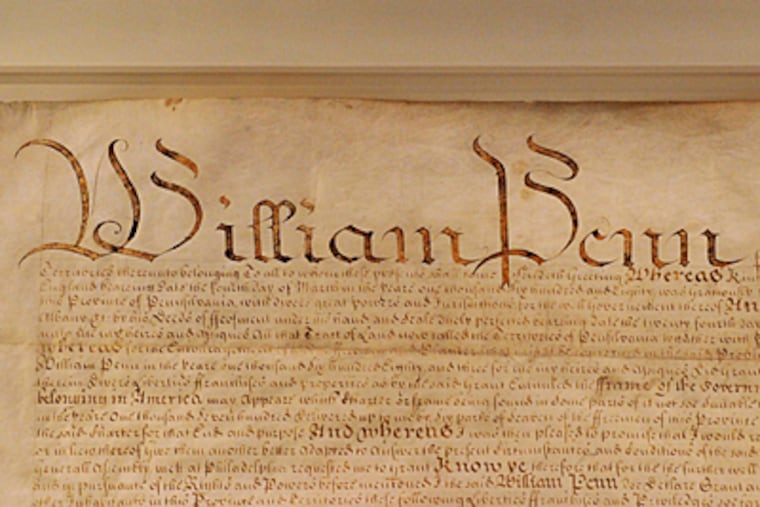
Here is a final copy of the Declaration of Independence, written in Thomas Jefferson's own hand to send to fellow Virginian Richard Henry Lee; over here are a few pages from the original journals of Lewis and Clark, deposited in the library by Jefferson. And here is William Penn's 1701 Charter of Privileges, pale ink fading but still legibly guaranteeing religious freedom.
"Pretty neat," Levitt said.
In November, an exhibition of Rebecca Kamen sculptures inspired by scientific manuscripts will be mounted.
The recently completed library renovations focused on enhancing and expanding conservation capabilities and beefing up security, fire prevention and technological systems. The upgrades, in turn, facilitate scholarly access to the collections and make it feasible to make the institution more accommodating to the public and to scholars.
Levitt, 54, who joined the library staff in 1986 and became librarian three years ago, wants just that. While the library is private and is not a circulating library, it is open to anyone who has a legitimate reason for using it. All those with university faculty or student identification are automatically admitted. Levitt does not want to turn a cold shoulder to the world.
"Reaching out is essential," he said. "In a secular nation, the journals of Lewis and Clark are our icons. If you have them, why not show them?"
Technological upgrading has not just yielded a more useable Web site (www.amphilsoc.org), it has allowed the library to begin digitizing its vast collection of images and audio materials, which will ultimately be available online. Right now, the focus is on creating digital files of about 115,000 historical American Indian images and a huge number of historical American Indian recordings (some on wax cylinders). All will eventually be searchable online.
The other day, Brian Carpenter labored at a computer in the library's new Digital Project Suite, creating computer files from a 1949 recording of a Tuscarora pipe dance. The sounds of rhythmic chanting filled the room.
"This is great for anthropologists," Levitt said. "But it's also great for Native Americans who are trying to preserve their own cultures."
The library's involvement in native languages and materials dates back to Jefferson's interest in the subject. He drew up lists of words in different tongues and sought cross-relationships between words and tribes. Some 200 years later, the library is still at it.
Scholars are the hard users of the collections, which have grown to include about two linear shelf miles of manuscripts dating back to the 18th century. The library's roughly 350,000 books and printed materials (beginning with Seneca's Opera Moralia published in 1478) are housed in what is now called Benjamin Franklin Hall on Chestnut Street.
These book and manuscript holdings will provide the grist for a planned major exhibition next year on Charles Darwin that will occupy not only the foyer of the library but the society's museum in Philosophical Hall, across Fifth Street. The society has the largest collection of Darwin materials outside the University of Cambridge.
The museum, located directly behind Old City Hall - the first Supreme Court building - began mounting exhibitions in 2003. (An exhibition exploring historical and contemporary exploration is currently on view.)
Exhibitions and online access are contemporary expressions of the society's original mission, as outlined by Franklin 250 years ago. The society was formed for the collection and promulgation of practical scientific information. That's still its purpose.
"I came here to get a Ph.D. and never left," Levitt said. "It's hard to drag yourself out."