Fortunate fathers and their offspring have warm, rich filial connections. Others struggle with relationships that are complicated, even toxic. On this Father's Day, we offer the stories of four area individuals as they recall the lessons of their fathers.
Minnie McFadden,
daughter of William Boone
Two hours after Marjorie Boone's car hit a tree last October as she was delivering dinner to two elderly neighbors, she died at Cooper University Hospital during emergency surgery. The cause of the accident has never been determined.
In that instant, her husband, William Boone, lost the love of his life, the woman who had been his wife since 1953. And his daughter, Minnie McFadden, knew that nothing between father and daughter would ever be the same.
"I rushed to the hospital and there was my father, sitting outside, slumped in a wheelchair. He was in severe shock. 'She's gone,' he kept saying to me. 'She's gone.' "
McFadden, the second of the Boones' four children, remembers with absolute clarity the very first thing she said: "Daddy, it's going to be OK. You're coming home with me."
She knew that not only was this what her mother would have wanted; it was what she herself needed to do.
That night, a new chapter began in the father-daughter story of Minnie McFadden, 54, and William Boone, 75.
One of two children whose parents migrated north from Georgia to Philadelphia, Boone graduated from Benjamin Franklin High School, served two years in the U.S. Army, and married at 20. He worked at the 30th Street Post Office for 30 years, and held down a second job, driving a truck for a private company, to provide for his family of three daughters and a son.
Marjorie and William Boone decided in the early 1960s to move the family out of West Oak Lane and to the "wilds" of Chesilhurst in South Jersey.
"My parents built our house - literally," McFadden says. "They built it together, with their own hands.
"And that was the house he just couldn't go back to after my mother died."
Suddenly William Boone had a new home, with Minnie and her husband Hartwell in Erial, Camden County.
"I told my husband that first night that I didn't know whether Daddy would be with us for a week, a month or forever," McFadden says.
And just as suddenly, the parent-child roles were reversed.
"All I wanted to do was protect my father just as he'd always protected me," says McFadden, a former librarian at Ancora Psychiatric Hospital and now a school librarian at Overbrook High School in Pine Hill.
"I wanted to shield him from his pain, even though I knew deep down that I couldn't.
"There was never any doubt that my brother, sisters and I would take care of the man who had taken are of us. I was just the fortunate one who had the privilege of having Daddy living under my roof. "
For weeks, then months, McFadden cared for her father while walking a delicate emotional tightrope.
"We're both independent people, but he was pretty lost. So I tried to do for him. I watched over him. And we grieved together with my sisters and brother."
Gradually, William Boone started returning to his life - to the church, where he had always been deeply involved, and to the home in Chesilhurst he had shared with his wife. Initially, he went there for a few minutes at a time, then a few hours.
But as he began to move ahead, McFadden wasn't ready to let go.
"I was the one who was really upset when that happened," she says. She even set up curfews for her dad.
"One night, he didn't get back here until about 11, and I was waiting for him, demanding to know where he'd been. He was out with church friends. I knew I was being overprotective and a little foolish, but I felt responsible for him."
On Mother's Day, Boone moved back to Chesilhurst and his own home - just a few miles, but light years away, from his daughter's home in Erial.
"I knew I had to let him go," his daughter says. "I knew he was ready to turn that page. Ironically, I was the one who wasn't."
"I was so happy to have my dad with me, but the hardest thing was to get my head wrapped around the idea that I couldn't really protect him. He grieves - I grieve - and life goes on."
Today, on this Father's Day, McFadden and her siblings will take their father out to dinner. He'll want Southern fried chicken and rice, his favorites. And after dinner, he'll go back to his own home.
"It's sure not the same," his daughter says. "But it's definitely where he belongs."
David Oh,
son of the The Rev. Ki Hang Oh
"For as long as I can remember, the only person I needed to please was my father," says David Oh, 48, a Philadelphia immigration lawyer and two-time candidate for City Council at-large.
Ki Hang Oh, who died in 2006, was the fourth of five brothers. He was born in 1919 to Korean parents who had fled to Manchuria in 1910 because of the Japanese occupation. By 17, he was enrolled at Meiji University in Tokyo.
"The plan was for him to study economics and political science for seven years," Oh says. "But when my grandfather died in 1939, my father took a different path and became very involved in the Christian movement, working in the ghettos of Tokyo."
Ki Hang Oh married and moved to Pusan, in South Korea, where he translated for the U.S. Army. In 1952, he emigrated to the United States to study, first at Faith Theological Seminary in Elkins Park, then at Dropsie College, and finally at Brandeis University.
Ordained in 1963, Ki Hang Oh ministered to Koreans and Korean Americans in Philadelphia for the rest of his life, insisting on a spartan existence for himself and his family, which by then included three sons and two daughters.
"Despite my frustration at times with his choice, I deeply respected my father for living a life based on faith," Oh says. As a teen, Oh says, he tested his father's limits.
"I was a terrible student, and I was a difficult and headstrong son. I loved my father, but was frustrated by his nobility."
And he was something of an angry young man.
"We were at the bottom of the barrel economically. I questioned why we had to live so humbly and in such a rough neighborhood in Southwest Philadelphia. I argued with a father who was such a devout Christian that he sometimes seemed like a foolish saint to me."
That would change as David Oh matured and learned more about the circumstances - one circumstance in particular - that shaped his father's beliefs.
He learned that in 1958, before he was born, his father's nephew had come to Philadelphia to live with the family and study at the University of Pennsylvania.
Soon after his arrival, the nephew was robbed and killed on the street by a gang of young marauders.
Despite their grief, the nephew's parents begged Philadelphia authorities for clemency for the perpetrators.
"It is our hope that we may somehow be instrumental in the saving of their souls," the murder victim's parents wrote in a 1958 letter that David Oh still cherishes. The letter requests " . . . the most generous treatment possible within the laws of your government" for the killers.
As the family's representative in the United States, Ki Hang Oh followed through and saw to it that his nephew's killers were treated with leniency.
"And that attitude summarizes the way our family lived. As an adult, I understand it and I'm enormously proud of it."
Oh is also very proud of his father's work in establishing the Philadelphia Korean Presbyterian Church, and a nonprofit social service agency for the local Korean community.
"My father may not have taken me fishing, or to baseball games, but he taught me the most amazing life lessons about charity, modesty, hard work and humility," Oh says.
That example, he says, inspired him to pursue public service.
"Now I'm a father," says Oh, whose daughter, Hannah, recently celebrated her first birthday. "All I can hope for is to be as fine a one as my own father was. "That," he says, "would be the greatest accomplishment in my life."
Sean Toner,
son of Thomas Toner
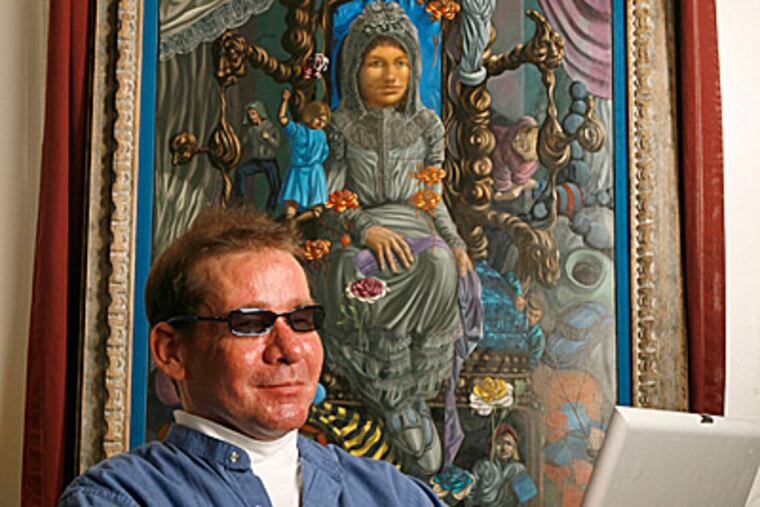
Sean Toner remembers his father, Thomas, as an artist and art historian, a man who was competitive to his core, tempestuous, unpredictable, demanding - and loving.
When Sean was 5 or 6, his dad hired some of his students from St. Louis University to go up on the roof of the family home and replicate the sounds of reindeer hooves so Sean would believe Santa had come.
"He was all about contradictions," says Toner, now 42.
Thomas Toner, one of three sons of a Sun Oil Co. executive, lettered in track and football at Malvern Prep, where he began painting. He would go on to earn simultaneous undergraduate and graduate degrees in art from the Pennsylvania Academy of the Fine Arts and the University of Pennsylvania. He married his childhood sweetheart, Drena, but they divorced when Sean was young, and Thomas Toner went on to marry five more times.
"More than anything, my dad wanted a close and warm family life, and it was the thing he couldn't achieve," Toner says. "Professionally, he was quite successful. His work was bought by prominent collectors and there were prizes. But personally, he was like a player who had been traded to a lot of teams, but never won the big game."
When Sean, a type 1 (juvenile) diabetic, was at a St. Louis boarding school, Thomas Toner insisted he compete in hockey and tennis with kids who were both far healthier and far more skilled than his son.
"He often told me that you only get better by playing tougher opponents, and he made sure that I did."
When his son needed dialysis for failing kidneys, his father dismissed it as an "oil change." When he underwent a double kidney/pancreas transplant in 1995, Thomas Toner likened it to "replacing car parts."
"But in the end, that tough love/live strong approach actually was helpful. My father taught me to absolutely expect challenges, and to finesse them."
Those challenges surely came.
In 1995, the same year as his only partially successful transplant, diabetes left Sean Toner totally blind.
"But through what may have seemed his indifference, my father had actually taught me about the relative insignificance of the body, and the message took. I accepted being blind and in some ways embraced it," says Toner, who lives in Bryn Mawr, has won or been a finalist in 14 regional and national writing competitions, and serves as vice president of the Philadelphia Writers Conference.
He is also a frequent speaker about living and working with a disability.
Thomas Toner developed adult-onset diabetes and slipped into ill health in his last years.
"After that," his son says, "he began to express admiration for how I'd handled a chronic disease, and I admit that was validating for me."
Toner says his father's legacy remains within him.
"Other than art - his painting, my writing - we didn't agree on much. But even with the difficulties, I wouldn't have had it any other way. I wouldn't be me without him as my father. For better and for worse."
Marie White Bell,
daughter of Alfoster White
He was one of seven children living on a white man's farm in southern Maryland with his parents and six brothers and sisters. But Alfoster White was given unusual access and privilege for a black child whose parents worked the land back in the early 20th century.
"My father spent a lot of time with that farmer's family, and he learned to read and write on the farm," says retired New Jersey Superior Court Judge Marie White Bell, 71, of Springfield Township, Burlington County.
"He even went to high school - segregated, of course - although he didn't finish."
By 1929, the family had come to York, Pa., where there were more opportunities. "Uncle Buck," as her father was known in the family, worked in one factory job after another until until he became the chauffeur of a factory owner. He loved that job and would keep it for most of his working life.
Married at 18 to Bell's mother, only 15 at the time, the gregarious White ultimately moved his wife and daughter to a mixed neighborhood.
"We were Italians, Lithuanians and 'Negroes' as we were called back then," his daughter says. "We lived in harmony."
The family experienced a tragedy when Marie was 7 and her 6-year-old sister Charlotte died of leukemia.
"My parents had temporarily moved us to Philadelphia so she could be treated at Children's Hospital. But they couldn't save her, and it was a devastating, terrible time for all of us."
Alfoster White slowly regained his spirit and his lifelong sense of justice. His daughter remembers a man who once even had the courage to stand up to York's all-white local police force.
"My father intervened when they attempted to arrest an old, blind black man who had unwittingly trespassed on the property of a local plant. The police hauled my father away to the local magistrate, who did release him. But I remember my father saying to me that before he died, there would be black police in York to balance things. And there were."
White moved into the political arena, becoming a longtime ward leader in York and an activist in community organizations, his daughter says. She knows her own activism comes from his.
Alfoster White also made sure his daughter read books that might inspire her, including Mary Church Terrell's A Colored Woman in a White World.
"That one," she says, "stuck with me."
Marie also was expected to learn 10 new words and their definitions from the dictionary every week. All these years later, she can still recite some of those first words: aardvark, abacus, abalone.
When she graduated from high school with honors, White proudly delivered his daughter to Lycoming College in Pennsylvania, where she was the only African American female on campus.
"You're going to have to learn to function in a white world," he told her. And she did.
When Marie White met and married Conrad Bell, a dashing young pharmacist who later became a physician, her father was delighted.
And when she chose law over her original path, research science, and then became Burlington County's first female municipal court judge in 1991, he bragged about her incessantly, the judge says.
Her father was too ill to see his daughter sworn in as a New Jersey Superior Court judge in 1997. He died a year later at 89.
During their last years, both her father and her mother lived with Bell, a "privilege," she says.
Bell, who retired from the bench in 2006, remembers her father as "my mentor, my best friend and my teacher. We didn't always get along perfectly, but he guided my life in the ways that matter. He lives in me."
xxxxxxxxxxxxxxxxxxxxxxxxxxxxxxxxxxxxxxxxxxxxxxxxxxxxxxxxxxxxxxxxx xxxxxxxxxxxxxxEndText