Sculptor Alexander Calder, ex-Moore chairman Harold Jacobs forged a bond in France
SIPPING COFFEE in the sunroom of his rambling rural property in the Touraine region of France, Harold Jacobs contemplated the idea that his life might have been different if he had not met the sculptor Alexander Calder.
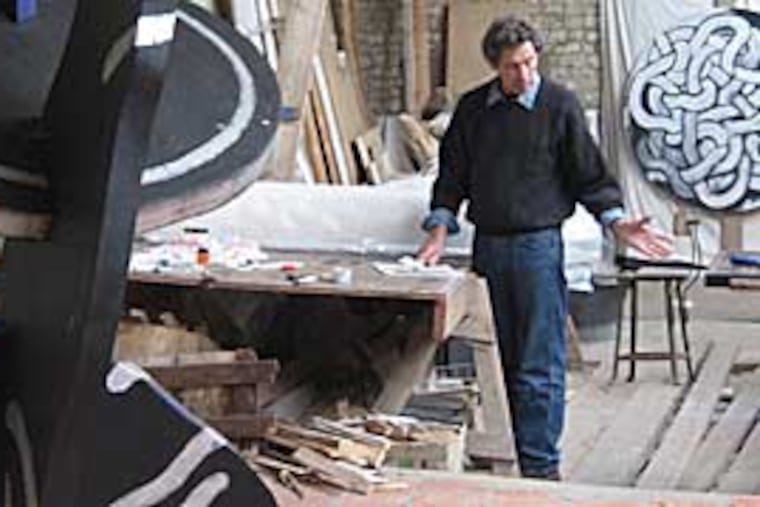
SIPPING COFFEE in the sunroom of his rambling rural property in the Touraine region of France, Harold Jacobs contemplated the idea that his life might have been different if he had not met the sculptor Alexander Calder.
When the former chairman of painting at Moore College of Art met Calder and his family on a visit to nearby Saché in the late '60s, "what impressed me was the simplicity and richness of his life," Jacobs recalled recently. "It didn't need any kind of superfluous attractions of the city. When I saw the way they lived, I said, 'Boy, this is what I want.' That's basically how we got rooted here."
Jacobs and his wife, Bérénice, settled into a home that is large enough for a sculpture garden of Jacobs' own work, a lichen-covered and no doubt storied Deux Chevaux (a once-ubiquitous French car) on the lawn, and buildings containing an art-filled salon and two large art studios.
Philadelphians like to lay claim to artist Calder. After all, he was born here, and his family spent many years in the city.
And Philly has the so-called Holy Trinity - the father, son and holy ghost - sculptures by three generations of Calders. Alexander Milne Calder's William Penn is perched atop City Hall, his son Alexander Stirling Calder designed the Swann Memorial Fountain at Logan Circle, and the Philadelphia Museum of Art has Alexander (Sandy) Calder's mobile, "Ghost."
The latter Calder spent his early childhood in the Philadelphia area. He lived in Paris, in the '20s and early '30s and traveled the world extensively during his lifetime. More than 20 years of his life, though, until his death in 1976, were largely spent between a home in Roxbury, Conn., and his home in the Touraine township of Saché. Particularly during the Vietnam War, which he opposed, Calder was more inclined to stay in France.
Currently, the city of Tours (which gives the Touraine region its name) is showing a Calder exhibition that highlights the artist's life in the area.
The period he spent in Touraine, where he moved as a mature artist, was "the richest, most inspired, most creative, most productive period" of his life, according to a Tours curator. It was here that Calder, working closely with a local ironworks, created many of his monumental mobiles and stabiles (the term modernist sculptor Jean Arp gave to Calder's stationary sculptures), which are scattered on plazas and in museums throughout the world.
Though Calder is certainly acclaimed for inventing his kinetic sculptures, which Marcel Duchamp dubbed "mobiles," Jacobs emphasized how revolutionary they were when he made them. Western sculpture, chiseled out of stone or cast in bronze, was "all solidly based on gravity. [Calder] was the one man in the history of art who put it up in the air. That's a revolutionary act."
Calder was well-known by the time he moved to Touraine, but he had a refreshing earthiness - which may have been what attracted him to the region.
Jacobs had taken a leave of absence from his academic duties at Moore to come to France to prepare a show. Through a mutual friend, he met Calder; his wife, Louisa (novelist Henry James' grandniece); and his daughter Sandra and her family. (Calder's daughter Mary was in the United States.)
"He was an immediate influence because he was just a lot of fun," Jacobs said of his friendship with Calder. "He was different from the artists in France. He was this lumberjack kind of character. He would walk around in a red shirt, you know, a big mountain of a man, who had none of the pretensions - we'll refer to them as 'the sophistications' - of Parisian artists. He was just very straightforward."
Alain Irlandes, exhibitions director for the city of Tours, has long nourished the desire to mount a Calder show. But he wanted to mount not just any Calder show, of the sort that "one can see anywhere in the world."
Irlandes, who met Calder in 1973, wanted to organize an exhibit that would show "Calder's daily life and Calder as a citizen of Saché, and the humanity, generosity, the intimate relationships that Calder had with his neighbors."
One way Calder showed his generosity was by giving artworks to his friends and neighbors, be they famous artists (Joan Miró and Antoni Tàpies were among artist friends who visited him in Saché) or simple farmers.
The Tours show is made up largely of works he gave away to people in the region, many of which have never before been seen publicly (including a gouache dedicated to Harold and Bérénice Jacobs). The show also includes photographs of Calder's life in Touraine, illustrated books and works borrowed from institutions around the world, including a large stabile borrowed from UNESCO, in Paris. This stabile now has pride of place in the courtyard of the Chateau de Tours, where the exhibition spans three floors.
Irlandes tells the story of one gouache that Calder gave to a local woman. She had invited Calder to lunch in her home in Tours, which had a large garden. Calder was surprised to see chickens running around freely on the well-manicured grounds. The woman told him that it was because she had snakes, and that chickens were the best snake hunters.
"Three days later, this woman asked her gardener to put two hens and a rooster into her car," Irlandes recounted. "She took her car to visit Calder in Saché. She rang the doorbell and Calder opened the door and was surprised to see her. She said, 'I'm bringing you chickens because you said you had snakes in your home too.' "
Calder, amused and touched, offered her a drink and a gouache, which he then dedicated to her - "to Marie-Rose."
On a cold and rainy spring afternoon, Alexander Rower, Calder's grandson and the head of the Calder Foundation in New York, was sitting in his grandparents' Saché kitchen, in front of the hearth. The home and immense studio, now dubbed Atelier Calder, houses an artist-in-residence program. He too recalled his grandfather's benevolence.
"In this room, at one of his late birthday parties [Calder] had a stack of 30 gouaches, and he gave one to each of the guests, inscribing them as they left," Rower said.
He added that the Calder Foundation, which he founded in 1987, has documented 22,000 works. It has also documented that Calder gave away over 15 percent of the works to friends, colleagues, even handymen who did work for him.
Rower mused that an Ulrich Mack photograph, displayed in the Tours exhibit, of Calder with several other men perfectly captured his life in Touraine and its charms. "It's three French local Saché guys with berets, drinking wine and having snacks. It describes why he was here and the sensibility. It was an almost 19th-century lifestyle."
"He would work and then he would eat, take a nap and then play billiards," Harold Jacobs remembered of Calder's habits. And Calder's house welcomed anyone, from museum directors and politicians to masons and carpenters. "Anyone who came over would sit down and a bottle of wine would appear. Simple." *
Former Daily News staff writer Sono Motoyama lives in France.