Science and showbiz
The Franklin Institute has two sides now, displayed in shows on pirates and machines that teach, entertain and spring happy surprises.
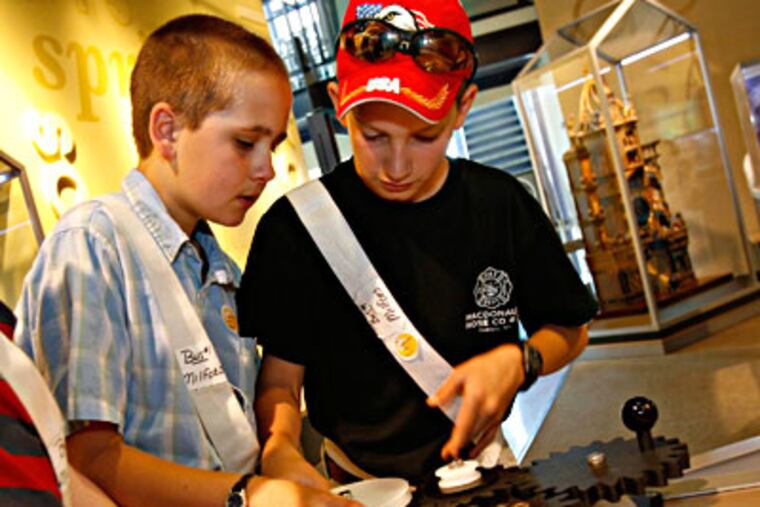
If you want to see physical evidence that the Franklin Institute these days is straddling two realms - one old-world didactic, the other more showbizzy; one science, the other, well, not - take a trip up the ramp in the museum's Mandell Center.
The walkway leads to a traveling pirate show, a substantive if highly produced exposition on plunder and booty, with fully drawn characterizations of Capt. Sam Bellamy and his 8-year-old stowaway, and an emotional climax in a treasure room of gold and silver accompanied by its own glittering harp soundtrack.
But before you get to the pirates, look down from this ascending gangplank for a good view of "Amazing Machine," the Franklin's latest permanent exhibit. It's packed full of treasure, too, if wrought in less flashy hunks of metal. Here, you learn. With a mix of hands-on gear-making equipment and valuable artifacts from the Franklin's own collection, you can, if you invest the time and mental energy, walk out with a greater understanding of machines and the principles with which they are designed.
The two exhibits, which opened recently within a few days of each other, are the programmatic manifestation of the two-tiered business plan the Franklin adopted in in recent years: Bring in traveling blockbusters that may or may not be tied to science, to pay for core programs and exhibits that are.
They also signify the happy news that the Franklin Institute is once again becoming a place that can surprise and delight, a destination where parents and children can spend several hours solidly engaged.
The traveling pirate show fits neatly into two other recent Franklin imperatives: to interface with current issues in society, and to engage the city's substantial African American slice. It carries a clunky title - "Real Pirates: The Untold Story of the Whydah From Slave Ship to Pirate Ship" - because it tries to do two jobs at once. Walking its 20,000 square feet (twice the size of the recent "Star Wars" exhibition) you learn a lot about slavery before you get to all that glitters.
The Whydah - recovered by archaeological explorer Barry Clifford starting in 1984 - was built in London, and began life in 1716 as a slave ship. The exhibition doesn't skimp on context. Every year from 1700 to 1720, we learn, 15,000 to 20,000 captives left the West African slave port of Ouidah (pronounced whydah). A short film with a local African historian shows their point of exit and describes the mechanics of the slave industry. A map illustrates how Europe, Africa, and South and North America depended on the movement of sugar, tobacco, coffee, rum and gold - an entire economy based on slave labor.
The exhibition was organized by National Geographic and Arts and Exhibitions International, but the slave-trade story was augmented when it got to Philadelphia, at the request of the Franklin, with artifacts brought in from the Slave Relic Museum in Walterboro, S.C. - shackles, a neck collar, a branding iron and the like.
Walk a little farther and you follow the capture of the Whydah in 1717 by Sam Bellamy, who both democratized the crew and criminalized the ship's purpose. Pirates, apparently, were an egalitarian lot. Blacks, whites, Indians and even a few women worked side by side. We follow Bellamy's course of exploitation, from Florida and the Gulf of Honduras to Central America and Cuba. We see his grenades, cannons, sword handles, all recovered by Clifford 270 years after the ship ran aground off Cape Cod.
The show devotes a lot of attention to immersing the visitor in the life of the pirate. You might feel a little seasick walking into a life-size replica of a cabin, looking out to sea as the horizon bobs up and down. Another room has visitors stepping onto a clear floor with artifacts strewn below, while mournful music is piped in.
Immersion extends to the olfactory. A burnt-wood smell permeates a tavern in one area where pirate culture is explained, the captain's cabin is infused with cedar, and an area below deck gets a shot of a fragrance called musty.
Science does make brief appearances, with an explanation of scurvy, and the disturbing information that, at sea, amputations were performed by the ship's surgeon - or carpenter. Later on, there's an explanation of the mineral "concretion" that forms on guns, cannons and other objects after they've been submerged for a period of time.
Sadly, some of our most deeply held and enduring pirate myths are debunked: There were no such things as treasure maps, and no one walked the plank. "If pirates wanted to get rid of someone, they just threw him overboard," we are told.
The music, the fleshing out of crew members' stories, the dramatic appearance of the ship's bell after a short, baleful introductory film - all these elements have a slightly hyping effect, especially in contrast to "Amazing Machine."
Basic concepts of machines are illustrated here in ways ranging from involving and dynamic to static and confusing. A table of gears meant to show the transfer of energy is instead an exercise in enervation, since the magnets meant to hold the gears down aren't strong enough to keep the structure you build in place. An 1886 Swiss-made cylinder music box is a gorgeous piece of sculpture - but a silent one. Would it have been so hard to include a recording of its tune? Here the Franklin can learn something about presentation from "Pirates."
A large crane, however, is nothing less than a thrill. Like a toy-fetching claw vending machine in macro form, this equipment allows you to manipulate controls in pursuit of a pillow. The challenge is just right - hard, but not impossible. In the process you're actually accumulating a lot of knowledge and feel for how machines move and work.
Quiet as it is, this new "permanent" exhibit (its expected life span is 10 years) contains one spectacular specimen of early machinery - an automaton, a small, androgynous human figure built by Swiss clockmaker Henri Maillardet. Set in motion, it draws. It has seven small illustrations in its repertoire.
Such a feat may seem unremarkable in an era of iPods and cell phones. But Maillardet built his early robot between 1800 and 1810. The first practical typewriter, less complex than the automaton, was far in the future. Singer's sewing machine was five decades off.
Unfortunately, Maillardet's automaton won't spring to life on demand, but a video playing nearby shows it in action.
Sitting amid the museum's considerably more sophisticated machines, the Franklin's wan, rote figure still carries enormous significance. In a way, it symbolizes everything the Franklin Institute has been - from its founding in 1824 as a society for mechanical engineers to the museum and shrine to Benjamin Franklin and his inventions it has become.
And starting this week, the Franklin's next incarnation begins to take form. Franklin Hall is now officially closed as the museum begins renovations of the rotunda. It's part of a larger, $60 million campaign that will create a new wing to the south of the enormous statue of Franklin.
Among other things, the new wing, slated to open in 2012, will contain a counterpart to the museum's beloved giant heart: an enormous, multimedia brain.
When done, it will be the largest statement in some time that the Franklin Institute is still thinking about science in a big way.
Aargh!
"Real Pirates: The Untold Story of the Whydah From Slave Ship to Pirate Ship," runs through Nov. 2 at the Franklin Institute, 222 N. 20th St. Tickets: $6-$23.25. Information: 1-877-834-8497, www2.fi.edu.
Journalist Michael H. Cottman speaks about his personal journey to uncover the history of a sunken 17th-century slave ship, the Henrietta Marie, Friday at 7:30 as part of the Franklin Institute's "Out of Africa" lecture series. Cosponsored by Philadelphia's African American Museum. Admission is free. Reservations: 215-448-1254. EndText