Art: The dog has its day - and then some
Dogs again. Is it because summer has arrived, or because museums are subtly but inexorably lowering the bar to spare their visitors any intellectual heavy lifting? Perhaps it's those factors working in tandem that have brought William Wegman and his remarkably patient Weimaraner, Fay Ray, to the Allentown Art Museum.
Dogs again. Is it because summer has arrived, or because museums are subtly but inexorably lowering the bar to spare their visitors any intellectual heavy lifting? Perhaps it's those factors working in tandem that have brought William Wegman and his remarkably patient Weimaraner, Fay Ray, to the Allentown Art Museum.
Wegman is well-known for photos and videos featuring a succession of Weimaraners. These began in the 1970s with Man Ray (named after the Philadelphia-born surrealist and Dadaist photographer) and continued in the 1980s and '90s with Fay Ray (named after Fay Wray, the leading actress in the original King Kong film), and her offspring.
This exhibition, organized by the museum in cooperation with Wegman's New York studio, consists of large-format Polaroids, smaller color and black-and-white prints, and brief video segments made for the PBS series Sesame Street.
Wegman's basic shtick involves transforming Fay through pose, costuming or anthropomorphizing - combining her head with a human body. The dog might assume improbable poses or she might be enveloped in a variety of costumes, some of which obscure her completely. Sometimes she impersonates other animals, sometimes the costumes transform her into a lumpy near-abstraction.
Wegman occasionally plays it straight by making conventional portraits of his partner, without props or wigs or funny hats. These richly colored studies reveal a true aristocrat, a paragon of dignity and poise. So why would such a noble animal sit still for Wegman's tomfoolery? She does most of the work, and he gets most of the credit.
One can only surmise that Fay is a natural performer who truly enjoys the masquerades. When you see an image like Harvest, in which the dog, wearing a red felt hat and comic "eyeball" glasses, is nearly buried under a mountain of plastic fruits, flowers and vegetables topped by a huge acrylic housefly, you marvel at her supercanine forbearance.
These photographs are humorous and technically superb, especially in their tonal harmonies. I suspect that in some cases Wegman is tweaking the pretensions of art history. Harvest recalls the elaborate and moralistic 17th-century Dutch still lifes. The reference in Die Brücke is more direct; the title refers to a group of German expressionist painters active in the decade before World War I.
Much is made of the fact that Wegman and his faithful dog are true artistic collaborators. That one can believe, because he could not have achieved these elaborate contrivances without Fay's active participation. One senses that the dog enjoys, or at least tolerates, the process of being swaddled in boldly patterned fabrics and made to wear garish wigs, that she doesn't resist when paired with a human actor in an elaborate pantomime like Cher.
But what, exactly, is the point of these collaborations? One wants to believe that they're more than elaborate jokes, and yet usually that's all one can recognize in them. And always, lingering in the background, is the feeling that this handsome and compliant animal is being exploited to aggrandize Wegman's reputation.
Still, children should love this show because they won't expect more than chuckles and giggles. They will especially love the videos, which are clever, witty and even more revealing of the dogs' - I'm including Fay's offspring here - intelligence and appealing personalities. See particularly Dog Baseball, a delightful Dadaist romp that's old-fashioned silly fun.
Linda Lee Alter. Alter is known to many artists in Philadelphia as the founder of the Leeway Foundation, which has supported female artists through a grants program since 1993. However, she also has been a professional artist herself for more than 45 years. Initially she worked in fibers, but for about 20 years she has preferred painting in acrylics because, she says, painting allows more spontaneity.
Jacqueline M. Atkins, Allentown's curator of textiles, has put together a retrospective exhibition for Alter that emphasizes both aspects of her career equally. Yet the textile constructions from the 1980s, being larger and more elaborate than the paintings, tend to dominate the display. This is appropriate, because the textile hangings represent a more distinctive and accomplished achievement.
They remind me in many cases of the carved and painted reliefs of Elijah Pierce. Alter's subjects, like Pierce's, are typically biblical - Noah's Ark, Adam and Eve, Moses and the burning bush. Alter used a variety of materials and textiles to construct the panels, which makes them intensely textural and thus analogous to carved reliefs.
A typical hanging might contain a combination of wool salvaged from old coats and suits, wool felt and yarn, suede, fake fur, and various threads, applied through applique, embroidery and machine- and hand-stitching. Beads and buttons occasionally add glitter. The palette is eclectic but always harmonious and under control.
Alter leavens the biblical themes with folksiness and verve, usually through imaginative color choices such as the cherry-red hair and beard on Moses. These are lively, visually stimulating visions.
The paintings, much smaller, are executed in the same spirit, but they are more like generic folk art. After the artist suffered an attack of intense facial pain called trigeminal neuralgia in 2000, she began to address her affliction through her paintings.
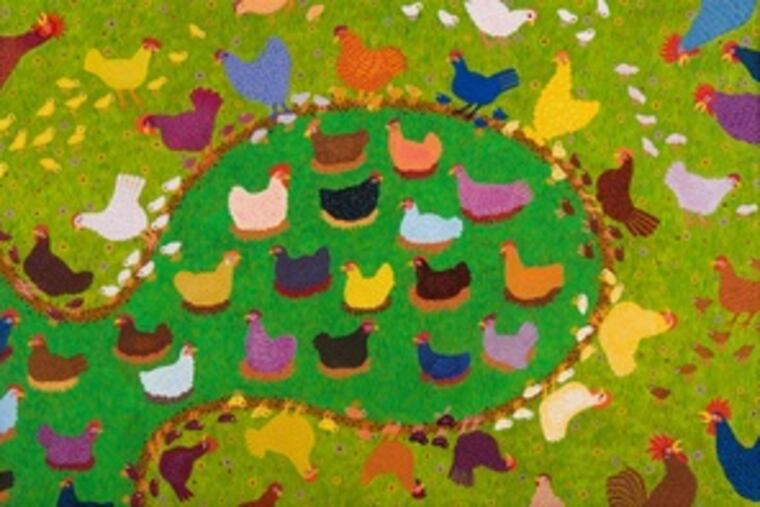
This isn't something the paintings announce, but Alter acknowledges that she intends these small, colorful works to communicate a combination of pain, fear, anger, frustration, depression and loneliness. I can't say that I recognized those emotions, except in the painting called Pain, Pain, Fear, Fear, Fear. What I saw was an artist trying to remain optimistic in the face of adversity, through sunny images such as Roosters Crow, Hens Deliver.
Overall, the show presents an uplifting and, in the textiles, technically impressive body of work. Alter creates in the cheerful, naive spirit of a folk artist, in the sense that she loves her materials and identifies closely with the themes she illustrates. This makes her art not only charming but eminently accessible and enjoyable.
Art: Fabulous Fay
"William Wegman: Fay" and "Linda Lee Alter: A Life in Art" continue at the Allentown Art Museum, 31 N. Fifth St., through Sept. 7. Hours are 11 a.m. to 5 p.m. Tuesdays through Saturdays and noon to 5 Sundays. Admission to either or both exhibitions, including a $5 surcharge, is $11 general, $9 for visitors 60 and older and students with ID, and $8 for visitors 6 through 12. Only the surcharge applies on Sundays. Information: 610-432-4333 or www. allentownartmuseum.org.
EndText