Ladytron trades substance for effects
At around 10:30 p.m. Thursday, the electro-pop band Ladytron took the stage at the TLA. Or at least, it looked like they did. Between the smoke-filled air and the blinding backlight, it was hard to make out more than a half-dozen silhouettes floating in the haze.
At around 10:30 p.m. Thursday, the electro-pop band Ladytron took the stage at the TLA. Or at least, it looked like they did. Between the smoke-filled air and the blinding backlight, it was hard to make out more than a half-dozen silhouettes floating in the haze.
Formed in Liverpool, Ladytron combines the icy remove of German electronic music pioneers Kraftwerk and the robot-love come-ons of Depeche Mode and New Order. Singers Helen Marnie and Mira Arroyo, who traded lead vocals throughout the night, stood back from the lip of the stage lost amid a forest of synthesizers, idly dancing to some private rhythm.
Marnie, whose role has become more prominent on recent albums, sings in a diffident coo, sweet and pure yet enigmatic. On "Ghosts," from Ladytron's fourth album,
Velocifero
, her faux-naive deadpan hid the song's final sucker punch: "There's a ghost in me, wants to say 'I'm sorry,' " she sang. "Doesn't mean I'm sorry."
Beginning with 2005's
Witching Hour
, Ladytron's songs have grown more ominous, less Euro-disco, and more sturm-und-drang. "Black Cat," from
Velocifero,
is built on a snarling two-note synthesizer riff and a trash-can drumbeat. Using her native Bulgarian, Arroyo sings in a druggy monotone, like an Eastern European version of the Velvet Underground's Nico.
The slick decadence of the band's set was intoxicating, but sometimes it was difficult to find the substance in all that atmosphere. Marnie's voice was drowned in reverb, turning "International Dateline" into a formless soup. The fog cleared when they pulled out older songs like "Seventeen," an ironic ode to the waning power of teenage allure. But a long run of dour, shapeless songs cast a pall that never quite dissipated.
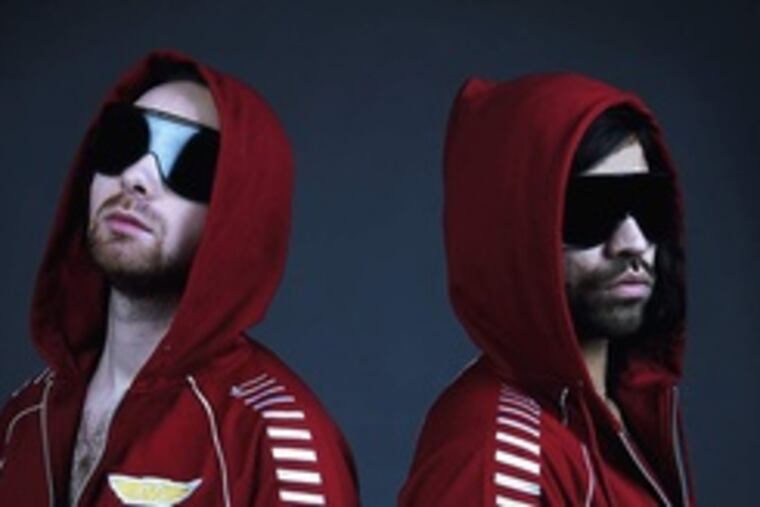
The openers, Norway's Datarock, can't be accused of taking themselves too seriously. Clad in matching red jumpsuits and blocky sunglasses, they jumped around the stage like excitable toddlers. Their lyrics are purposefully juvenile.
"Computer Camp Love" is a bouncy ode to nerd romance, and "Night Ride to Uranus" rests on a single entendre only an 8-year-old could love. Their songs cop licks from 1960s soul, but there's not much soul in their one-note shtick, even when they paraphrase Otis Redding on "Fa-Fa-Fa."
Still, the infectious energy won the crowd over. Like its neighbors the Hives, Datarock exploits the cliches of arena rock while sending them up. This is not a great band, but pretends to be one, and the crowd happily played along.