One man's revelations of his native Puerto Rico
Painting, sculpture by Miguel Luciano at Taller.
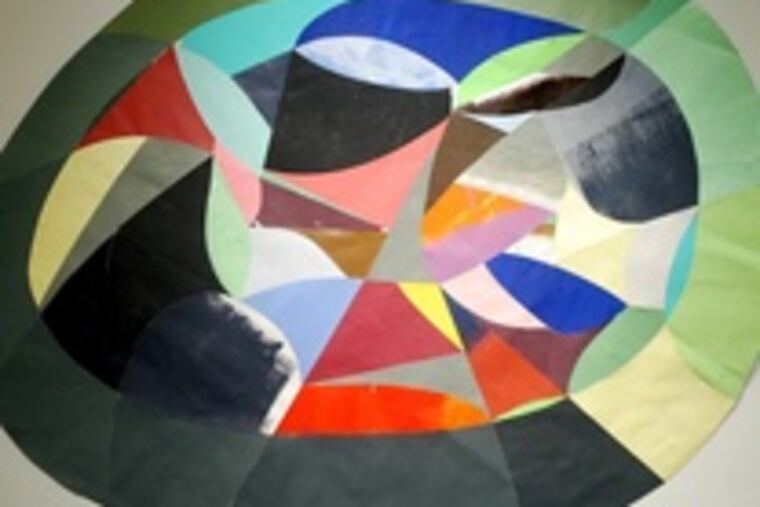
If the Taller Puertorriqueño has fallen off your usual gallery itinerary, its current exhibition should make it a destination once more. Miguel Luciano's intensely felt paintings and sculpture make up one of the most rewarding shows in Philadelphia. Hurry, though - it's up for only eight more days.
Luciano's art takes its inspiration from the mutually convenient relationship between Puerto Rico and the rest of the United States, and in particular from Puerto Rico's still tangibly colonial status. It's as much about Puerto Ricans' being historically taken advantage of in this relationship as it is about their complacency, although there's little doubt that Luciano, who was born in San Juan in 1972 and now lives in New York, is for independence. But his work transcends politics: He has such a natural facility as a painter and sculptor, and his conceptual forays into the past and the present are so fluid, that his art feels revelatory, not rantish.
I was immediately drawn to his large, vividly colored paintings that take the historical-allegory painting, the poster, and the label as their models. A conquistador in a scene reminiscent of an 18th-century narrative painting is the spitting image of Ronald McDonald. Several canvases from Luciano's "Louisiana Porto Rican" series are virtual facsimiles of labels - vastly enlarged, and painterly - that were first printed in the 1920s for cans of different brands of Louisiana Porto Rican yams. Luciano's appropriations and enlargements of these now startlingly un-P.C. images illuminate the true turn-of-the-century story of Puerto Ricans who stopped in Louisiana while en route to work in Hawaiian pineapple and sugar fields and were forced into farm labor there.
Luciano's sculpture, on the other hand, is pointedly of the moment. For example, a plantain, the traditional, homegrown vegetable of the old Caribbean, has been plated in platinum and is displayed both as an object and in a photograph, as an ornament on a long platinum chain around a boy's neck. A coqui, the frog considered the stereotypical tourist-trade symbol of Puerto Rico - and an invasive species in parts of the United States - is presented here as an actual vintage child's coin-operated ride (like the American pony), with no perceptible interventions by Luciano.
The surprising effect of Luciano's work, besides its seductive visual appeal, is to make you feel you are witnessing the inexorable loss of the value of ethics and ideals not just in Puerto Rico and the larger United States, but in the world, with all responsibility equally apportioned.
(A note: While I didn't find a mention of it on the Taller's Web site when I clicked on its Lorenzo Homar Gallery, I was told when I arrived at 12:30 p.m. that the gallery, like the bookstore downstairs, is closed from 1 to 2 p.m. daily.)
.
Calm and thoughtful
"A Cleaner Heart a Do It" casts a more reflective mood than some of Fleisher/Ollman Gallery's recent group exhibitions, mainly because of the presence of several enigmatic pieces by Bill Walton, in his first appearance at this gallery. Walton's simple, beautifully made sculptures of found wood, steel and concrete; his ink writings on rice paper, made while the paper was wet, causing the ink to run (one thinks of tears falling on a letter); and a work that comprises several small pieces of linen mounted to the wall, each piece slightly larger than the next, are like haiku. Each one is sublime.
There are other quiet, engaging works here, too. Matthew Rich's matte latex paintings on cut paper are the do-it-yourselfer's version of geometric abstraction, purposefully abject, like an elegy for formalism. Casey Watson's remarkably intricate painted cut-paper pieces suggest the efforts of a newly discovered Victorian artist with a taste for spiders and man-eating plants.
Even Jennifer Levonian, whose previous stop-motion animations I'd seen in the company of more raucous work, which made me notice her humor first, comes across as a poet in her latest film. Holy Donuts tells the story of an imaginative girl who accompanies her family to church and, while watching the assembled parishioners munching doughnuts, begins to see doughnut shapes in everything around her. It's clever and amusing, as Levonian's other animations are, but also a requiem for childhood innocence.