In the killing seat
The Iraq war becomes a brutal and gritty mini-series in HBO's "Generation Kill," adapted from an embedded journalist's reports.
There's no Big Picture evident in
Generation Kill
- HBO's brutally good Iraq war mini-series, debuting tonight at 9 - and that simple fact sets it apart from the Hollywood big pictures that have tried to get a handle on Operation Iraqi Freedom these last few years.
Forget geopolitical context, forget Sunni-Shiite conflicts and Bush-Cheney conspiracy theories. Forget Halliburton, forget Abu Ghraib.
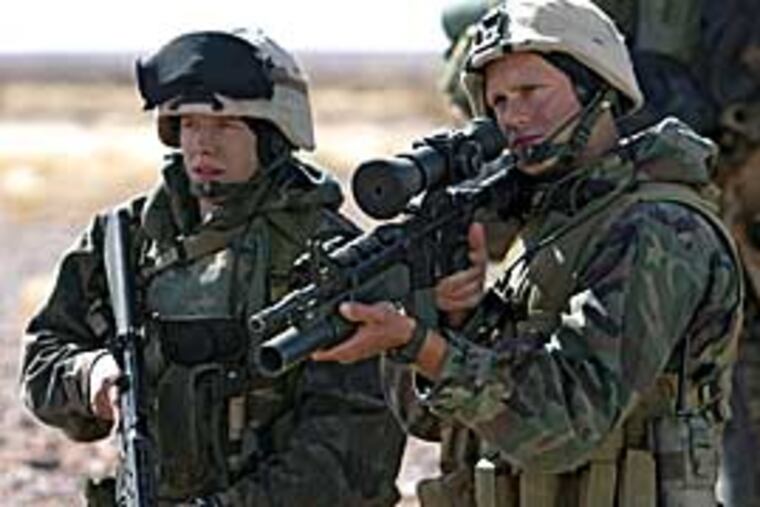
Instead, this gritty, gripping set of seven episodes puts you smack down in the Humvee seat with the First Reconnaissance Battalion. The work of David Simon and Ed Burns, the team behind HBO's rightly celebrated series The Wire, Generation Kill is an adaptation of the reports of Evan Wright, a journalist embedded with a U.S. Marine platoon.
The "tip of the spear" that sliced into Iraq on March 20, 2003, the elite First Recon decamped from Kuwait and rolled into Saddam Hussein's country from its southeastern border. Generation Kill follows a squad of these Marines, and the Rolling Stone reporter who tagged along (and who later won a National Magazine Award for his series), as they contend with sandstorms and sleep deprivation, roadside ambushes, and the baffling commands coming from "Godfather" - a steely Marine lieutenant colonel (played by Chance Kelly) who got his nickname because of his Don Corleone rasp.
There are maybe 25 principal characters in Generation Kill, all but two of them Marines. Lee Tergesen, looking wide-eyed but wily, plays Wright, the embedded Rolling Stoner who ingratiates himself with the Devil Dogs (what Marines call themselves) by letting them know he used to write for Hustler. The other non-Marine is Neesh (Nabil Elouahabi), an Iraqi interpreter who got his marching orders from Central Command, or the CIA, or the State Department, depending on whom you ask. In any event, Neesh's translations are not to be counted on. He's a spin artist, trying to convince the Marines that the Iraqis they're talking to are welcoming, happy people.
The first cast credit on Generation Kill belongs to Alexander Skarsgård (son of the Swedish actor Stellan Skarsgård). As McNulty was to The Wire, Skarsgård's Brad "Iceman" Colbert is to this series. He's a keen-eyed, taciturn noncom, a bit of a cowboy, the team leader in the Humvee that the reporter dude rides with - and that audiences will want to rely on. The driver of Team 1's first vehicle is Cpl. Josh Ray Person (James Ransone), hopped up on ephedra and something called Ripped Fuel, talking nonstop and wildly profane, offering up theories on war, women, and the indigenous people they have come to liberate. He is no diplomat, and the demonizing and objectifying of the Iraqis that springs from his maw, and those of his fellow Marines, is crude and ugly.
In the same way that the corner talk and copspeak of The Wire rang true, the dialogue in Generation Kill feels authentic, spontaneous. Rife with references to hip-hop, porn and video games, it pulses with a jokey, homoerotic bravura. Only now and then, when Skarsgård's character waxes philosophical, say, or the startlingly boyish Lt. Fick (Stark Sands) tries to put a human face to the Iraqi enemy, does a writerly tone, a touch of poetry, show up in the script. Simon, Burns and Wright wrote or cowrote these seven episodes - working from Wright's book, also called Generation Kill - and two Brits, Susanna White and Simon Cellan Jones, directed.
Where Generation Kill succeeds, far more than films like Kimberly Peirce's uneven but powerful Stop-Loss or Brian De Palma's pretentious Redacted, is in showing how ill-prepared the U.S. military was for this war - even if the super-trained, "Get Some" Marines of First Recon are nothing but prepared.
"We're like a Ferrari at a demolition derby," Iceman gripes about the mess flying all around them. They've got high-tech gear (night vision goggles, thermal imaging devices) that doesn't work for lack of batteries; incompetent officers sending out contradictory orders; inadequate supply lines; and egos, vanity and politics up and down the chain of command.
Most profound, and joltingly disturbing, is the inevitable, seemingly haphazard killing of Iraqi men, women and children. They're not Hussein's Republican Guard, not insurgents from Syria, but regular villagers, innocents in the line of fire. The image of a driver who appeared to ignore orders to stop at a U.S. roadblock, the blood from the bullet hole in his forehead gleaming in the hot sun, is stunning - and seems to stun Iceman, Person, and the other Marines, too. Wounded kids carried in the arms of weeping parents, brought to the Marines for medical attention - the same Marines who maimed the children in the first place - it's harrowing stuff.
But even Sgt. Rudy Reyes (played by the real Marine veteran himself) - a New Age kind of guy who drapes a kaffiyeh over his shoulders, and who brought his own stovetop espresso maker with him from San Francisco - even he gets back to the business at hand. He climbs into the Humvee and drives the rattling mother north into Nasiriyah, Al Kut, and the rest of the forsaken places Godfather tells him to go.