As I ambled through Garry Knox Bennett's exhibition at the Delaware Art Museum, I thought of Walt Whitman's lines from
Song of Myself
: "Do I contradict myself? Very well, I contradict myself. I am large, I contain multitudes."
That's the 73-year-old Bennett to a T - large in stature, in personality, in talent, in imagination and in artisanal skill. And for this show he has produced multitudes of chairs, 52 one-of-a-kind examples from a series of more than 80 begun in 2003.
So where does the contradicting come in? As you proceed through the show, you encounter Bennett quotations on the walls. One proclaims, "Art is too precious and too clever for me. Craft comes before art." That makes sense coming from a guy who made his reputation as a maverick furniture-maker.
But then you come to another quotation that declares, without equivocation or qualification, "I am an artist. I am an artist deep and true." So, which is it, Garry - artist (or, as he prefers, "art guy") or craftsman? Are these chairs supposed to be expressions of artisanship, or should we read them as art?
Through both the quotations and his comments in a video that plays continuously in the installation, Bennett seems to shift effortlessly between the polar positions of "artist" and "damned good furniture-maker."
Matthew Kangas, a respected Seattle critic and curator, argues in the exhibition catalog that Bennett's chairs are sculpture. When you see the dazzling variety of forms Bennett has produced, the idea doesn't seem so far-fetched.
All the pieces can be considered variations on a theme, like Cezanne's multiple visions of Mont Sainte-Victoire. They elucidate the idea of "chair," an object with three or four legs, a seat and a backrest.
Ah yes, but most of Bennett's chairs appear to be functional, not hypothetical or conceptual. You could sit in them, although they might not all be stable or comfortable. Does that disqualify them as fine art?
No, because Bennett's chairs express a variety of aesthetic qualities that one finds in paintings or more conventional sculptures. One can see that he's acutely aware of how to compose through energetic contrasts of line, shape, and color. His creations are, for the most part, balanced and harmonious. You often look at them and think, what a lively design or, how neatly the parts play off each other.
So, despite his protestations, Bennett is an artist. What he really seems to be railing against is the pretension or, as in the quotation above, the "preciousness" of high art.
As we see in the video, filmed partly in his Oakland, Calif., studio, he's a no-nonsense, hands-on guy whose chairs seem to emerge not out of protracted conceptual anguish but from working things out directly through pieces of wood and the myriad other materials he uses.
Yet I'm not contradicting myself when I say that Bennett is also a craftsman. "Call Me Chairmaker," organized by the Bellevue Arts Museum in Washington state, makes this abundantly clear. He's comfortable with a broad range of materials, particularly metals, and his workmanship is superb. I presume that he prides himself on his ability to make any material do what he wants it to do.
In large part, his masterly craftsmanship helped to make his 1979
Nail Cabinet
such a sensation. This is an elegant standing cabinet of glowing hardwood with dovetailed drawers and one glaring, deliberate flaw - a huge ugly nail that Bennett hammered into its face.
Naturally such desecration, and by the maker himself, caused outrage among purists, whom Bennett calls "woodies." He explains in the video that he wanted to "do something hurtful" to this paragon of woodworking perfection. In doing so, he established a reputation as a radical, akin to Marcel Duchamp drawing a mustache on the
Mona Lisa
.
Irreverence is central to Bennett's method, liberally mixed with humor. Many of his chairs can be accepted mainly as jokes. As he says, "A good joke is better than bad art."
In the chair series, the jokes are frequently at the expense of titans of furniture design, including famous architects such as Frank Lloyd Wright, Charles Rennie Mackintosh, and Gerrit Rietveld, but also including revered artisans such as George Nakashima of New Hope.
With few exceptions, Bennett thinks architects design lousy furniture, so they have become prime targets for his parodies. The show includes several variations on Rietveld's famous
Zig-Zag
chair, which, with its cantilevered seat, appears too fragile to bear any weight.
Rietveld's original
Zig-Zag
exemplifies modernism perfectly. In
Great Granny Rietveld,
Bennett subverts its iconic character completely with a double whammy, by covering the bare wood surfaces with cushions, upholstered in pink-and-green floral-patterned cotton.
Several of Bennett's chairs incorporate Mackintosh's signature ladderback design into the
Zig-Zag
. In the most literal example, he inserted a miniature stepladder into the plain maple back.
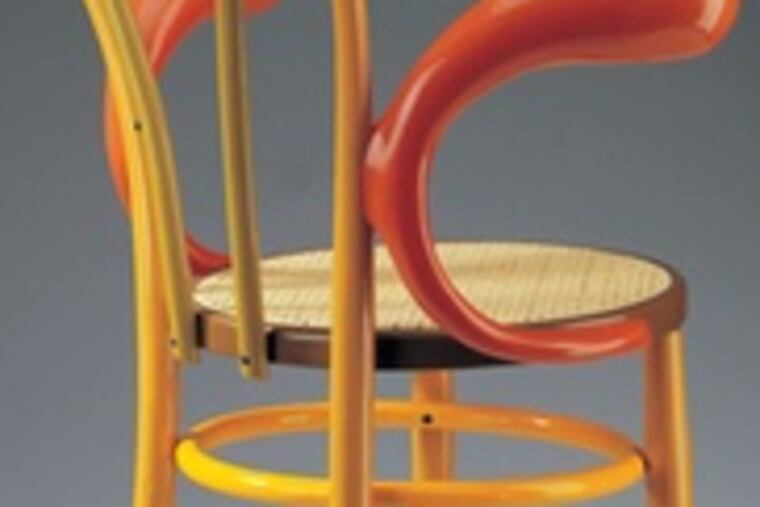
Yes, his jokes are often that broad, but not so obvious as to be recognizable by visitors ignorant of the design history he's tweaking. If you recognize such prototypes as the Thonet bentwood cafe chair, which in Bennett's version sports bulbous arms like giant zucchini, you'll be smiling most of the way through.
You will also, I hope, come to recognize some of the hallmarks of Bennett's approach, particularly his love of playing curves against straight lines, mass against delicacy, metal, cloth and woven cane against solid wood, and bright color and gilt against natural finishes.
For instance, his interpretation of a Wright chair includes a hexagonal back, a geometric shape Wright favored, but enlivens his rectilinear austerity with what Bennett calls "squiggles" in two legs. The squiggle appears frequently in Bennett's chairs as a way of introducing movement and playfulness, not common attributes of traditional studio furniture.
All these tactics represent contradiction, yet Bennett avoids cacophony and usually harmonizes the parts without sacrificing liveliness. That last quality is perhaps the summarizing one in a body of his work; it's playful, continually engaging and frequently provocative.
The least satisfactory aspect of Bennett's chair language is his predilection for thronelike compositions, often dominated by blocky, elephantine legs. These chairs can't help but be ponderous, which contradicts the fanciful character one has come to admire in his work.
On balance, though, Bennett puts on a dazzling performance, seasoned with ingenuity, wit and panache. This sassy exhibition should make you appreciate that chairs can be much more than a convenient place to park your glutei maximi.
Art: Master of Chairs
"Garry Knox Bennett: Call Me Chairmaker" continues at the Delaware Art Museum, 2301 Kentmere Pkwy., Wilmington, through Sept. 21. Hours are 10 a.m. to 4 p.m. Tuesdays though Saturdays and noon to 4 p.m. Sundays. Admission is $10 general, $8 for visitors 60 and older, $5 for college students, and $3 for visitors 7 to 17. Free Sundays. Information: 302-571-9590, 866-232-3714 (toll-free) or
» READ MORE: www.delart.org
.