Pianist Hugh Sung generous with his time, talent
Mention pianist Hugh Sung's name to any recent Curtis Institute student and it will trigger an enthusiastic outpouring about his artistry - and generosity.
Mention pianist Hugh Sung's name to any recent Curtis Institute student and it will trigger an enthusiastic outpouring about his artistry - and generosity.
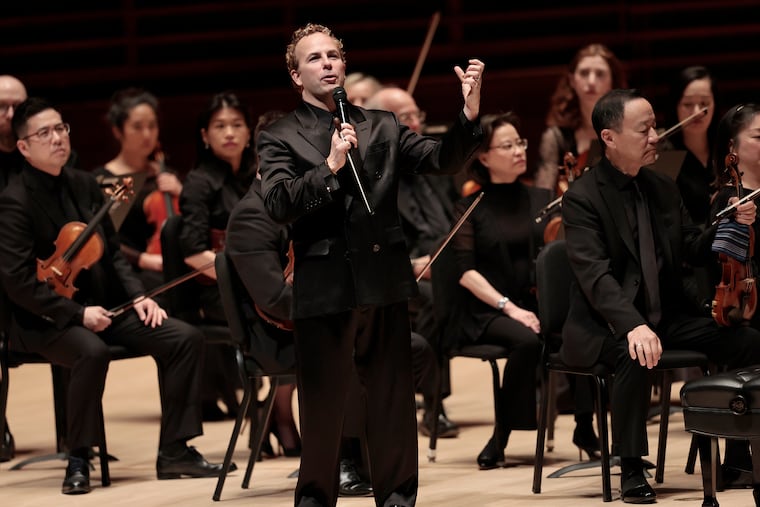
A brilliant artist and caring mentor, the diminutive Philadelphia native tirelessly shares his enormous musicality and roaring laugh with virtually every student at Curtis, and with pianists around the world whom he's never even met.
Sung's career began with a Philadelphia Orchestra debut at age 11, then Curtis at 13. He graduated in 1990 and three years later, at 24, he joined the faculty.
Holding the impressive title of Curtis' Director of Student Recitals and Instrumental Accompaniment, Sung helps schedule the popular, free Monday-Wednesday-Friday student concerts. Most also involve him as accompanist.
Years before a student could ever dream of playing a concerto with an orchestra, Sung's versatility supplies the orchestral accompaniment, reduced to a dense piano part. To eliminate turning pages, he reads music from the 6,000 scores available on his laptop, using a foot treadle to move the pages onscreen.
Sung often accompanied soloists in preliminary rehearsals for the Philadelphia Orchestra's Christoph Eschenbach and has been filling in with the orchestra on celesta.
Among his many CDs, Sung has partnered with the orchestra's principal flutist, Jeffrey Khaner, on several highly regarded Avie discs. A jazz-tinged one is in the works.
A singer friend of this writer was stunned when Sung volunteered to accompany her whole benefit concert, simply out of respect for the cause. He not only played brilliantly but had to be dragged off the bench at the end to receive a standing ovation.
Sung is also compiling a huge Psalmody, or catalog of sung Psalm settings, for the Christ Covenant Presbyterian Church in Warminster, which he attends with his wife, Kyungmi, and sons Paul, Eric and Timothy.
He also performs in the summer musical programs at the 6,500-seat Great Auditorium at Ocean Grove, N.J.
For the July 30 program, which he's calling a "visual recital," Sung will play Mussorgsky's original "Pictures at an Exhibition" and Chopin's G Minor Ballade on a Cunningham concert grand.
We spoke to the modest but passionate artist, who has purchased a Cunningham piano for his home, at the Cunningham factory showroom on Germantown Avenue, just before he dazzled the sales staff and technicians by playing the Chopin.
Q: What's so unique about your new Cunningham piano?
A: I was a little suspicious of an affordable instrument made in China, but it responds extremely well. The action and the sound impressed me immediately, and it's remarkable that they can offer a piano of this level of quality at that price.
Q: Why did you need a piano?
A: I've been playing the same Steinway since I was 5, and it had been beaten to a pulp because of my heavy technique. A piano can only take so much abuse! Though I have two instruments at Curtis, eventually mine wouldn't hold a tune for more than an hour, and the cost of repairing wasn't worth it.
Q: Why are you calling this a visual recital?
A: I'm heavily into technology and have been working on projected visual imagery and animation triggered by the music that's played. A microphone captures the music and a computer program makes the visuals explode or gives a change of scene, interpreting the music dynamically and providing more layers of experiencing.
I've been collaborating with artist Charmain Schuh and other visual designers to expand the possibilities, and a programmer in Brazil is helping me refine the software for the engine that powers the show.
Q: Are the visuals meant to be educational?
A: Certainly. Musicians take for granted how sophisticated our language is, and younger audiences now have no connection to it. In some workshops at West Philadelphia schools, kids have made artworks which were used in the visual presentations, which immediately made them relate to the music. And it's great for a contemporary work, where nobody would know anyway.
Q: How do you organize the Curtis student concerts?
A: The students can schedule their own pieces, and I step in when there are logistical issues like the length, appropriateness for the program's theme or duplication of pieces.
Q: How much room is there today for new pianists?
A: When I first began teaching, my outlook for anyone making a career in music was pretty bleak. But in the last five or six years, the possibilities have exploded. People are launching musical businesses, tying music to technology, administration, legal matters, fund sharing for making CDs and even privatelessons.com.
Thanks to the Internet and a wealth of new fields, there are so many more opportunities to utilize music and make a difference.
Q: What else are you working on?
A: I've been studying the history of keyboard instruments and, actually, all musical instruments. They are all miracles of science and engineering, and a holistic view of that technology helps to augment and enhance creativity.
Q: Is anything more satisfying to you than guiding young talents?
A: Not really. At first, nurturing talent at this level was intimidating, but sharing and collaborating helps you rediscover the joys of making music. Serving and helping others brings optimism to the next generation. It's really true, the more you give . . . *
Send e-mail to dinardt@ phillynews.com.
Woodmere Art Museum, 9601 Germantown Ave., 7:30 p.m. July 30, $10, 215-247-4076, www.woodmereartmuseum.org.