Face-lift for Friendship Gate
Five artisans have arrived from China to restore the weathered, peeling Chinatown landmark to its former brilliance.
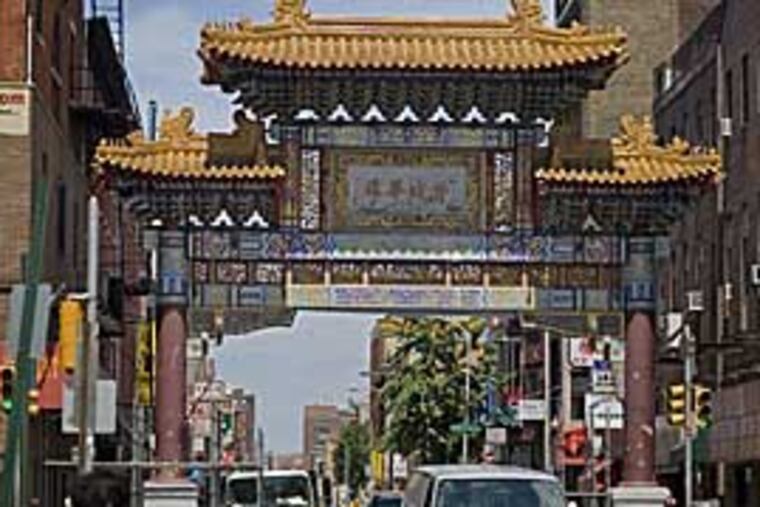
This is not your ordinary paint job - unless your ordinary paint job includes partnering with the U.S. State Department to get traditional artisans from China to Philadelphia, shopping for paint supplies at a restaurant-equipment store, and finding fresh pig blood to add to the homemade primer, which will be boiled in a giant wok.
Don't ask Sherwin-Williams.
Ask Philadelphia Chinatown Development Corp.'s John Chin, local architect Yao C. Huang, Nancy Gilboy from the International Visitors Council, and the five artists from Philadelphia's Chinese sister city of Tianjin. They are the key players in this unusual paint job that will restore Chinatown's Friendship Gate.
On Thursday, scaffolding began to rise on 10th Street near Arch by the ornate 25-year-old landmark, a gift from Tianjin to Philadelphia. Next week, the restoration will begin.
Time and weather have worn away what once were the vivid colors of the gate. The original materials were shipped from China in numbered pieces and assembled by Chinese artisans in the winter of 1983-84.
Today, the red, blue, yellow and green paint is peeling, the Chinese calligraphy announcing "Philadelphia Chinatown" has faded, and the golden dragons, whose magic powers are said to have once protected the gate from a nearby blaze, have lost their brilliance. Well past its youth, the gate looks like an aging elder.
"We want to restore it to its original glory," said Chin, executive director of Chinatown Development Corp., which helped develop the city-owned gate. "There's a lot of pride in the Chinatown gate."
A local company replaced roof tiles and wood in 2004. But the painting is a more difficult and costly task - it has to be done by Chinese artisans to maintain the gate's cultural authenticity. The city's Capital Program Office, Rohm & Haas, City Councilman Frank DiCicco, and Peco Energy Co. also have helped make the $265,400 painting effort possible.
The project now is in the hands of Liu Jinduo of Tianjin Yingchen Archaize Architecture Engineering Co., his four colleagues, and local architect Huang.
What a trek it has been. Gilboy, the State Department and Temple University, whose students are documenting the project, worked for three years to get the artists visas. Five artisans arrived in Philadelphia on July 17. Gilboy, the visitors council's president, is still trying to get the expert in gold-leaf application a visa.
The others aren't waiting for him.
Sent ahead of the artists, in large burlap sacks, were brick powder and other materials. Chin and Huang shopped this week with Liu's team for other supplies. First stop was a Chinese-owned warehouse of shops at 15th Street and Washington Avenue called the Construction Mall.
"This is the Chinese version of Home Depot," Chin said, chuckling.
The artists were looking for pure tung oil with nothing flammable in it, for use in a special primer that will make the paint finish more durable and vivid.
It's the only time in his life that he cooks, Liu said.
First, they will boil two or three batches of the oil for about three hours in a 2-foot-diameter wok they found at Discover Metal Fab Restaurant Equipment in the mall. If the tung oil had additives, it could catch fire.
The artists chose two 100-quart stockpots to keep the tung oil warm, and two plastic garbage cans to store the brew. There is one more step in making the undercoat: adding a mixture of the brick powder sent from China and fresh pig blood - which they're now hunting for locally - to enhance the primer's adhesiveness.
On Thursday, the artisans, Huang and Chin went to Washington Square Paint & Hardware on South 10th Street, which is donating the paint. Owner John McIntyre supplied some of the gate's original paint 25 years ago.
Liu and the others studied paint chips in the store and outside in the sunlight.
"Let's have a shade of blue in between these two colors," Liu said in Mandarin. Huang translated into English for store employee Tim Bolton.
"I want a water-based color, not oil-based," the artist said. "If it is water-based, it doesn't reflect the sunshine. If it's oil-based, it has some highlights and reflects the sunshine."
They picked about 30 colors in all, which Bolton will mix in the next few days.
On Monday, the artisans will climb the scaffolding and scrutinize the 88-ton, 40-foot-high gate. After damaged paint is removed (carefully, because it might contain lead), they will put on several undercoats and then the paint. The patterns are the hardest to repaint.
The artisans will trace the gate's Ming and Qing Dynasty symbols onto paper, prick pinholes in the outlines, and hold the paper up against the designs to apply the new paint. If the gold-leaf expert gets a visa, he will reapply $10,000 worth.
In all, the gate's face-lift should take no more than 50 days. And that should make all those who visit, live and work in Chinatown feel good - especially the elders in the community.
"I think it brings a little bit of home to them," said Cecilia Moy Yep, founder of the Chinatown development group. "Where else are you going to see something as beautiful as that?"