Jonathan Storm: Out of nowhere
"Mad Men," on AMC, is up for 16 Emmys, more nominations than any other drama series. Never mind that few viewers have tuned in.
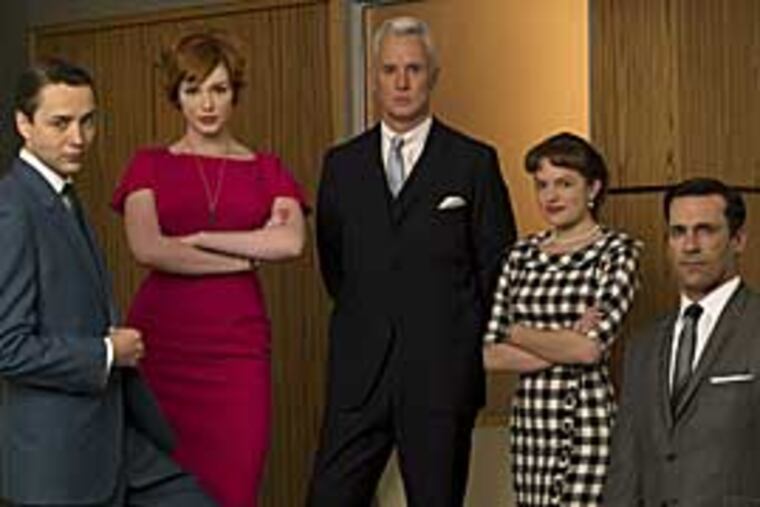
BEVERLY HILLS -
Mad Men
.
Never have so many accolades been heaped upon a TV show that has been seen by so few.
Others can make up for their loss beginning tonight at 10, when the meticulously crafted look at high-wire desperation in the Madison Avenue advertising world in the early '60s returns to AMC.
The show is the product of an obsessive executive producer, who shares some of the traits of his former boss, David Chase of The Sopranos, and of dedicated actors and crew who saw something old and different and stunning and took a shot to get aboard.
It is a deal-changer for everyone involved, not the least of which is AMC, which until now has been best-known as the cable channel that ruined American movie classics by filling them with advertisements.
Fewer than a million people watched initial episodes of the show when they premiered last summer, despite glowing reviews.
But it was noticed in the right places. It beat House and Grey's Anatomy, among others, to be named best TV drama at the Golden Globes last winter. Lead Jon Hamm was dubbed best dramatic actor, though others on the show are just as good. It won a much more prestigious Peabody Award in spring.
On July 19, it grabbed three of the 11 Television Critics Association awards for 2008, including Program of the Year. Only The Sopranos has won more in the same year.
And at the Emmys, where no basic cable show has ever been nominated as best drama, it stands ready in September to win not only that award but 15 others as well, with more nominations than any other drama series.
This is a take-no-prisoners show written by the guy who helped to define, finally, the extent of Tony Soprano's depravity by having him suffocate his beloved, troublemaker surrogate nephew, Christopher.
"I'm enjoying this, let me tell you," says creator and executive producer Matthew Weiner. "No one ever says, 'No one will get that,' or, 'That's too smart,' or, 'Regular people don't like that.'
"No one ever says any of that to me."
That could cause a problem tonight. The already addicted may puzzle that questions from last season are left unanswered in the opening episode, but they will understand the rhythms of a series that can creep stylishly through an entire hour, intimating pending intrigue or disarray, without offering any at all.
Newcomers may find the arrival of the office's first Xerox machine slightly less exciting than the decapitation of Ralph Cifaretto on Weiner's old show. They may not understand the implications - oh, about half a million of them - of Betty Draper's simple imperative, "I wish you would tell me what to do," when a Valentine's Day tryst with her husband suffers mechanical breakdown.
Activities ramp up next week, however, and anyone trying to climb aboard the best series on TV should commit to watching through Episode 2 before deciding it's all too mannered, or action-deficient or disdainful of the solid values of the '50s - a cultural, not numeric, era, of which 1962, where we join the show a year and a half after we left it, was still an integral part.
Much has been made of the series' impeccable style.
"People really do research and try to get it right," says Weiner, who was born in 1965. "The secret: It's really not that complicated. . . . When you do history, everything exists at once. Right now [in 2008], some people are dressed from the '80s, some people are dressed from the '60s.
"I do it on the show."
He cites Peggy Olson, an ambitious, naive, lower-middle-class secretary played by Elisabeth Moss. "For Peggy's outfit on the pilot, I said, 'Just give me 1949.'
"We see Peggy's apartment this year, with a beautiful art deco vanity, because it was used furniture. In Brooklyn in 1960, people were just putting it out in the yard, or in garage sales."
The first shot of the space is from an overhead camera. Peggy is sprawled on her bed in her red party dress, petticoats and all, so outmatched by the dress that her head looks the size of a pea. With Caravaggio colors and some semi-expressionist composition, the shot, like so many in Mad Men, demands a freeze frame for deeper contemplation.
"Peggy is kind of the Everyman," Moss says. "Everybody identifies with her. She's us. She's you, and she's me, and she's Matt."
The giggly Moss, who turned 26 Thursday, has been acting professionally since she was 6 and is best-known for playing President Josiah Bartlet's daughter in The West Wing.
"All the Mad Men characters are very mysterious," she says. "They're very vague sometimes, and you don't quite know what's going on, and I think that's unusual and really cool. Yeah, it's a little difficult to play sometimes, but it's really fun."
Peggy has moved on more than a bit since we last saw her, no longer beholden to the statuesque Joan Holloway, the office manager who was her boss, and the one person in the entire operation who seems to have come to terms with the delicate dance between work and personal life. Which means, most likely, in Weiner's world, that she's headed for disaster.
Joan, dispensing her sexual favors to key men in her world, fully understands the strength of the glass ceiling that holds women down in the office as they dress and flirt, seeking success in the more traditional field of marriage.
"The role wasn't intended to be that at first," says Christina Hendricks, who plays Joan. "Matt said he imagined the role of Joan to be sort of a tight-lipped, mousy, comic-relief character, and when I auditioned, he decided to change it. So I'm incredibly flattered by that.
"I turned down testing on a different show to do Mad Men, because I thought it was so special," she says. "The other one didn't even get picked up. I knew which one was better."
But nobody expected AMC's first drama series instantly to establish the network as a quality destination, something that took Showtime, for instance, more than 15 years to achieve.
"Even we have been blown away," says Ed Carroll, president of Rainbow Media, which owns AMC. "The show has become a cultural icon." And that, Carroll says, means top creators now come to AMC first or second with their pitches, rather than dead last, as happened with Mad Men.
The pilot script, which Weiner wrote while he was working on the Ted Danson sitcom Becker, got him in the door of The Sopranos, but it kicked around Hollywood for nearly three years. Broadcast networks saw no mass audience. Cable networks didn't see it filling a niche.
"The pilot was famous as an unproduced script, after I got on The Sopranos," Weiner said.
That phase now seems almost as far in the past as the show's retro sets and the cigarette- and whiskey-punctuated sexist behavior of the men who rule the roost at the Sterling Cooper ad agency, even as they struggle to hold their own psyches together.
Moss bubbles: "Maybe on other shows, we'd be like, 'Oh, my God, this is really going to take up seven years of my life.'
"But on this, it's like, 'Please go on as long as it can.' "