Forever is here
The impetuous Return to Forever reunion, "the jazz tour of the summer," comes to the Mann, along with reflections on fusion's excellence and excess.
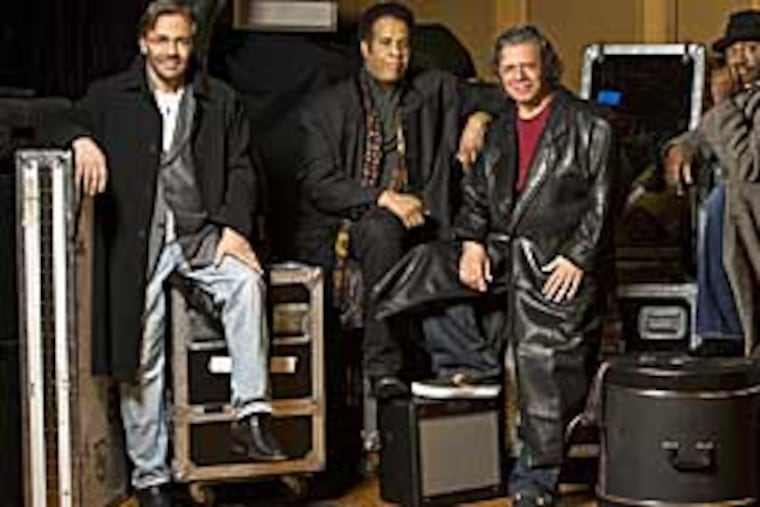
Return to Forever, the jazz-fusion group founded in the early 1970s by master pianist Chick Corea, is in the midst of a reunion tour that few thought would ever happen.
Hard-core fusion fans will be pinching themselves when Corea, guitarist Al Di Meola, bassist Stanley Clarke, and drummer Lenny White take the stage at the Mann Center on Tuesday, on what DownBeat magazine calls "the jazz tour of the summer."
How will the band's hypercomplex works and flights of daredevil virtuosity sound after such a long absence?
Reports from the road are encouraging. But beyond just giving a stiff dose of nostalgia, the Return to Forever (RTF) reunion tells us much about the legacy of fusion and the evolution of jazz aesthetics in a new century.
Clarke, born and raised in Philadelphia, has compared RTF's rebirth to the reunion of the Eagles. But more pertinent examples come to mind: This month, prog-rock warhorses Jethro Tull (Friday, the Mann) and King Crimson (Aug. 11 and 12, Keswick Theatre) will also play Philly, greeting audiences that no doubt overlap with RTF's.
To fusion's detractors, groups like these invented a kind of '70s pretension and bombast that should remain extinct. Granted, RTF's rococo excesses and mystical-futurist presentation - even the band's name reflects Corea's decades-long immersion in Scientology - can seem dated and hard to swallow.
But to write them off is to miss flashes of inspired, individual artistry that have in fact aged quite well.
"Return to Forever" is the title of a 12-minute piece on Corea's 1972 album of the same name. Featuring Corea with Clarke, saxophonist-flutist Joe Farrell, drummer-percussionist Airto Moreira, and vocalist Flora Purim, this lineup became the first edition of RTF, which also released Light as a Feather in 1973.
The group had a strong Brazilian influence. Purim's tender singing, in accented English, recalled Astrud Gilberto on Stan Getz's bossa nova outings of the previous decade. It was no accident that Corea and Clarke spent time in Getz's band, recording several of Corea's RTF-associated tunes on the tenor master's 1972 album Captain Marvel.
But with the appearance of Lenny White and guitarist Bill Connors on Hymn of the Seventh Galaxy, RTF took a more epic-sounding, rock-oriented turn. Soon Di Meola replaced Connors, and the classic RTF quartet brought forth No Mystery, Where Have I Known You Before, and Romantic Warrior - selections from which are likely to send the Mann Center crowd into hysterics.

Return to Forever went through one last incarnation and released two nonessential albums, Musicmagic and Live, before disbanding in 1977.
But it was the classic, now-reunited RTF quartet - along with John McLaughlin's Mahavishnu Orchestra, Joe Zawinul and Wayne Shorter's Weather Report, Herbie Hancock's Headhunters, and Tony Williams' Lifetime - that came to define the fusion era. Every one of these bandleaders was a former Miles Davis sideman. All had participated, to varying extents, in the trumpeter's invention of a new kind of ensemble funk.
Rhodes electric piano, distorted guitar, and flamboyant clothing were the order of the day. Stanley Clarke and Weather Report's Jaco Pastorius introduced entirely new, highly virtuosic approaches to electric bass playing.
Some heard a vital, forward-thinking language. Others heard an appalling sellout, the betrayal of jazz tradition. Peter Watrous, the former New York Times critic, took the latter view in a 1995 piece trashing Wayne Shorter's album High Life and assailing what he called "the Miles Davis curse."
Describing fusion as "a mule idiom, a bastardization of jazz and pop," Watrous slipped in an incisive point: that this music, in part, was a means for jazzers to reconnect with black listeners at a time of changing tastes and widespread social unrest.
The result, Watrous argued, was "shockingly ephemeral." Yet Return to Forever is back (playing, ironically, to heavily white audiences). Boxed-set reissues of Davis' electric music are flooding the market. Recent books on the period include Paul Tingen's Miles Beyond and Philip Freeman's Running the Voodoo Down. (And Concord has just released The Anthology, a two-disc RTF retrospective.)
On countless new jazz recordings, even in primarily acoustic environments, it is common to hear Rhodes and other keyboards, rock-inflected guitars, irregular time signatures, and other fusion hallmarks. For many of today's young jazz players, whether or not they consider themselves fusion artists, these inheritances are a given. Beatmakers and DJs who swoon to old Moog synthesizers and involved '70s funk grooves feel the same way.
To some, fusion will always be a synonym for adulteration, and it's fair to say that the light R&B now known as "smooth jazz" is part of the fusion legacy as well. But arguably, so are the genre-defying works of guitarists Vernon Reid and Marc Ribot. "I think a particular music can be part of more than one history," Ribot says in the biographical film Marc Ribot: The Lost String.
Indeed, hybridization is now the norm across genres. Jazz is being bred with hip-hop and breakbeats, Balkan and Carnatic music (a style of Indian classical), indie rock, you name it. In most cases it is creative growth, not commercial calculation, driving this process.
By the early 1980s, Corea, Clarke and White were playing pure acoustic jazz with trumpeter Freddie Hubbard and tenor great Joe Henderson in a band called Griffith Park. They never burned that bridge. (Hubbard and Henderson were fusion dabblers themselves.)
The classic RTF lineup regathered for a brief tour in 1983, then fizzled for good. Clarke, White and Di Meola have pursued varied solo careers, but none come close to matching Corea's, with 45 Grammy nominations and 14 wins. It was Corea's guest appearance on Di Meola's 2006 effort, Consequence of Chaos, that led to plans for a reunion.
(Clarke will return to the area on Aug. 19, when he performs in the bass supergroup S.M.V. at the Keswick Theatre, with Marcus Miller, and Victor Wooten of Bela Fleck and the Flecktones, who are opening the RTF show.)
Much like Herbie Hancock, Corea has alternated freely between acoustic and electric formats for decades. His RTF recordings stand up as some of the most visceral, harmonically rich, sonically inventive work of his career. There is talk, but only talk, of keeping the band together.
All of RTF's members wrote music for the group, and not every bit of it is stellar. But if they break into the sultry, operatic funk of White's "Sorceress," or the fierce keyboard/bass dialogues of Clarke's "Vulcan Worlds," or the oddly explosive rhythms of Corea's "Medieval Overture," this writer might join the throng and get a little hysterical, too.
If You Go
Return to Forever will appear Tuesday at the Mann Center for the Performing Arts. With Bela Fleck and the Flecktones. Tickets $29-$64. Information: 215-893-1999 or www.manncenter.org.
EndText
The Best of Return to Forever
If you're new to Return to Forever, here's where to start:
Hymn of the Seventh Galaxy (1973) - The classic, hair-raising jazz-rock edition of RTF is born. Original guitarist Bill Connors soon left to pursue solo acoustic playing, then dropped off the radar (left the galaxy?) from the late '80s until 2005.
Where Have I Known You Before (1974) - Rich textural contrasts, short acoustic piano interludes, and an earthshaking finale in "Song to the Pharaoh Kings" make this not just a great RTF album, but one of Chick Corea's most representative works.
Romantic Warrior (1976) - RTF's defining document, a vast improvement over the preceding No Mystery. Al Di Meola's guitar sound reaches maturity, and the crisp, round tone of the recording frames every dazzling solo break and unison passage as never before (or since).
- David R. Adler
EndText