Thanks, Anne, for the treasures
The Art Museum spotlights “Gross Clinic,” and “Angel of Purity,” saved for their city by Anne d’Harnoncourt.
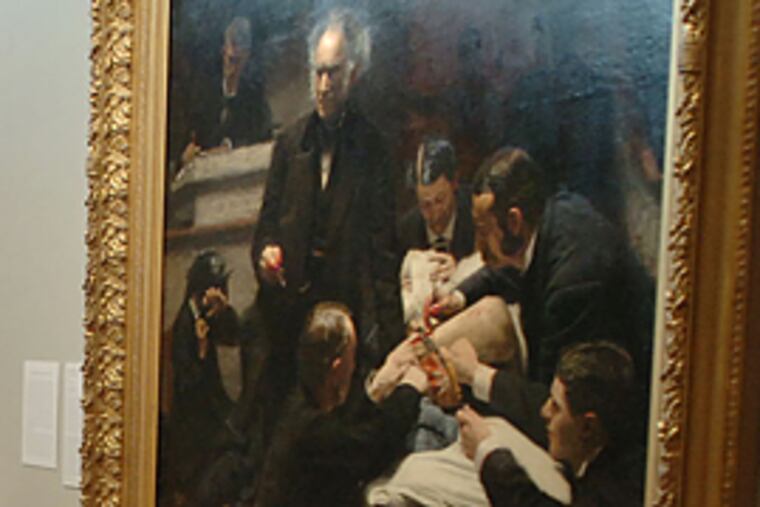
In an unassuming gallery on the first floor of the Philadelphia Museum of Art, a special exhibition is showcasing two of the greatest works ever created by artists in America.
Both are inextricably bound to the cultural history and identity of Philadelphia - and both nearly disappeared from the city in recent years via out-of-town sales.
But Thomas Eakins' The Gross Clinic (1875) and Augustus Saint-Gaudens' Angel of Purity (1902) remain here, thanks in no small measure to the efforts of museum president Anne d'Harnoncourt, who died unexpectedly in June.
"Philadelphia Treasures," which also includes several supporting paintings, including an oil portrait of Eakins done by his wife, Susan Macdowell Eakins, will remain on view through February.
Distressed at seeing other great works of art leave the city - particularly the 1996 sale of Ellsworth Kelly's 64-foot steel sculpture created specifically for the lobby of the old Greyhound Bus offices at 17th and Market Streets - d'Harnoncourt became increasingly focused on Philadelphia's artistic fabric.
The loss of the Kelly, privately owned and sold for $100,000 to Kelly's New York dealer Matthew Marks - who turned around and sold it for $1 million to cosmetics heir Ronald S. Lauder - brought home to d'Harnoncourt the fragility of this city's cultural ecology.
"I was certainly as shocked and amazed as anybody to find it had been removed and was in New York," d'Harnoncourt told The Inquirer in 1998, after Lauder had donated the piece to the Museum of Modern Art (which has since placed it in storage with no plans for future exhibition). "I have to say that it never even occurred to me that it could be removed or moved. Never."
When The Inquirer reported in 2004 that St. Stephen's Episcopal Church on South 10th Street had removed its Angel of Purity to be "cleaned and restored," according to rector Charles T.A. Flood, d'Harnoncourt was all attention.
The one-ton marble piece represented a high point of neoclassical sculpture at the turn of the century and is widely viewed as one of Saint-Gaudens' finest works. Just as important, the piece had been commissioned by Philadelphians S. Weir Mitchell and his wife, Mary Cadwalader Mitchell, in memory of their daughter, Maria, dead from diphtheria at 22.
Largely forgotten now, Mitchell was one of the most prominent doctors and writers of his day. He studied and taught at Jefferson College of Medicine, treated many artists (including Thomas Eakins) for neurological and nervous disorders, wrote several novels (Hugh Wynne, Free Quaker was a 1896 bestseller), and served as a trustee for the University of Pennsylvania (accepting on behalf of the university Eakins' The Agnew Clinic, commissioned and donated by the Penn Medical Class of 1889).
"Mitchell is the link between the scientific community and the artistic community, which is where Eakins lived, too," said Kathleen Foster, the museum's senior curator of American art. "He was a true Renaissance man."
D'Harnoncourt quietly rallied financial support to acquire the Saint-Gaudens when St. Stephen's turned the piece over to a New York gallery, and in 2005, the museum bought it for $2 million to $4 million. A fund for acquisitions supported by the Annenberg Foundation was a key to the purchase, museum officials said.
Prior to its current installation, Foster said, the museum cleaned and restored Angel of Purity and constructed a steel frame for the sculpture, facilitating installation and removal.
"She was in conservation," Foster said of the angel, "and she's about three shades lighter. Taking the years of grime off her completely transformed her."
Natural light from high, recessed gallery windows now floats across the Saint-Gaudens, revealing the deep sadness captured in her features.
With her head slightly tilted, she gazes directly across the gallery at Dr. Samuel Gross, whose portrait by Saint-Gaudens' friend Eakins triggered one of the most dramatic public fund-raising campaigns in the city's history.
At the end of 2006, Jefferson University announced it would sell the painting, widely viewed as Eakins' greatest work, for $68 million to a partnership of two out-of-town museums. But the university stipulated that if Philadelphia institutions could match the price, the painting would remain here, where Eakins conceived it as an homage to the city's scientific preeminence. Jefferson alumni had purchased it and donated it to their alma mater in 1878.
Gross, depicted in mid-operation, bloody hands poised, was one of Jefferson's most famous surgeons.
D'Harnoncourt and the leaders of the Pennsylvania Academy of the Fine Arts mounted a frantic effort to retain the painting for the city, announcing they had matched the sale price in December. (For the last year, the painting has resided at the Academy.)
Now, next to the painting is a broad, thick book in which the names of more than 3,600 Gross Clinic contributors from all over the region, nation and world are inscribed.
But the purchase of the painting did not come without cultural cost. The full purchase price was not raised, and the Pennsylvania Academy, which jointly owns the painting with the Art Museum, was forced to sell another Eakins, The Cello Player, to cover its share.
Earlier this year, the Art Museum followed suit, selling Eakins' Cowboy Singing, plus two oil sketches, to a partnership of the Denver Art Museum and the nonprofit Anschutz Collection, based in Denver and backed by billionaire Philip Anschutz.
The price was not announced, but the Art Museum needed to raise roughly $10 million to $15 million to cover its Gross Clinic debt.
As part of the deal, the Denver Art Museum also sold a half interest in Long Jakes (The Rocky Mountain Man) by Charles Deas, acquired by the museum in 1999, to the Anschutz Collection. The unusual Denver-Anschutz arrangement subsequently raised questions at the Association of Art Museum Directors, according to art blogger Tyler Green.
The association requested details of the arrangement, according to a museum spokeswoman, and discussions about the arrangement are ongoing. The museum directors association said no conclusions had been drawn regarding the nature of the agreement. "It's really a conversation," said Millicent Gaudieri, association executive director.