Ready for a 13.1-mile run: Why they go the distance
It's love, not money, that drives most of these folks to find time to train, at home and away, and compete in races.
Come Sunday, 15,000 people will put aside the coffee, the paper, and the luxury of sleeping in to run 13.1 miles in the Philadelphia Distance Run - one of the city's most popular races.
But it's not something anyone will do on a whim. The task takes months of training and preparation, and most people on the starting line won't be professional athletes. They're neighbors, coworkers, parents - impossibly busy but still managing to carve out time to tackle a prime city race.
If you think you're too busy to run, think again. Here's how a few local runners find the time to train, and why they keep going back for more.
The traveler
"I had always tried to do it before in middle and high school," Rebecca Shapiro, 30, said about running. "I would be on teams, but I was a pretty bad runner."
Then her employer, FMC BioPolymer, offered to pay the entrance fees for any employee who wanted to run the 2002 Race for the Cure 5K. So she entered.
Shapiro prepared by setting goals in time instead of distance, starting with 10 minutes. "Ten becomes 12 becomes 15. Next thing you know, you're finishing your 5K," she said.
Shapiro then used books and an online coach to run longer distances, working up to the 2003 Philadelphia Marathon, a 26.2-mile race. This year's Philadelphia Distance Run will be her third, and she plans to run the Philadelphia Marathon Nov. 23.
"One of my favorite parts of the race is when you're going down Martin Luther King Drive and looking across the river to the fast runners coming the other way down Kelly Drive," she said. "You're never going to play golf with Tiger Woods but you can be in the race with world record holders."
As an area sales manager, Shapiro is on the road sometimes as many as 18 days each month. She runs three days a week - through Philadelphia when home, and when on the road, creating routes by using the Garmin 305 Forerunner watch. It tells her where she is and how far she's run. Sometimes her views are stunning - she counts trails in Utah and California as her favorites - and sometimes not. "I was staying in an industrial park," she said of a recent business trip, "and just ran laps around the parking lot."
Shapiro continues to run for confidence and stress relief. "If I can go out there and run and meet the challenge I set for myself, it's like I can do anything," she said. "I ran the marathon and that took five hours, so if my flight's delayed for two hours, that's not as long as a marathon."
The team players
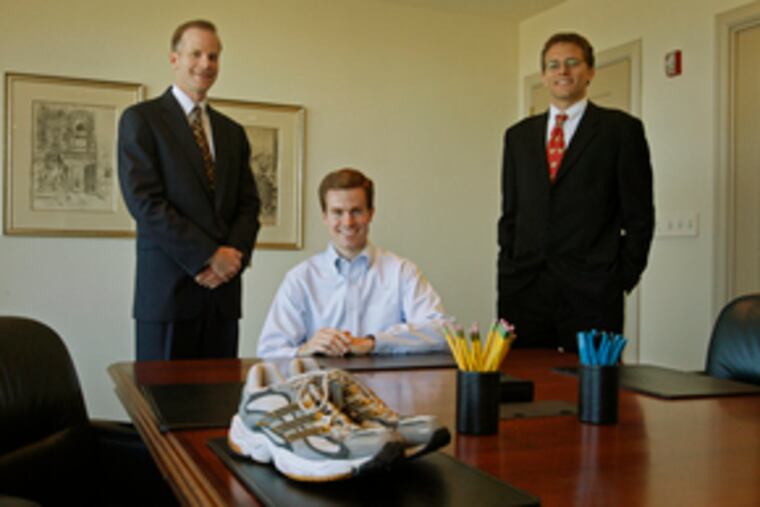
Bill McSwain and Brad Barron don't call themselves serious runners, even though they have a handful of marathons and half marathons between them. The real runner, they said, pointing across a conference-room table, is Joe Doherty.
"My idea of warming up was doing a few toe touches," McSwain, 39, said about the time he ran the 2008 Broad Street Run, a 10-mile race. "Joe warmed up for that by running to the start line." Not so impressive unless you consider that Doherty started from his Manayunk home, 10 miles away.
"I had to get a few extra laps in," said Doherty, 28.
The trio are lawyers at Drinker Biddle's Philadelphia office and form the Drinker Biddle team that runs the annual Chester County Bar Association's Trial Run 5K. It was the law firm of Unruh, Turner, Burke & Frees that initially lured them, saying it would donate $100 to the local Legal Aid fund for every team that beat its own. Drinker Biddle's team went on to win two years in a row.
Doherty ran in high school and kept up his routine while on the crew team in college. He's completed nine marathons and two Philadelphia Distance Runs, and his training gets him up at 5 a.m. six days a week.
"It's such a minimalist sport," said Doherty. "I don't wear a watch. I don't like gear. I don't even think I need a Dri-Fit T-shirt." (That's one of those high-tech garments that help regulate body temperature.)
McSwain is a former Marine who plans to run the Marine Corps Marathon Oct. 26, something he did 14 years ago.
"Some people say that a lot of lawyers are out of shape because they spend a lot of time at a desk," said McSwain, who works out in the morning - once a week with the West Chester Running Club, once a week with a partner, and then on his own. "But a lot of us are Type-A obsessive people, which lends itself to competing and racing."
Barron, 28, played varsity water polo in college and during law school. He also trains on mornings before work. "Running helps bring structure to the day and week," said Barron. "It helps keep me focused. When I do heavier training, I have a better workweek."
The parent
Mark Gatti, 40, of Audubon, insists he was a chubby kid. Now he looks fit and trim sitting at Grooveground coffee bar in Collingswood, his sons Nick, 11, and Sam, 6, by his side.
Gatti, a cartography supervisor with the Delaware Valley Regional Planning Commission, picked up running 12 years ago when he joined the now-closed Echelon YMCA to lose weight; his first race was the Bancroft Neurohealth 5K (now the Haddonfield Adrenaline 5K Run). Later, he joined an online listserv of local runners and picked up tips on how to train for longer runs. He's since run seven Philadelphia Distance Runs, two marathons and five Long Beach Island 18-Mile Runs.
He was running more than 20 races a year during what he considers his peak. But while training for the 2000 Philadelphia Marathon, Gatti promised his wife, Dee, that he wouldn't run another marathon until their son, Sam - born a few weeks before the race - was at least 5 years old. With two children, she wanted more help from him. Now that Sam is 6, Gatti plans to run both the Philadelphia Distance Run and Philadelphia Marathon this year.
He trains early, running shorter courses before work on weekdays and getting up at 5 a.m. one day a weekend to complete a long run. After his weekend run, Dee hands over the children in time for their sports practices, activities, and any homework that needs to be done. It's a hectic schedule.
"I start out by thinking, 'Why am I doing this?' " he said, but running in the morning doesn't tire him out. "It gives me energy."
He doesn't have as much time to train now that he has two growing and busy sons, but he squeezes in those runs to balance his day - and his life.
"I see it as meditation. I need to zone out and think. Without that, things start to go downhill."