On Movies: Harris gets back in the directorial saddle
TORONTO - It took him eight years, but Ed Harris finally got to direct another movie. Appaloosa, a loping, likable Old West yarn about friendship, power, corruption, and a woman with fierce instincts for self-preservation, is something the four-time Oscar-nominated actor cottoned to (as they say in those oaters) when he read Robert B. Parker's novel back in 2005.
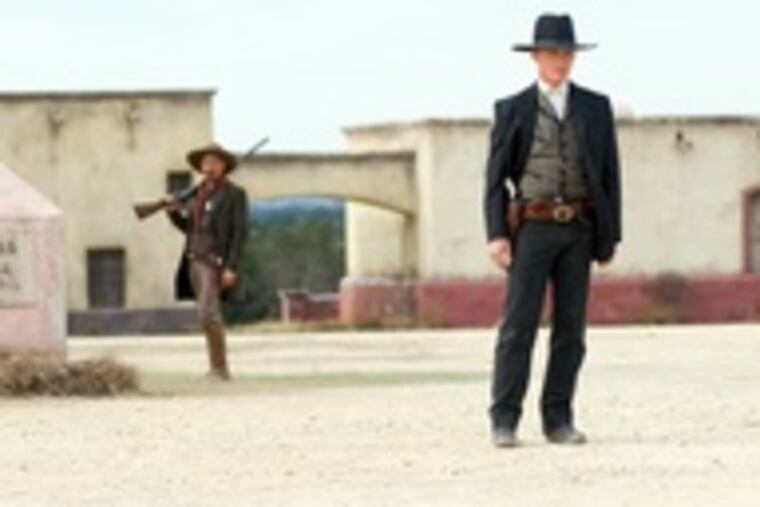
TORONTO - It took him eight years, but
Ed Harris
finally got to direct another movie.
Appaloosa
, a loping, likable Old West yarn about friendship, power, corruption, and a woman with fierce instincts for self-preservation, is something the four-time Oscar-nominated actor cottoned to (as they say in those oaters) when he read
Robert B. Parker
's novel back in 2005.
Harris, who cast himself in the title role of his directorial debut,
Pollock,
was itching to get back behind the camera, and here was his ticket. He gave himself the part of the gun-for-hire hero, and hired
Viggo Mortensen
as his laconic, wily sidekick,
Jeremy Irons
as the murderous powermonger, and Renée Zellweger
as a woman who turns heads and hearts in 1882 New Mexico.
Appaloosa
, nicely received at the Toronto International Film Festival a few weeks ago, opens Friday.
"I really do enjoy being involved in all aspects of filmmaking," says Harris, in a hotel room overlooking Lake Ontario on the day after
Appaloosa's
festival bow.
"As a director, seeing where this germ of an idea leads you, it's a thrill. You know, some directors say they have a 'vision' of their project. But for me, it's - well, you just have a
desire
in a way, and then it manifests itself. Which is cool, because you're not quite sure where you're going to go, or how you're going to do it. You just want to, and need to."
It's all about putting your trust in others, Harris says - department heads, production designers, costumers, and, of course, actors.
"Yeah, big time. And in their aesthetic, and wanting them to grow as artists and go someplace they haven't been. So it's pretty invigorating. Particularly when you start shooting, but even in pre-production . . . you're forced to be in the moment, and deal with the situation, because there's nothing but decisions to be made, constantly.
"And I'm not that decisive a person in my everyday life, you know what I mean?" He cracks a smile. "So it's really a nice thing for a couple of months to have to be very decisive, and be responsible for those decisions. . . . Then I can go back to being my wavering, wishy-washy self."
Harris, 57, New Jersey-born, possesses one of those rugged, iconic American faces that has given him the chance to play heroes (
John Glenn
in
The Right Stuff
) and villains (
E. Howard Hunt
in
Oliver Stone's
Nixon
) and all manner in between. His portrait of the pioneer abstract painter
Jackson Pollock
won him an Academy Award nomination, and he has appeared in significant commercial and cultural hits over the decades:
Apollo 13
,
A Beautiful Mind,
Places in the Heart
,
The Truman Show.
It was on the set of
David Cronenberg's
A History of Violence
that he got to know Mortensen. Harris had only two weeks on the shoot, playing Mortensen's character's shady nemesis, but the two hit it off, and when Harris was looking for funding for
Appaloosa
, he sent the script to Mortensen.
The Lord of the Rings
' star's commitment helped Harris get his financing in place.
And the two of them - as ace gunslingers, old confreres - are terrific together in
Appaloosa.
"I always intuitively felt that this is a guy I can do this with," Harris says about his costar. "It's not like you can really invent the chemistry between people. There's either something going on, or not. You sit two people down and they either have some unspoken feeling that they belong together, or not. . . .
"You know how sometimes you'll have a [movie] romance where the man and the woman, where it's just not happening? But I kind of trusted that we could make it work."
Which isn't to say that
Appaloosa
is gay - there's a reason Zellweger is in the picture, too. But like a lot of Westerns, the male bonding gets pretty intense. Along with the horses, the hats, the guns, it's part of that Hollywood tradition.
"I wasn't looking to do a Western, per se," Harris explains. "But I started reading this book, and I wanted to see if I could bring this relationship between these two guys to the screen. That's what really got me when I read this book. And it also made me laugh quite a bit. . . . They can be pretty funny."
The fact that it was set in the western territories in the 1880s just made it "even better," Harris says.
"I've always loved Westerns. And I like to ride. I know it's a genre that's not tapped into that much these days, they're not as 'cool' as they were once considered to be. Which is understandable in terms of times changing, the way we live these days. But I figured it was a good story, and the characters were interesting. So I decided, let's do it."
If
Appaloosa
- the name of the town in the movie - does decent business, Harris says, he wouldn't mind following the fates of the three characters in a second film.
And he certainly wouldn't mind directing again. Although, "I don't particularly want to wait another eight years," he says.
"But Parker has written two sequels to this novel. And if this is successful and they wanted to do another, and the cast wanted to, I could see that it would be interesting, combining the two books. We can see where these three lives go, what trouble they get into."
"Lucky" man.
Writer-director
Neil Burger
had the world premiere for his
The Lucky Ones
in Toronto, in a theater with 2,000 people, 21/2 weeks ago. The road movie, about three returning veterans of the Iraq conflict (played by
Rachel McAdams
,
Michael Peña
and
Tim Robbins
) traveling across the States in a rented minivan, was received rapturously.
The film opened across the country on Friday, and Burger, on the phone last week, hopes it gets the same sort of response.
"I hope people get the tone mixture of absurdity and tragedy," he says. "It's a deliberate risk that we took, but a purposeful one . . . to go at the subject matter in sort of a roundabout way. I knew that to go head-on at the subject" - the war in Iraq - "in a dogmatic way, or intensely serious way, was to just drive audiences away, you know?
"The humor is like the Trojan horse - it gets you through the wall . . . it breaks down people's resistance, it breaks down their guard. And so they kind of fall in love with these characters.
"After laughing, and having the scab knocked off the wound by the laughter, then the other feelings are that much more intense."
True that.