The movies, and readers, love him
Author Chuck Palahniuk has adoring fans all over, including Hollywood.
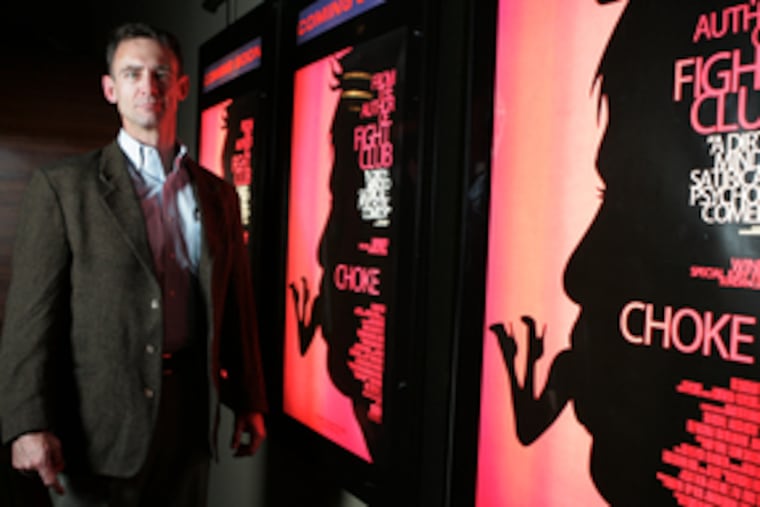
They're not here for the movie.
For the 200 Penn and Drexel students overflowing West Philly's Bridge theater on Tuesday
, Choke
, the comedy of sexual addiction and filial love, is not the principal draw. Nor are the film's stars, Anjelica Huston and Sam Rockwell.
Like Neo with the Oracle, the students have come to bathe in the aura of their prophet, Chuck Palahniuk, who wrote the book that inspired the film.
As the credits roll, he materializes in the theater. Down from the stadium seats, beatific eyes shine, searching for answers, guidance, grace - perhaps a cameo in the next book?
Palahniuk cuts a compelling figure, this blue-collar intellectual with a passing resemblance to Ed Norton. But admittedly, the guy tagged "the rock star of the literary circuit" by the Free Library's Andy Kahan is, tonight, less in-your-face Mick Jagger than avert-his-eyes Kurt Cobain.
Can it be that the creator of
Choke
's Victor Mancini, a sexaholic screw-up who attends Sex Addicts Anonymous meetings in order to meet insatiable women, is painfully shy?
And given his material, can it be that this ex-machinist, prolific author of precision-tooled, scabrously funny, envelope-pushing books such as
Snuff
,
Fight Club
and
Rant
, is on track to become the movies' most-adapted writer since Stephen King and John Grisham?
Two Palahniuk books have received the movie treatment thus far, seven more are in development, and
Snuff
- well, how do you make a movie about the world's biggest orgy?
Palahniuk (say PAULA-nick, that's how his grandparents Paula and Nicholas said it), is cheroot-slim, self-effacing, soft-spoken. He is unfailingly polite.
His books are anything but. At public readings, their sexual, medical and psychological candor makes audience members pass out. He strikes nerves - and pay dirt. People who ordinarily don't buy books buy his.
In the decade or so since Palahniuk's first,
Fight Club
, was adapted into a film, the Oregon-based author has quit his day job, reliably turned out a volume a year, and toured three continents to meet readers.
In return his fans, mostly in their 20s, perform curious devotionals. More than one has self-mutilated in homage to the notorious lye scene in
Fight Club
.
In May 2007 at the Free Library, 900 fans descended, more than half turned away from the packed auditorium. Many were men in bridal gowns, Palahniuk having promised in advance to throw a bouquet to anyone who came wearing one. Rare is the author who throws posies at readers, rarer still the reader who takes them to weave into hero's garlands.
If there are any personality disorders or exhibitionists at the Bridge, they are neither audible nor visible. Tonight, books will be autographed, movie posters signed. But what's happening here isn't the ordinary celebrity/fan transaction where the famous graciously gives a relic to a supplicant.
What's happening, as Palahniuk launches into an O. Henry-like yarn about his friends and their diabetic cat that will be put to sleep when its expensive food runs out (if they don't secretly continue to replenish it) is "audience seeding," a give-and-take that puts author and audience on the same plane.
As Palahniuk tells it over dinner at Pod before his appearance at the Bridge, "There are three aspects to audience seeding."
"One, it allows you to test a new premise.
"Two, if you cast a net for something you're researching, the audience will bring you back anecdotal examples that might be more useful.
"Three, it allows you to hone the timing and pacing of your stories, like vaudeville.
"Essentially, audience seeding permits you to beta-test your work. You hear when you need that beat," says the writer, who quietly explains that he "vampires off the deeds of my audience and the misdeeds of my friends."
Palahniuk, 46, is a most linear speaker, perhaps the result of 13 years on the assembly line at Freightliner trucks in Portland, Ore. Or of being the son of a brakeman for the Burlington/Northern Santa Fe Railway.
But to become a writer Palahniuk, the second of four children of the brakeman and his wife who split when Chuck was 10, took a more circuitous route.
Not to put too fine a point on it, he says, quoting his younger sister, the Palahniuks were "trailer trash." He grew up in a "single white trailer" stranded across the street from the tavern in Burbank, Wash., pop. 800. Every night his mother would arrange the kids "like spokes in a wheel, reading to us so slow that we couldn't wait to learn to read ourselves." From early on, Edgar Allan Poe was a favorite.
After his father decamped for what would be the umpteenth and last time, Chuck was encouraged in his writing by his fifth-grade teacher, Mr. Olsen, who told him, "Chuck, you do this really well. And this is much better than setting fires, so keep it up."
When Palahniuk speaks about his childhood - "It was the '70s! Nobody had homework! It was the generation of Everybody Left Behind!" - you hear the irreverent voice of his narrators.
But it's what he doesn't talk about that lies behind his narrators' unspeakable pain. That would be the killing spree by his paternal grandfather that nearly took his father's life in 1943. And the murder - committed by his father's girlfriend's jealous ex - that took his father's life in 1999.
Working his way through college(s) as a movie projectionist, the younger Palahniuk applied himself, earning a degree in journalism from the University of Oregon in 1986. "But I made more money as a bike messenger delivering ad proofs than as a reporter."
So, with 12 grand in student loans to pay off, he got a real job - as a machinist at Freightliner. It might not be the most direct route to writing. But his experience on the main assembly line where the chassis come down and on the branch lines where the axles and engines come in, gave him a conceptual map of how to put together components of literary as well as motor vehicles.
In the early '90s he made two important connections. He got involved with the man with whom he shares a spread on the Columbia River, in Oregon. And he hooked up with a group "of nice ladies who wrote mysteries and thrillers with the word
child
in their titles."
"I knew I couldn't do this writing thing by myself," he says. But they weren't the ideal audience for his story about the guy who nails the sex doll that springs a slow leak and deflates during congress.
Then he found his literary mentor, Tom Spanbauer, a protege of editor Gordon Lish, and joined the Thursday night writing group that has been his creative support for 15 years.
"We studied Amy Hempel and learned to write like her, then Thom Jones and learned to write like him, then Tom Spanbauer and learned to write like him," he says. At the Bridge, he tells the crowd, "Develop your own writing voice by stealing what you like about other people's writing voices."
A young woman asks if she can give him a story she has written. With a shy smile he accepts an envelope from her trembling hand, and tenderly slips it into his breast pocket.