The Revolution, in art and artifacts
The two Georges stand directly across from each other, as if facing off for a fight. On one wall, Britain's King George III stands in his coronation robes of ermine and velvet. In Allan Ramsay's oil painting, he is aloof, staring into the distance, one hand on a table, the other at his waist.
The two Georges stand directly across from each other, as if facing off for a fight.
On one wall, Britain's King George III stands in his coronation robes of ermine and velvet. In Allan Ramsay's oil painting, he is aloof, staring into the distance, one hand on a table, the other at his waist.
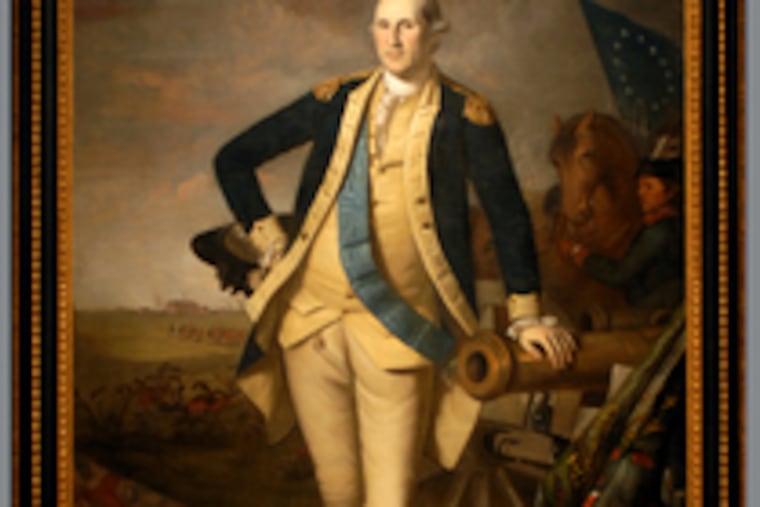
On the facing wall, a more engaged George Washington strikes a similar, if easier, pose. The general's eyes look squarely at you from Charles Willson Peale's oil; a subtle smile crosses his face as his hand rests on a cannon following victory at the Battle of Princeton.
More than two centuries ago, these two full-length paintings hung in the Statehouse - now Independence Hall - but not at the same time. Today, they're face-to-face at the Pennsylvania Academy of the Fine Arts, part of a provocative new exhibit using rare art and artifacts - never before displayed together - that tell the story of the Revolution and mark the 225th anniversary of the Treaty of Paris, which secured American independence.
The exhibit, " 'Peace, Liberty and Independence': 225 Years After the Treaty of Paris," runs through Oct. 19.
"This is unique," said art historian David Brigham, the academy's Edna S. Tuttleman museum director and cocurator of the exhibit. "They will never be together again. . . . There should be thousands of people here to see this."
The exhibit "brings together pieces from private collections and institutions," said R. Scott Stephenson, exhibit cocurator and director of collections and interpretations for the planned American Revolution Center at Valley Forge, which partnered with the academy to present the collection. "It's very rare to have a gathering of material like this in one place."
Next to the portraits of Washington and King George are cases filled with the period's formidable implements of war: American and British muskets, swords, bayonets and powder horns, many of them beautifully carved or engraved.
Two galleries display paintings, prints, banners, watercolors, maps and documents, as well as a William Rush sculpture and Peale's portrait of the Marquis de Lafayette, American's important French ally.
On one wall is Paul Revere's incendiary hand-colored engraving of the Boston Massacre,
The Bloody Massacre Perpetrated in King Street
, an event - and image - that helped propel the colonies toward armed resistance.
"For me, as an art historian, I think what is most important in doing an exhibit like this is to show that art did not simply reflect history; it helped shape history," said Brigham.
"It was used for persuasive means. It was used to establish authority. It was used to create cohesion among 13 otherwise divergent colonies with their own economic and social needs and pressures. Art is not simply a record. It was actually created to help win the war."
The art and artifacts track "more than a decade of transformation," Stephenson said. "In the beginning of this story, virtually no one was thinking about American independence. It was probably even undesirable, certainly to people like George Washington and most of the protagonists.
"There was such a tremendous change in a short period of time that's really traced through these works and works of such central significance to the story."
Hundreds of years later, the pieces still evoke strong emotions, especially evident in the gallery where the squaring-off of the portraits of Washington and the British King is the principal focus.
"To see those two Georges facing one another across the gallery is powerful," Stephenson said. "I know them from books. I know them from intellectually thinking about them. But to literally be able to stand between them, turn your head one way or the other. . . ."
The painting of George III was finished soon after his 1761 coronation. Copies were sent to North American and other colonial British cities, where they were prominently displayed, said Brigham.
"George III is not going to travel to all places of business and government in the British empire, but his protrait is," he said of the painting, restored by the academy a few years ago.
"When they were writing the Declaration of Independence and then reading it for the first time in Statehouse yard, this was the public image of George III. It was still hanging in the Statehouse."
But it didn't stay there long. Another portrait went up a few years later: Peale's 1779 portrait of Washington, which helped rally Americans to enlist, invest and commit themselves to the war, which was not officially over until 1783.
While one exhibit gallery focuses on the days leading up to and including the Revolution, the other takes visitors to the aftermath. Here are two iconic full-length portraits of President George Washington by Gilbert Stuart, one privately owned, the other belonging to the academy.
"The pair of portraits points to the fact that Stuart basically had a whole major chapter of his career focused on painting portraits of George Washington," said Brigham.
"Stuart came to Philadelphia [in 1794] for the express purpose of painting a portrait of George Washington. He ended up painting more than 100 of Washington in the remaining years of his career."
In this gallery too is Benjamin West's beautiful, albeit unfinished, painting of the 1782 signing of the preliminary Treaty of Paris. The official treaty was signed in 1783.
"I can't tell you, during the course of working on this exhibition, how many conversations I had where educated adults said to me, 'Oh, 1783 - I thought the Revolution was over in 1776,' " said Brigham. "This is a 25-year-long chapter in American history. It is not the reading of a document in public and then we go from subservient colonial body to being an independent nation."
He said the exhibit tries "to break up that sense of inevitability. This thing could have gone other ways. There were lots of complexities and lots of moments when the future was not certain. Time is linear but history is not. It is much more complex."
The academy's exhibit partner, the American Revolution Center (ARC) at Valley Forge, also has been trying to find its own future, with plans for a new museum and conference center on a 78-acre tract in Lower Providence Township. Several local politicians and business leaders have expressed concern that having two competing Valley Forge sites - ARC's and the National Park Service's Welcome Center - would benefit no one.
While waiting for construction to go forward, ARC sees the academy exhibit as a way of beginning its mission of sharing its wealth of art and artifacts from the Revolution.
"I think we're fighting against historical illiteracy," said ZeeAnn Mason, ARC's senior vice president. "This is a wonderful way of using art objects to try to help people remember - or maybe discover their history."