Art: Calder's ingenious jewelry; Neel's portraits
Alexander Calder created some of the most monumental sculptures of the 20th century, and also some of the smallest. It's a measure of his talent that his visual ideas not only proved to be adaptable to any scale, but also could comfortably straddle the divide between pure aesthetic statement and decorative embellishment.
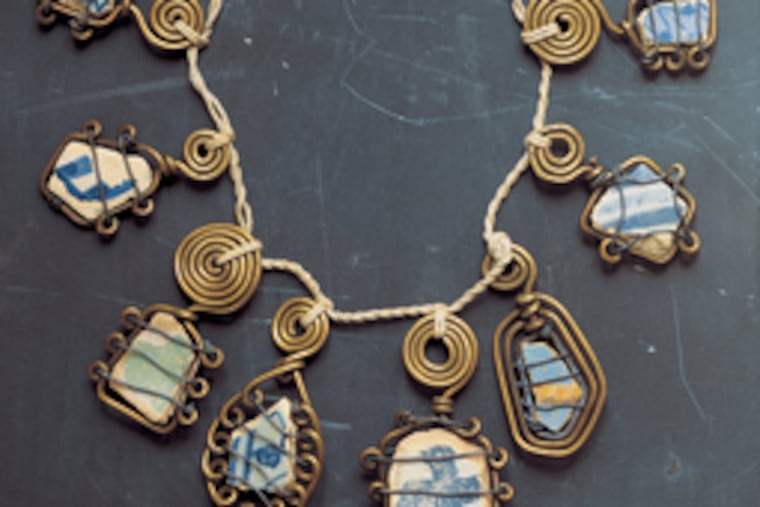
Alexander Calder created some of the most monumental sculptures of the 20th century, and also some of the smallest. It's a measure of his talent that his visual ideas not only proved to be adaptable to any scale, but also could comfortably straddle the divide between pure aesthetic statement and decorative embellishment.
We're speaking now of Calder's jewelry, a not-insignificant aspect of his artistic production over six decades. We're also speaking again about the shattering of hierarchies.
Like the artists of Gee's Bend, Ala., who transform utilitarian fabrics into dazzling works of art, Calder injected aesthetic gravity into a decorative genre that traditionally relied on sparkle, precious metals and ostentatious display.
Calder's jewelry, presented in a major exhibition in the Perelman building at the Philadelphia Museum of Art, is clearly the work of an artist rather than an artisan. In terms of craft, it's primarily ingenious rather than finished to a high polish or encrusted with precious gems.
The pieces are usually animated rather than static, and sometimes larger than one might think practical, especially the brooches and necklaces.
Besides his famous mobiles and stabiles, which extended modernist sculptural vocabulary in delightful ways, Calder created more than 1,800 pieces of jewelry. This exhibition of about 100 necklaces, bracelets, pins, earrings and tiaras represents the first time the jewelry has been considered on its own, rather than as a sidebar to sculpture, textiles and works on paper.
The show was organized jointly by the Norton Museum of Art in West Palm Beach and the Alexander Calder Foundation in New York. After closing here Nov. 2, it will be presented at the Metropolitan Museum of Art beginning Dec. 8.
It comes with a lavishly illustrated catalog that includes an essay by Mark Rosenthal, former Art Museum curator, an adjunct curator of contemporary art at the Norton, and one of the co-organizers.
Much of Calder's sculpture has been characterized as "drawing in space," using bent wire or thin lengths of metal to describe volumes. (The mobiles add motion to this equation.)
Much of the jewelry also embodies Calder's genius for using wire and a pair of pliers like pencil and paper. The most spectacular examples of this idea are the flowing necklaces that envelop the wearer's neck and shoulders like shawls.
The necklaces aren't just large, they're also more three-dimensional than flat, typically bearing spiked projections as if to discourage unwelcome intimacy. While they achieve their full effect when married to a person, they also stand alone as fully realized sculptures. One especially stunning example is constructed like a mobile, its elements counterbalanced into delicate equilibrium.
Calder's brooches are generally flat, but some seem too large to be worn comfortably. As someone who doesn't wear jewelry, I tend to consider them as intricate sculptures composed of metal ribbons that curve and coil and turn back on themselves like miniature mazes.
Calder's only concession to standard jewelry practice was to use gold and silver wire for some pieces, the wires flattened into ribbons by hammering. Yet just as often he used brass wire the same way.
When he wanted a nonmetallic counterpoint, he might use shards of pottery or hunks of irregular glass, never precious stones. As a result, the value of his jewelry derives from its aesthetic quality rather than from the market value of its components.
Most of the pieces in the exhibition date to the 1930s and '40s. Calder began making jewelry in earnest in the late 1920s, while living in Paris, and first showed it commercially in 1929. (An exhibition of work from his Paris years will open at the Whitney Museum of American Art on Oct. 18.)
"Calder Jewelry" is a fascinating and instructive exhibition not only because it reveals the artist's exceptional skill and ingenuity as a maker of ornament, but also because it emphatically confirms that artistic intelligence cannot, and should not, be arbitrarily compartmentalized.
Moore's first daughter.
Alice Neel (1900-84) is perhaps the most famous painter to have attended Moore College of Art and Design. No surprise, then, that Moore has chosen to celebrate its 160th anniversary with an exhibition of painted and drawn portraits (with a companion show of clothing designs by alumna Mary McFadden).
The Philadelphia Museum of Art staged a major retrospective for Neel, who was born in what is now Gladwyne, in 2001. This show, 28 drawings and nine oils, doesn't add anything significant to that survey, although it does cover more than a half-century of her career, from the early 1930s to the early 1980s.
For people thoroughly familiar with Neel's distinctive style, exemplified by one of the show's most alluring portraits,
Ginny in Blue Shirt,
the earliest work might be the most intriguing. It includes a small female nude from 1930 and several drawings made several years later, particularly the gauntly expressionistic
Spanish Mother and Child.
Neel's vision was always basically expressionistic, but it softened over the years. Except for two intimate watercolors from the 1930s in which she depicts herself and a lover, the earlier oils and drawings look not only tentative but somewhat crude in execution, like cave art.
After she settled into her mature style, Neel's empathy for her sitters became more pronounced. She painted family members, such as her sons Richard and Hartley, and people she knew from New York's bohemia and working-class neighborhoods.
The finished portraits are the antithesis of photographic or formal boardroom-type likenesses. They are more labors of affection in which viewers can sense an intense connection between Neel and her sitters.
If you missed the museum retrospective, the Moore show offers a piquant sample of one of American art's most individualistic approaches to one of painting's most traditional genres.
Art: Sculpted Jewelry
"Calder Jewelry" continues in the Perelman building of the Philadelphia Museum of Art, Fairmount and Pennsylvania Avenues, through Nov. 2. Hours: 10 a.m. to 5 p.m. Tuesdays through Sundays. Admission to Perelman is $7 general, $6 for visitors 62 and older, and $5 for students with ID and visitors 13 to 18. Pay what you wish Sundays. Information: 215-763-8100, 215-684-7500 or
» READ MORE: www.philamuseum.org
.
"Alice Neel: Drawings From Life" continues at Moore College of Art and Design, Parkway at 20th Street, through Dec. 6. Hours: 11 a.m. to 7 p.m. Mondays through Fridays, 11 to 5 Saturdays. Information: 215-965-4027 or
» READ MORE: www.thegalleriesatmoore.org
.