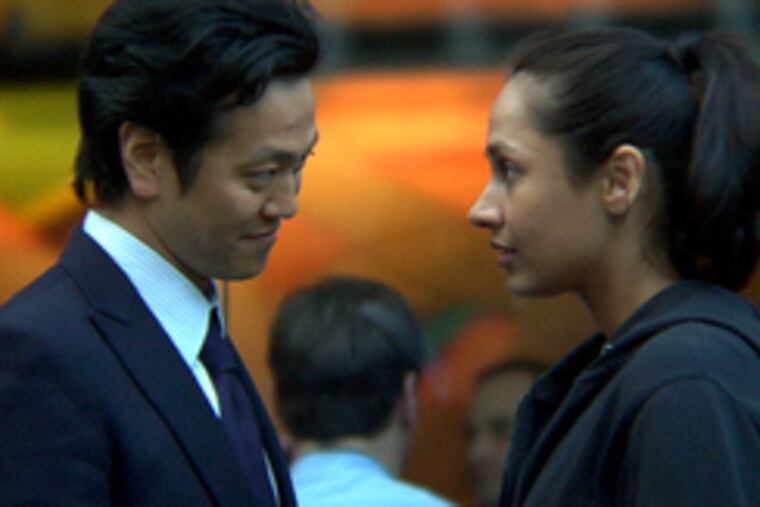
Tonight Philly will join a dozen North American cities - from Vancouver, San Francisco and Los Angeles to Houston, Chicago and Pittsburgh - to offer an Asian American Film Festival.
It's about time, say festival organizers Joe Kim and Franklin Shen, two young local filmmakers who will launch the inaugural Philadelphia Asian American Film Festival (PAAFF) tonight at 7 in University City. It starts with a screening of the critically acclaimed drama Far North, starring Dirty Sexy Money's Michelle Krusiec and Hong Kong movie legend Michelle Yeoh at the Bridge movie theater.
The rest of the fest includes screenings of seven other features and 30 shorts, plus a film-industry panel discussion. It all takes place at the Asian Arts Initiative near the Convention Center in Center City tomorrow through Sunday.
"Asian American film festivals have been around . . . since New York launched the first one in 1978," says Kim, 29, a Cheltenham High School alum who studied film at Temple. "Philly is the fifth-largest city in the country with a large Asian population, and yet it's never had one."
Shen, 27, grew up in Lancaster and volunteers in a mentoring program for Asian American students at his alma mater, Penn. He said PAAFF's offerings, selected from more than 120 entries, represent a broad range of cultures, including Vietnamese, Korean, Chinese, Filipino and Indian. Ethnic identity, he says, is the "underlying issue that affects most of the other issues" in the films.
Notable features include Kissing Cousins (screening Sunday at 6 p.m.), a terrific romantic comedy from Indian American director Amyn Kaderali. The film tells the tale of Amir, a "relationship termination specialist" who breaks up other people's romances for a living.
"The premise is that the guy has difficulty with his own relationships," Kaderali says in an understatement.
Kaderali, an NYU Film School grad, said he wasn't interested in making a film that's only about skin color: "We wanted to make a very mainstream Hollywood comedy, and the leads just happen to be brown. . . . But I have learned over the past year that people put you in a box no matter what." He said he's frustrated by Hollywood execs who tell him Cousins will appeal only to other Indian Americans: "Nobody watches a Matthew McConaughey movie and then says, 'Wow, that was such a great Irish American movie!' "
Samrat Chakrabarti, who plays Amir, feels the same frustration. "There are only so many doctors and terrorists you can play," said the London-born actor, who has had supporting roles in Law & Order, The Sopranos, and Hope and Faith.
The irony, he said, is that Cousins was never intended as a political film. "I may not be involved directly in politics, but politics is involved in me," he said. "It's in every casting choice and every part I play."
New York attorneys-turned-filmmakers Steven Hahn, 34, and Francis Hsueh, 34, take a different tack with Pretty to Think So, which raises subtle questions about a controversial aspect of racial politics. The story of a tragic love triangle among an Indian American woman and two rival suitors, one Korean American, one Chinese American, the film explores the ethnic barriers that still exist within the larger Asian American community.
Hsueh said he and Hahn didn't want to force the issue: "When the [audience] see the faces on screen, they will make certain judgments and assumptions of their own."
The festival's most enjoyable entry is the frenetic Planet B-Boy, documentarian Benson Lee's exploration of the international b-boy (or break dancing) scene. Shot on location in America, Korea, Japan and France, Lee's film follows five b-boy crews as they prepare to compete in the olympics of b-boying, the Battle of the Year in Germany. Planet B-Boy screens Saturday at 8:30 p.m.
Lee, who grew up near Huntingdon Valley, said he was first exposed to hip-hop and break dancing via the TV show Dancing on Air. "I saw people like Grandmaster Flash, and I was just mesmerized by these kids who were spinning on their backs on the floor," he said.
He said breaking, which had disappeared from MTV by the early 1990s, is having a worldwide resurgence and is especially big across Asia: The Korean crew dominates many of the contests.
But like many of the other filmmakers in the festival, Lee is adamant that he doesn't want to be pigeon-holed as an Asian American filmmaker: "I don't do films to express my Asian identity. I make films to become a filmmaker."