Lindsey Buckingham plays Keswick Theatre
In Fleetwood Mac, Lindsey Buckingham plays the role of mercurial mad scientist, toiling away in his sonic laboratory until he emerges with songs that might be considered avant-garde were they not so irresistibly catchy.
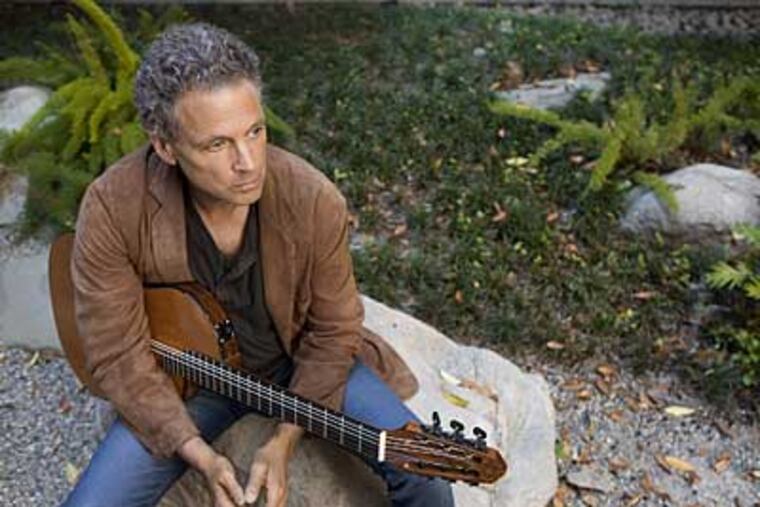
In Fleetwood Mac, Lindsey Buckingham plays the role of mercurial mad scientist, toiling away in his sonic laboratory until he emerges with songs that might be considered avant-garde were they not so irresistibly catchy.
If you forget for a moment that "Second Hand News," one of several Fleetwood Mac numbers Buckingham inserted into his Keswick Theatre concert Saturday night, is drawn from one of the best-selling albums of all time (Rumours, at 30 million-plus copies), you might be struck anew by the song's sheer and utter strangeness. Its middle section, nestled between verse and chorus, comprises nasal, almost aggressively unpleasant nonsense syllables interspersed with Buckingham's exhortation to "Do it do it do it!" Do what, now?
On his own, away from what he referred to as the "massive selling machine" of Fleetwood Mac, Buckingham often develops a case of cabin fever. His five solo albums have produced a handful of gems, like the manic title track of 1984's Go Insane, or the baroque "Don't Look Down," from 1992's Out of the Cradle. But the songs often feel fussy and overworked, a drawback that followed Buckingham to the Keswick. Although he frequently seized the opportunity to cut loose on a variety of oddly shaped guitars (he is a dextrous and inventive player, ranging from stinging leads to lightning-fast finger-picking), the solos began to take on a rote quality over the course of a two-hour concert.
As his fingers flew over the fretboard, Buckingham practiced his arena-rock moves, whipping picks into the crowd, which responded with fists thrust into the air. But between songs, he took on an almost professorial air. Introducing "Big Love," he described the stripped-down version he developed as a solo spotlight for the Fleetwood Mac concerts as "the template for an approach I became involved in subsequent to that." Not exactly "Hello, Glenside!"
Aided by discreet offstage electronics, he and his three-piece band convincingly simulated his studio albums' claustrophobic chamber-pop. But the show hit its emotional highs when he had the spotlight to himself - although even then he often seemed to be trying too hard. The sprightly simplicity of "Never Going Back Again" was sabotaged by a heavy-breathing vocal, as if he was straining to convince the audience of his sincerity. His seriousness was never in doubt; it was his sense of humor that was missing in action.