Art: Outrageous, and very talented
Peter Saul's name might not be familiar, but it should be, because among contemporary American painters he's one of the most skillful and outrageous iconoclasts of his generation.
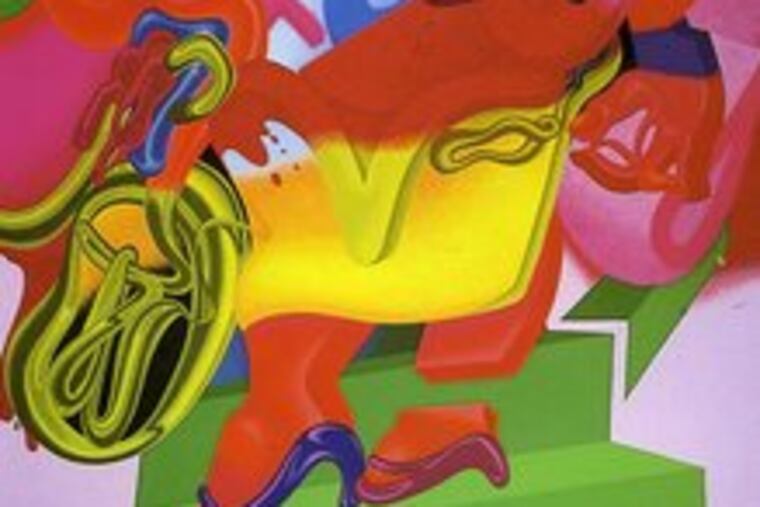
Peter Saul's name might not be familiar, but it should be, because among contemporary American painters he's one of the most skillful and outrageous iconoclasts of his generation.
The 74-year-old Saul belongs to the cohort that, during the 1950s and early '60s, emphatically rejected the mock-heroic stance of abstract expressionism, the supernova of high modernism.
This generation of revolutionaries, including most prominently Jasper Johns and Robert Rauschenberg, opened a Pandora's box of expressive possibilities for young postwar artists who wanted to overthrow what they considered to be an outmoded aesthetic regime.
Saul is sometimes described as a fellow traveler of pop art, perhaps the most coolly subversive of the postwar movements. Yet the Saul retrospective at the Pennsylvania Academy of the Fine Arts suggests that, while his early work and pop share some affinities, he is more flamboyantly transgressive.
The pop artists were ironic and deadpan, while Saul in the late 1950s and early '60s is sardonic, combative and, to some people, aggressively offensive. As he has remarked:
"When it comes to absolute craziness, no place can match America for inspiration. Good, bad or indifferent, it makes me laugh every day and lets me be a rebel against artistic authority."
Even picture titles proclaim this attitude. Not only does
Donald Duck Crucifixion
of 1965 grotesquely caricature American popular culture, it also refutes the detached stance of pop art while cocking a snook at Christianity's most revered icon.
Anticipating Andres Serrano by nearly 25 years, Saul framed the unfortunate Donald with a half-dozen urinating penises.
This is pretty savage stuff for the 1960s, but it's only the beginning of Saul's career-long assault on sacred cows related to race, sex, war, politics and just about any other topic that might inflame Americans who don't live in Manhattan or the artist's native San Francisco.
Saul's Vietnam paintings - two are included in the show - and a portrayal of O.J. Simpson being executed for murder typify his indifference to public sensitivities on controversial topics.
As he has said, "To be not shocking means to agree to be furniture." This apparently is a riposte to Henri Matisse's famous observation that he preferred art to be soothing and calming, "rather like a good armchair which provides relaxation from physical fatigue."
As you will see, there's nothing in the least anodyne about Saul's art, neither in its convoluted and chromatically incandescent visual style or its prosecutorial stance.
His ostensible subjects include sex deviates, executions, militarism, the pretensions of modern art, and the suppressed barbarities of conquest, the latter introduced at the entrance to the show by the large painting
Columbus Discovers America
.
In the gallery, visitors encounter, in a similar vein,
Bush at Abu Ghraib
and the bizarrely comical
Stalin in 1943,
in which the dwarfish dictator, pistols blazing like miniature cannons, blasts hapless German soldiers at the battle of Stalingrad.
Saul's impressive talent for venomous social, political and historical revisionism is perhaps one reason his work has not previously been exhibited at this comprehensive scale in an American museum. Even by current standards, it's egregiously raw and combative. Yet it's often wryly amusing.
This exhibition, organized by the Orange County Museum of Art in Newport Beach, Calif., covers 50 years, from Saul's crude "refrigerator" and "washing machine" paintings of the late '50s to visually slicker, far more acerbic works such as the Stalin and Bush images, made during the last two years.
Throughout the selection of about 50 paintings and large drawings, one readily recognizes allusions to other artists and famous images. His extreme figural distortions, seen in
Donald Duck Crucifixion
and other earlier paintings, call Picasso to mind. His cartoonish style might also suggest to some viewers the late works of Philip Guston, one of which hangs in the lobby just outside the exhibition.
The general tenor of the earlier paintings also evokes the Chicago artists known as the Hairy Who (Jim Nutt, Gladys Nilsson, Karl Wirsum and others) and even Robert Crumb and underground "comix."
Yet Saul has never belonged to any group or movement and, especially early in his career, seems to have been somewhat isolated from other artists.
The exhibition describes the evolution in his painting through several stylistic and thematic shifts. The earliest canvases are crudely drawn and thinly painted. Gradually the visual language becomes increasingly Picassoid as compositions become more intricately detailed. Eventually Saul settled into a smooth, "airbrushed" style with highlights that's easier to read.
Thematically, he moved from the pop-related "consumer goods" pictures to more socially charged subjects involving sex, violence, racial intolerance, and particularly executions. Typical of the latter are
Ethel Rosenberg in the Electric Chair
and
San Quentin No. 1,
in which African American radical Angela Davis is impaled on a sinuous crucifix.
He made a series of paintings about other paintings; the most arresting of these is the lusciously lurid
de Kooning's "Woman With Bicycle." Vietnam
and
Typical Saigon,
both masterly compositions crammed with narrative incident, present Saul's response to that war with intense vigor and emotional intensity.
They're contemporary history paintings, akin to his
Columbus Discovers America
and
Fall of Constantinople,
which revisit the past by pointing up the darker dimensions of conquest and occupation. Saul's history paintings are his largest and most complex works. They display his exceptional compositional deftness and ability to control a hot palette that in lesser hands might turn raucous.
These qualities are particularly evident in
Subway 1,
a disaster scene in which police brutalize victims of a transit disaster. I read this as Saul's homage to Théodore Géricault's
Raft of the Medusa
, one of Western art's supreme examples of the genre. It's a brilliant bit of painting.
Saul hasn't mellowed in his later years; as
Bush at Abu Ghraib
indicates, his visual rapier is as sharp and relentless as ever. He isn't easy to deal with, and many people would probably disagree with most of what he says. Some might find him repulsive.
Yet in terms of visual imagination, compositional flair, and ability to restate historical verities in contemporary language, he's brilliant. He deserves a more prominent place in the art history of the last half-century. Perhaps this show will make that happen.
Art: Biting Art
The Peter Saul retrospective continues in the Hamilton building of the Pennsylvania Academy of the Fine Arts, Broad and Cherry Streets, through Jan. 4. Hours are 10 a.m. to 5 p.m. Tuesdays through Saturdays and 11 to 5 Sundays. Special-exhibition admission (includes the permanent collection) is $15 general, $12 for seniors and students with I.D., and $8 for visitors 5 through 18. Information: 215-972-7600 or
» READ MORE: www.pafa.org
.