A son reconnects with father and past
What does it take for a 37-year-old Washington journalist to reconcile with his estranged father back home in Los Angeles?
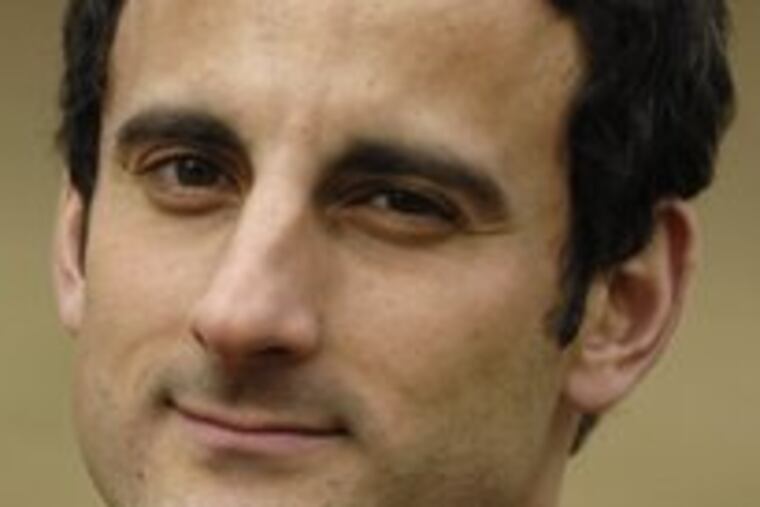
What does it take for a 37-year-old Washington journalist to reconcile with his estranged father back home in Los Angeles?
Simple: Take Dad on a trip to an obscure town nestled in the Kurdish mountains in a remote corner of northern Iraq.
At least that's how it was for former Baltimore Sun reporter Ariel Sabar, whose remarkable new memoir,
My Father's Paradise
, recounts his journey back to his father, Yona Sabar, a first-generation immigrant from Iraq, by way of Jerusalem, and through his dad to his roots in the Jewish community of Kurdish Iraq.
Paradise
is the selection for the second annual "One Book, One Jewish Community" program, a region-wide celebration of Jewish literature and Jewish identity that will feature talks, discussion groups and workshops at more than 60 venues, including synagogues, community centers and schools.
Organizer Philip Warmflash said Sabar would launch the five-month program on Sunday at 7 p.m. at Temple Beth Hillel-Beth El, 1001 Remington Rd., Wynnewood.
Warmflash said "One Book," inspired in part by the "One Book, One Philadelphia" program, has a simple mission - to "start a communal conversation" about a significant book as it speaks to "our own lives and its broader implications on art, literature and drama in Jewish life."
Last year's selection was Aaron Lansky's
Outwitting History
, the true story of how a small group of volunteers organized a massive reclamation of Yiddish books across the country.
Warmflash, director of the Jewish Outreach Partnership of Philadelphia, said Sabar's book was a natural fit. "We wanted something that would cross ethnic and national lines and speak to people in different ways," he said.
"
Paradise
is about a young person coming to terms with his family, so it has family-seeking. It deals with Jewish tradition. . . . And it has something to say about Sephardic Jews [from Spain and the Middle East] in a community which is dominated by Ashkenazi [European Jewish] culture."
Sabar's
Paradise
(Algonquin Books, $25.96) is especially noteworthy because of its multilayered narrative. While it begins with a young man's personal and familial crisis, it ends up exploring universal themes about the linguistic origins of culture and about the vital importance of tradition to the health of any community.
The story starts with Sabar's tortured relationship with his father.
An L.A. native, Ariel Sabar writes that he is more a product of surf shops, the Red Hot Chili Peppers, and
The Breakfast Club
than the Talmud. For most of his life, he said, he felt separated from his father by a chasm.
"Ours was a clash of civilizations, writ small," he writes in
Paradise
. "He was ancient Kurdistan. I was 1980s L.A."
Like all teens, Ariel was easily embarassed by his parents in public. But it was different with Yona, who stuck out like a sore thumb with his thick accent and ridiculously unfashionable outfits.
"I didn't want to be affiliated with him. I didn't want who he was to define who I wanted to be," Ariel said by phone from his home in D.C., where he lives with his wife, Meg, a child psychiatrist, and their 5-year-old son, Seth.
Worst of all, Yona "came from that part of the world that was stigmatized in the 1980s with the Iranian hostage crisis," Ariel said.
Ariel said he got a chance to "redeem" himself and "make things right" with his father with the birth of his own son.
"Everything changed with Seth's birth," he said. "It helped me acknowledge my own shortcomings."
Ariel said the best way he knew to reconcile with his father was as a journalist: He decided to tell Yona's incredible life story.
"Here's a man who was born in the most isolated part of the world," in a predominantly illiterate community in the Kurdish town of Zakho, "who ended up becoming an eminent professor at UCLA," where he is an expert in the biblical language of Aramaic.
What's most fascinating is that like his fellow Kurdish Jews, Yona grew up speaking Aramaic, which has virtually disappeared from the globe.
Yona's town had somehow preserved the language Jews spoke before they were taken to Babylonia (Iraq), after the fall of the First Temple in Jerusalem 2,600 years ago.
"Time stood still" in Zakho, Ariel said. "The rest of Jews had switched to Arabic after the Islamic conquest" in the seventh century. Ariel said the town's isolation also contributed to a spirit of tolerance that existed among Kurdish Muslims, Jews and Christians.
Ironically, since moving to L.A., Yona has been in demand from some movie-industry types looking "for something Aramaic to make [their] movie authentic-sounding." Yona has been tapped to help on the movies
Oh, God!
and
The Celestine Prophecy
, and the HBO show
Curb Your Enthusiasm
.
"The producers on
The X Files
used [Yona] to add an inside joke," said Ariel. "They asked him to translate 'I Am the Walrus' into Aramaic."
Ariel said that all his life, Yona has wanted to return to Zakho, which he thought of as the paradise he lost when he was 12 and his family emigrated to Jerusalem.
In 2005, after spending "time beyond count" interviewing his father about his life, his past and his interest in Aramaic, Ariel persuaded Yona to travel with him back to Zakho. "He had gone back once, in 1992, and he was disappointed, because he had built [Zakho] up to something amazing," said Ariel.
For the first time he could remember, Ariel felt totally dependent on his father, who was his translator and guide. "I needed him for every step I took, every bit of food I got," Ariel said. The father and son, who shared a tiny hotel room, were able finally to bond.
"I'm not a sentimentalist, but when we got to Zakho . . . with the mountain air, I really was in something close to ecstasy."
Ariel Sabar said that's what he wishes for his son, Seth.
"I want him to feel a connection to his roots. To look at Iraq and say, 'My people lived there.' "