On Movies: Kaufman as director: On the whole, he's up to the parts
'I don't need to be mentored," says Charlie Kaufman, a touch indignant, when asked if Spike Jonze helped out with advice on Synecdoche, New York. The film, which marks the famously idiosyncratic screenwriter's directing debut, was originally going to be helmed by Kaufman's pal - and his Being John Malkovich and Adaptation director - Jonze.
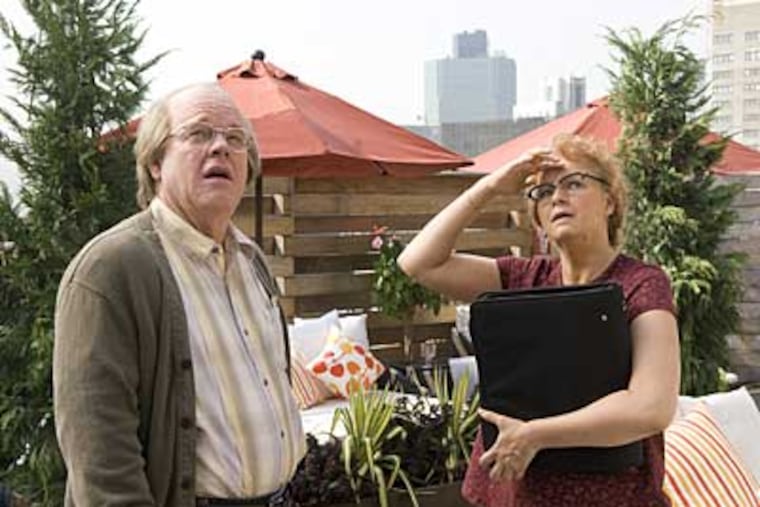
'I don't need to be mentored," says
Charlie Kaufman
, a touch indignant, when asked if
Spike Jonze
helped out with advice on
Synecdoche, New York
. The film, which marks the famously idiosyncratic screenwriter's directing debut, was originally going to be helmed by Kaufman's pal - and his
Being John Malkovich
and
Adaptation
director - Jonze.
But here is Kaufman, at a table in a Toronto eatery, getting a tad exercised about the idea that he's not up to directing the likes of Philip Seymour Hoffman, Catherine Keener, Samantha Morton, Emily Watson and Michelle Williams by himself. "I'm my own person. Why don't you put that in your article? The whole point of my doing this is for me to have done it.
"I'm not at that point in my life where I need a mentor. . . . I don't really even care if I fall on my face. I wanted this to be mine."
And Synecdoche, New York, which is set in (and pronounced almost like) the city of Schenectady, is certainly, and completely, all Kaufman. Synecdoche (sih-NECK-doh-kee) is a figure of speech in which a part stands for a whole, or the whole stands for a part (as in, the screen = the movies; or the law = the police), and the title's bearing on Kaufman's film is about that easy to grasp.
"It's not your action movie or big-budget comedy, but I think it's pretty terrific," says the film's star, Hoffman, in a separate interview on the day of the film's September premiere at the Toronto International Film Festival. Synecdoche, New York opens Friday at the Ritz East and Showcase at the Ritz Center/NJ.
"I think it's one of a kind, and I stand behind it," says Oscar-winner Hoffman, who appears in virtually every frame of Synecdoche, as a theater director whose creative and emotional psyche is deconstructed in Kaufman's epic, surreal tale.
"I'm pretty defensive about it," Hoffman adds. "It's a lot more accessible than people think, actually, and it will become much more accessible as people start seeing it and talking about it. . . . If you let go, you're going to pretty much identify with the whole thing."
The actor laughs.
"It's not as 'out there' and crazy as people think. It's just really imaginative and quite creative, as all film and theater and art are supposed to be."
Kaufman, who turns 50 in a few weeks, worked on the Synecdoche screenplay for close to three years. Like Hoffman's character in the pic, Kaufman is married to a painter (she's played by Keener in the film). And it's a safe bet that Kaufman, like Hoffman's Caden Cotard, lies awake at night, full of worry.
"It's very complicated stuff that I want to think about," says the writer. "Complicated for me, anyway. I don't go in [to a script] knowing where something's going to go. I go in thinking, 'OK, I want to think about these issues, I want to think about time passing, or I want to think about illness, or I want to think about dying.'
"And then how these things interact with each other becomes part of the structure, and then a story starts to surface."
Time, illness, dying - that may sound morbid, and, indeed, Synecdoche, New York is, on one level, a meditation on said themes. But for his part, Hoffman found humor, hope and insight in Kaufman's multi-tiered yarn. And as for the "nutty" label that Kaufman's screenplays get stuck with (Confessions of a Dangerous Mind, Eternal Sunshine of the Spotless Mind), Hoffman bristles.
"It's going to take people laying down the 'isn't it nutty?' thing, putting that aside," he insists. "Because, no, 'isn't it heartbreaking?'
"Isn't it heartbreaking that we all have to die, and that we might see our children die, and we're not going to understand? We're never going to feel like we're finished, and we wish we would but we don't.. . .
"These things sound depressing - but no, that's life. That's what it is. And that's beautiful and that's sad and that's a lot of things, and Charlie encompasses all that in this movie in a way that really gets under your skin."
"Good" people. Marianna Palka and Jason Ritter, the duo behind the provocatively titled, intimate indie Good Dick, were in town this week to attend to the Ritz Bourse opening of their labor of love.
She, 27, is originally from Glasgow, and wrote, directed and stars, as a depressed Los Angeleno fixated on cheesy softcore porn. He, 28, is a busy actor, NYU-trained, the son of the late John Ritter, and plays a video-store clerk determined to break through his customer's protective shell. There's some serious stalking involved, and kinky role play, but essentially the super-low-budget, R-rated feature offers a portrait of two lonely people trying to connect in an alienating world.
"With online porn taking over the definition of sexuality, I feel like intimacy is hidden, in a way, in society right now, and it ought not to be," says Palka, seated alongside Ritter, her real-life boyfriend, at a Rittenhouse Square cafe the other day.
"There's a big question in the culture about what is a healthy sexual relationship," she says. "And I know it's not what I see in porn. . . . You can't just be sitting there alone with your mouse and your computer screen. That's not intimacy.. . .
"So I wanted to illustrate what sex means for these characters, and sexual healing, and how much kindness has to do with that, tenderness. And that's where the title came from."
A title that Palka and Ritter were adamant about keeping. "Even though, for a long time, for our grandparents, it was known as The Untitled Marianna Palka Project, says Ritter, smiling. And when they finally heard the real title?
"I told my grandmother it's a movie about a detective," quips Palka. "A very good private eye."